

Depreciating yen fuels Singapore companies’ M&As in Japan
Buyout opportunities could arise from succession crisis, say observers; Singapore’s outbound activity targeting Japan hits US$1.2b in 2022

Paige Lim
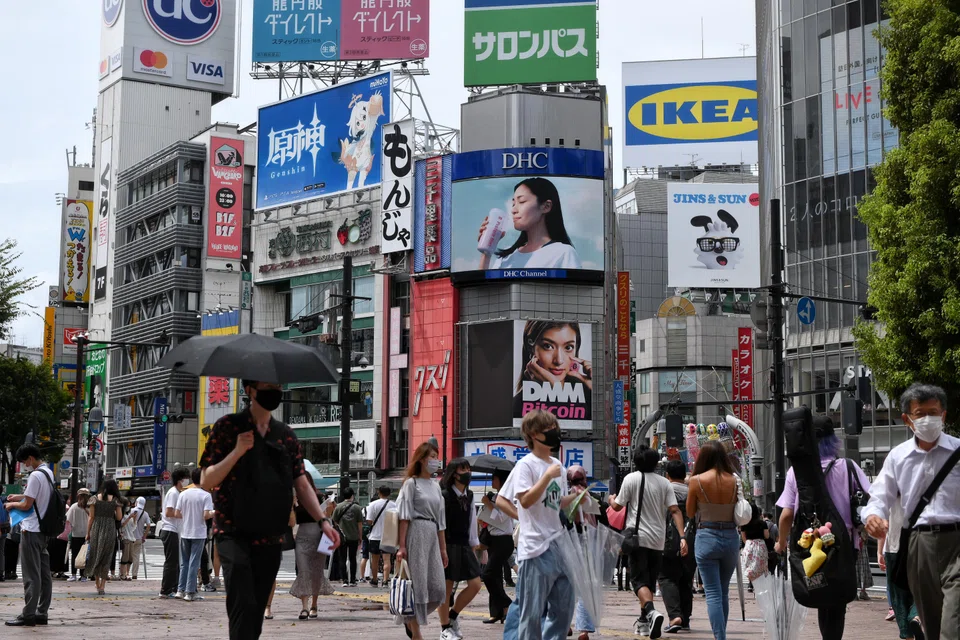
MORE Singapore companies are acquiring and investing in Japanese businesses, as they take advantage of lower valuations driven by the depreciating yen. They could also be presented with more buyout opportunities as Japan’s national succession crisis deepens, said industry watchers.
According to financial data platform Refinitiv, Singapore’s outbound mergers and acquisition (M&A) activity targeting Japan reached US$1.209 billion in deal value in 2022, up 14.6 per cent from US$1.056 billion in 2021. This marked the highest annual total deal value since 2017’s US$1.398 billion, driven mostly by acquisitions in Japan’s real estate market.
Refinitiv data showed that real estate deals accounted for 97.2 per cent of Singapore’s overall M&A deals in Japan at US$1.175 billion.
According to M&A intelligence service Mergermarket, Singapore real estate investment trusts (Reits) were big buyers of Japanese real estate last year. Notable acquisitions included Parkway Life Reit’s acquisition of five nursing homes across Hokkaido, Tokyo and Chiba last September; as well as CapitaLand Ascott Trust’s purchase of five rental housing properties in Kyoto, Osaka, Hyogo and Nagoya in August.
Japanese assets more affordable
Industry watchers told The Business Times that the sharp depreciation of the yen against the US dollar has made Japanese assets more affordable and an attractive market for M&As. Last October, the yen tumbled to a 32-year low against the greenback.
Sumit Punwani, partner for corporate finance, deal advisory at KPMG in Singapore, said: “This, coupled with (Japan’s) low-growth economy, has resulted in lower valuations for Japanese assets as compared with other developed economies such as America and Europe.” On the other hand, the Singapore dollar has maintained its position against the US dollar – increasing Singapore companies’ purchasing power, he added.
MUFG Bank has seen growing investment appetite from Singapore-based companies and sponsors for opportunities in offshore wind assets in Japan, given the “necessity of energy transition”, as well as in data centres, said Scott Campbell, its managing director and head of sector coverage for Asia-Pacific. “Investment appetite across these sectors exists for both organic and acquisition growth in both greenfield and brownfield opportunities.”
In the last two years, private equity (PE) and venture capital (VC) investments by Singapore firms have been “robust” in Japan, Punwani noted, adding that these firms are usually part of larger investor consortiums.
Koji Hamasaki, partner at Japan-based KPMG FAS, has observed a growing number of transactions led by Japanese PE sponsors across various sectors in Japan over the years, which see “expanding the overseas business of their portfolio companies as a crucial strategy for value creation”, he noted.
“Singapore is often considered as the first choice for implementing such overseas expansion strategies. This movement has led to more and more potential deal discussions between Singapore investors and Japanese companies,” Hamasaki said.
Lack of successors, more opportunity
Japan’s rapidly ageing population could also see more small and medium-sized enterprises (SMEs) up for sale than ever before.
According to statistics from Japan’s Small and Medium Enterprise Agency, the number of business owners over the age of 70 is expected to reach 2.45 million by 2025. About half of them are likely to have difficulties finding successors.
“The current spate of acquisitions signals the growing interest of Singapore-based firms to acquire Japanese companies, which are also considering succession issues and are thus open to considering strategic investors to help manage and grow their businesses,” said Punwani.
Foreign PE funds have been quick to flock to the market in anticipation of buyout deals. Earlier this month, Bahrain-based Investcorp opened an office in Tokyo to raise investment capital and pursue acquisitions; in 2020, the Carlyle group more than doubled the size of its fourth Japanese buyout fund to 258 billion yen (S$2.6 billion).
F&B, hospitality, infrastructure sectors see interest
The cheaper yen has also lured more Singapore individuals and companies to purchase Japanese properties for business and personal investment purposes.
Since mid-2022, Tetsuo Kurita, partner at One Asia Lawyers, has seen more Singapore individuals and companies “rushing” to buy properties such as apartments or condominiums. “Some plan to rent them out as accommodation for long-term vacations, before selling them when the yen goes up again,” he said.
The lawyer now receives about one to three enquiries from interested buyers once a month; previously, he would get just one or two enquiries a year. He was recently approached by a high-net-worth individual interested in buying two holiday properties, including a hotel, in Osaka and Niseko.
Likewise, the Japanese external trade organisation Jetro Singapore has received more enquiries since 2021 from Singapore companies about incorporating a business in Japan. A small percentage of these enquiries are on acquiring small hotels and guest houses in regions around Japan, said Khoo KieWai, its director of business development and public relations.
Japan’s F&B industry also commands interest from Singapore SMEs, said Joanna Tan, senior consultant at boutique advisory firm Nihon M&A Center Singapore. This includes acquiring Japanese dining concepts, food retail brands, or firms with food processing or production facilities. Such players have “high food standards and access to quality raw ingredients”, she noted.
There has also been interest to acquire tea plantations or sake breweries.
“F&B is something that’s a bit more palatable to a foreign investor, as it’s more readily exportable. There is always interest from Singapore firms to further associate themselves with Japanese brands and boost the quality of their food.”
While the centre gets one to two enquiries – usually on opportunities in Japan’s F&B industry – from Singapore SMEs every month, most of these “are driven by curiosity rather than real strategic intent”, Tan pointed out.
Established in 2016, the centre focuses on helping Japanese investors looking for acquisition targets in South-east Asia. It has not facilitated any successful deals between a Singapore acquirer and a Japanese firm to date.
Real estate, infrastructure and hospitality have been “continuously active” sectors for Singapore investors seeking acquisitions in Japan, said Hamasaki of KPMG FAS.
The firm has also observed growing interest from Singapore companies to invest in Japanese startups “that have strong technologies or products that can be exported globally”.

Language barriers and cultural differences remain the biggest challenges for foreign buyers in Japan, said industry watchers.
This is especially the case for Japanese family-owned SMEs that face difficulty finding successors, said Nishitani Kazuyoshi, financial advisory managing director at Deloitte Singapore. “Investing in SMEs poses a lot of challenges for foreign strategic investors, such as language barriers, hesitation to invite foreigners to the board, as well as business scale.”
Navigating some of these challenges may be easier today. Due to the emergence of more firms specialising in M&A, foreign buyers have more access to information and better support services for their acquisition considerations, noted Jetro Singapore’s Khoo. “In the past, information about Japanese companies offering to sell was not easily available, especially to foreign buyers.”
Yasuyuki Yamamoto, partner for lead advisory, strategy and transactions at EY, said having a retention plan would be key to securing talent, as Japanese SMEs “value their employees very much”.
“There may be some resistance to being acquired by a foreign firm, so building a trusting relationship through dialogue is as important as a compensation plan.”
TRENDING NOW

Singapore bars Alice Huang, woman tied to affair with Nvidia’s Jensen Huang, for misleading police

Nvidia prepares to oust Jensen Huang after news of second affair, with executive: reports

Higher rates, weaker spending: Is the Philippines entering stagflation?

Nvidia’s market value sinks below US$4 trillion after CEO Jensen Huang resigns

