

Sembcorp to miss 2025 target on green business profits, drops metric from 2028 strategy
Management will not receive compensation tied to this particular sustainability goal

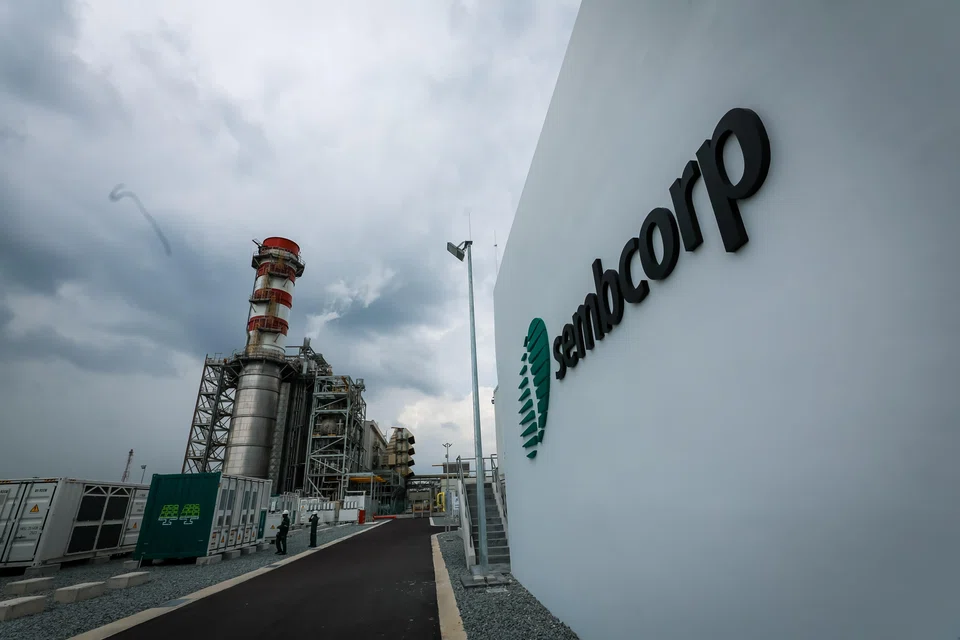
SEMBCORP Industries will miss one of its 2025 strategic targets of having 70 per cent of its net profit come from its sustainable solutions business, said the energy company in response to queries from The Business Times.
This means that Sembcorp’s management will not be able to receive the compensation tied to this particular sustainability goal.
It is one out of three energy transition targets Sembcorp had set in 2021, as part of its pivot to be a renewable energy company, with the executives’ remuneration directly linked to the achievement of all three targets.
Following this, Sembcorp has also stopped using this metric as one of the targets in its next set of energy transition milestones it aims to reach by 2028.
Sembcorp failed to meet the target of having 70 per cent of its net income come from sustainable solutions because its gas business has recorded strong growth, with earnings from the segment almost trebling since 2021, said a spokesperson. “As a result, group net profit after tax has more than doubled to almost S$1 billion, with the percentage from sustainable solutions remaining below 70 per cent,” added the spokesperson.
Compared to Sembcorp’s gas business, the net profit from sustainable solutions – which includes its renewable energy business, integrated urban solutions and decarbonisation solutions – has increased only by about 1.5 times over the same period. This means that its sustainable solutions segment has been accounting for an increasingly smaller portion of the company’s total net profit since the target was set, as earnings from the gas business grew.
In the six months to June 2024, sustainable solutions made up 30 per cent of Sembcorp’s net profit, down from close to 45 per cent in 2021. It is expected to decrease even further with the proposed sale of its waste management arm, which is under the integrated urban solutions unit, said Donald Chan, chief operating officer of climate non-profit Asia Research and Engagement.
As proceeds from the sale is to be invested into renewable energy assets along with its strategy to be a low-carbon industrial park player, it may take some time before these investments materialise into net profits, he added.
Sustainability performance targets
While Sembcorp no longer has a green business profit target for 2028, it has continued to set targets for installed renewables capacity to hit 25 gigawatts (GW), and for its emissions intensity to be further lowered to 0.15 tonne of carbon dioxide equivalent for every megawatt-hour.
These were the other two metrics for which Sembcorp had set 2025 targets, alongside having its sustainable solutions business account for 70 per cent of the company’s net profit, as part of its decarbonisation shift.
At that time, the aim was to increase renewables capacity to 10 GW and to lower carbon emissions intensity to 0.4 tonne – both of which have been achieved.
Sembcorp had been able to vastly increase its renewables capacity by aggressively acquiring renewable energy assets or entering into renewable contracts across Asia over the last few years.
It recently announced that it will be entering the renewable energy sector in the Philippines by buying over the stake of a solar company. As at Dec 18, 2024, Sembcorp’s renewables capacity stood at 16.5 GW – more than six times the amount in 2021.
As for its emissions intensity, that metric was able to go down sharply in 2023 to 0.29 tonne from 0.5 tonne the year before just from the sale of its coal plant in India.
Even though it did not meet all its targets, a company spokesperson said, its overall business is delivering strong value for shareholders.
But while management’s compensation will be affected from not meeting one target, the company itself will likely not be penalised financially by having to pay higher interest rates from its sustainability-linked loan.
Companies that issue debt instruments tied to the achievement of sustainability performance targets will have to pay a higher interest if they fail to meet these pre-determined objectives.
In the case of Sembcorp’s S$1.2 billion sustainability-linked loan that was taken in May 2022, the step-up interest rate payments will be triggered only if the company fails to meet its 2025 renewables capacity and emissions intensity targets.
Industry-wide challenges
While Sembcorp has missed one of its targets, a company’s transition journey should be viewed holistically across multiple metrics, said Chan.
The missed target comes amid a backdrop of industry-wide energy transition challenges. Globally, other energy companies have reduced their carbon emissions reduction targets, including Shell.
The Ukraine-Russia war which started in 2022 sent gas prices to record highs in several markets, including Singapore, helping to boost Sembcorp’s gas business.
On the other hand, stiffer competition in the renewables space – as more companies enter into clean energy – has made it a challenge for the industry to find quality renewable energy assets that can fulfil companies’ internal rates of return, especially during scenarios when tariffs move unfavourably, said Carmen Lee, head of OCBC Investment Research.
This is even though the levelised cost of electricity from renewables is the cheapest, said Ho Pei Hwa, senior vice-president of equity research at DBS.
She noted that returns from renewable energy assets are generally in the low teens, while gas-fired power plants are in the high teens.
Corporates and investors are becoming more realistic about their energy transition journey. While progress towards net-zero targets are still important, there is still a need for reasonable returns, added Ho. “It’s about balancing targets and returns,” she said.
TRENDING NOW

Indonesia stocks suffer worst plunge in nearly 30 years as MSCI proposes standalone status
The grid is the transition: Why Asean’s next energy challenge is coordination

Firms linked to haze pledge cooperation in meeting with Shanmugam; government to table changes to haze law

If Europe goes to war, the fallout will be felt in East Asia

