Issue 77: MAS works out cost of a late start; COP28’s wild kick-off

In this issue: Singapore’s financial regulator analyses the cost of climate transition under different scenarios, while allegations of conflicts of interest mar the start of the annual global climate conference.
Singapore & S-E Asia
Wait now, pay later
Delaying climate action to 2026 instead of starting immediately could cost the Singapore financial system about 50 per cent more in the short and medium term, the latest analysis by the Monetary Authority of Singapore (MAS) has shown.
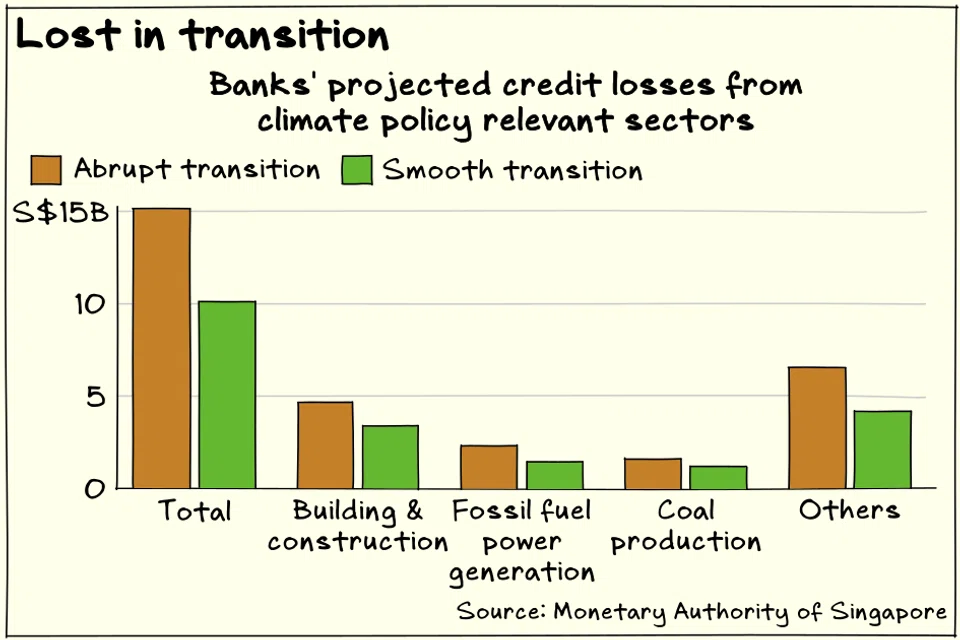
In its latest Financial Stability Review report, MAS analysed the impact of two climate transition scenarios over the eight-year period from now until 2030.
The first scenario – the “smooth transition” – assumes that “decisive policy action” by governments to reduce greenhouse gas emissions begins in 2023. That action spurs competition to be greener, accelerating global decarbonisation, and economic and financial adjustments manifest more gradually.
The second scenario is an “abrupt transition” where concerted climate policy only begins in 2026. Because of the delayed start, carbon prices increase more sharply as policymakers try to make up for lost time, and economic and financial adjustments are more sudden and disruptive.
In a smooth transition, Singapore’s banking system could incur credit costs that are 1.63 per cent of its aggregated portfolio that is exposed to sectors that are vulnerable to transition risks, also known as “climate policy relevant sectors”. In an abrupt transition scenario, those costs go up by 50 per cent to 2.43 per cent. In dollar terms, the credit losses could work out to about S$10 billion in a smooth transition and about S$15 billion in an abrupt transition.
Banks’ market portfolios could lose 2.2 per cent of value in a smooth transition, versus 3.1 per cent in an abrupt transition.
For insurers, a smooth transition could lead to market losses of 2.9 per cent, growing to a 4.5 per cent loss under an abrupt transition scenario.
What is notable in the MAS analysis is that there is significant variance among the banks, largely due to differences in the make-up of the banks’ portfolios. For credit costs, for instance, individual banks’ potential losses range from 0.37 per cent of their exposed portfolio to 4.6 per cent.
MAS had undertaken a longer-term assessment a year ago that looked at potential impact through to 2050, and the new scenario analysis is meant to complement that earlier work. After all, planning for tomorrow is meaningless if you can’t get past today.
The 2022 stress-test analysis worked on three scenarios. The first is an “orderly transition”, in which “structural adjustments initially pose headwinds to the growth outlook and impose short-term costs” but outcomes improve significantly over time. The second is a “disorderly transition” where concerted climate policy action only starts in 2031 leading to economic slowdown in the 2030s. The third scenario is a “no additional policies” world in which the world stops taking new climate action and in which South-east Asia’s major economies suffer severe flooding damage in the short term.
In the long-term analysis, median estimates of banks’ credit costs were between 5.87 per cent and 6.09 per cent of their vulnerable portfolios across the three scenarios, with the disorderly outcome being the most costly.
Taken together, the analyses show that climate transition will be a costly event for the financial sector, regardless of which path the world takes. However, beginning climate action earlier lowers those costs.
Other Singapore reads
- Mizuho to invest in Climate Impact X to scale Asia’s global carbon credit market
- Indonesia’s energy transition plan may be short on concessionary support: Singapore banks
COP28
A contentious start
The annual United Nations Climate Change Conference (COP28) has kicked off in Dubai under a cloud of suspicion after the BBC reported that the United Arab Emirates’ national oil company was planning to make side deals at the event.
The report prompted a sharp rebuttal by conference president Sultan Al Jaber, who consulted a thesaurus and called the allegations “false, not true, incorrect and not accurate”.
Whatever the case, it should not be a surprise to anyone that the oil and gas industry will have a significant presence at this year’s Conference of Parties, the official name of the event from which the COP acronym is derived. In fact, Al Jaber himself has previously said that it is important for the oil and gas industry to be part of global decarbonisation instead of being cast out.
In March, Al Jaber, who also heads the Abu Dhabi National Oil Company, said: “With the right incentives, the right technologies, the right mindset and the right partnership model, the oil and gas industry has the capacity and the resources to help everyone address Scope 3.”
The proof will be in the pudding.
Climate negotiators in Dubai will have a full plate of thorny issues to go through. For South-east Asia, two key issues will be financing and the “just transition” – industry speak for decarbonisation that also considers social impact. A slew of announcements regarding the broad area of transition finance – which includes blended finance – are expected, as are developments in advancing the early retirement of coal-fired power plants.
Underlying the entire conference is the first global stocktake of progress since the signing of the 2015 Paris Agreement. The science is clear that the world is not moving fast enough; whether that will spur stronger climate action remains to be seen. Initial sentiment appears to be less than optimistic, however, with economic pressures expected to lessen many countries’ will to pay the decarbonisation toll at this time.
As the MAS analysis has shown, the sooner the world acts, the less painful the climate transition will be. But getting the world pulling in one direction is difficult enough, much less trying to get it to pull hard enough.
Other South-east Asia reads
- Climate damage fund hailed, but ‘needs billions rather than millions’
- LeapFrog, Temasek and EIB put US$500 million into tackling climate change in Africa, emerging Asia
Other good reads
- Four major banks quit initiative assessing climate targets: sources
- Addressing roadblocks for the new ESG reporting paradigm