China's parliament abolishes two-term limit on presidency
Beijing
CHINA removed presidential term limits from its constitution on Sunday, giving President Xi Jinping the right to remain in office indefinitely and confirming his status as the country's most powerful leader since Mao Zedong died more than 40 years ago.
China's ruling Communist Party announced the proposed amendment only last month and there was never any doubt it would pass as parliament is packed with loyal party members who would not have opposed the proposal. The amendments also include inserting Mr Xi's political theory into the constitution, something that was already added to the party charter in October at the end of the party congress, a feat no other leader since Mao had managed while in office. Additionally, clauses were included to give a legal framework to a new super anti-corruption department.
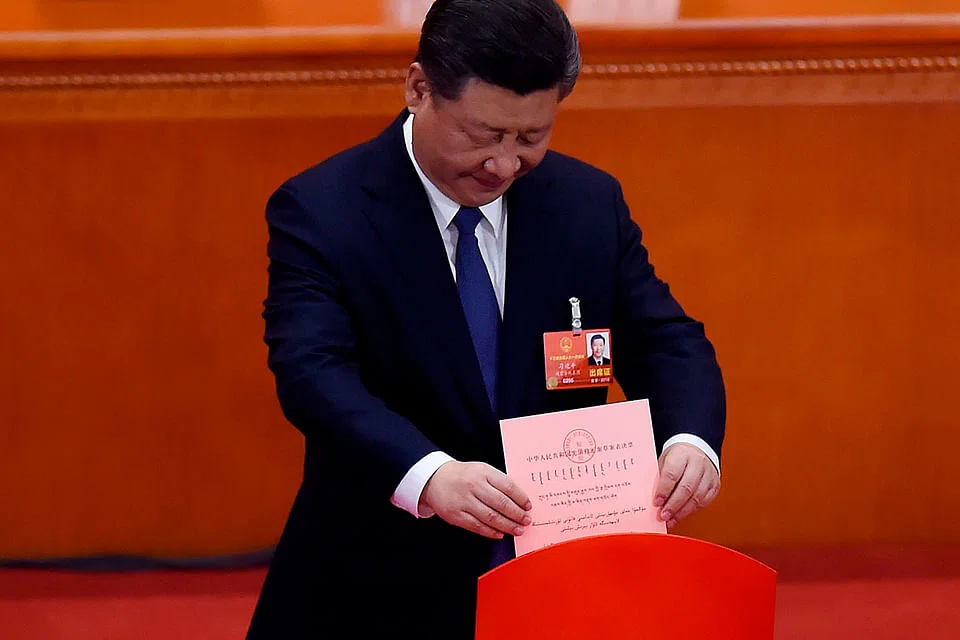
Only two dissenting votes were cast, with three abstentions, from almost 3,000 delegates. Reporters were briefly ushered from the main hall in the Great Hall of the People as delegates filled in their ballot papers, but allowed back in to see them placing the papers, one by one, into large red ballot boxes placed around the room.
Mr Xi cast his vote first, on the podium at the front of the hall, followed in turn by the other six members of the party's elite Politburo Standing Committee, which runs China. The room erupted into loud applause when the result of the vote was passed, though Mr Xi did not address parliament.
Mr Xi, 64, swiftly consolidated power after taking over as party chief in late 2012, and the move to lift the presidential term limits is not unexpected. In the run-up to the vote, critics on Chinese social media attacked the move and drew parallels to North Korea or suggested a Mao Zedong-type cult of personality was forming.
But the government quickly mounted a propaganda push, blocking some comments and publishing pieces praising the proposal. The party loyalists who attended the annual session of parliament have said the decision is popular with ordinary Chinese people and asserted that China was lucky to have a leader of Mr Xi's calibre. "Protecting the country's long-term stability is an extremely good thing," Cheng Bingqiang from Sichuan province, better known for its spicy food, told Reuters shortly after the vote, when asked if he worried about Mr Xi being in office forever.
He Guangliang from the poor south-western province of Guizhou said it wasn't fair to draw comparisons with North Korea. "China has its own national characteristics," Mr He said. "There's no one system that suits all countries." However, the question was too sensitive for several legislators, who scurried away when asked about Mr Xi being in office forever.
"You can't ask me that," said one lady, laughing nervously and declining to give her name.
In a further measure of Mr Xi's strength, a key Xi ally, former top graft-buster Wang Qishan, could be elected vice-president on Saturday, having stepped down from the Politburo Standing Committee in October. He cast his vote right after the seven members of the Standing Committee. The amendment also lifts term limits for the vice-presidency. "We've not got around to discussing that yet," said Chen Yunying, a senior defector from self-ruled Taiwan. "We'll get it in the next few days," she told Reuters, referring to the candidate list for vice-president, and adding "everyone has been saying it will be Wang for the position".
Mr Xi began his second five-year term as party chief in October and at the end of the week will be formally appointed by parliament to his second term as president. The limit of two five-year presidential terms was written into China's constitution in 1982 after Mao's death six years earlier by Deng Xiaoping, who recognised the dangers of one-man rule and the cult of personality and instead espoused collective leadership.
The government has said lifting the term limits is about protecting the authority of the party with Mr Xi at its centre. The party's official People's Daily has said this does not mean life-long terms.
The party gave Mr Xi the title of "core" leader in 2016, a significant strengthening of his position at the time. While the presidency is important, Mr Xi's positions as head of the party and head of the military are considered more important, and these titles are always given first by state media. With the passage of the amendment, all three positions now do not have formal term limits. REUTERS