Open collaboration, non-dilutive funding can nurture more homegrown biotechs

Singapore
THE pandemic has put Singapore biotech research on the global stage, thanks to more open collaboration across the industry.
But biotech startups here could use more funding support, said panellists at the Deep Tech Summit, held in conjunction with the Singapore Week of Innovation & Technology (Switch) 2021.
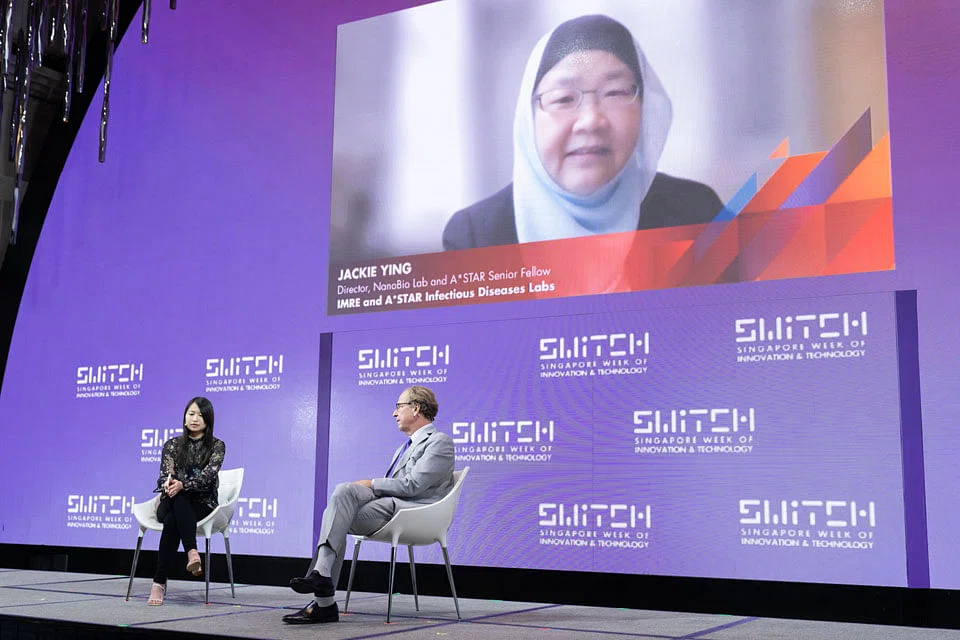
"Sharing of information has been unprecedented," said Professor Jackie Ying, senior fellow at the Agency for Science, Technology and Research (A*Star) and director of the NanoBio Lab.
For instance, the genomic sequencing data that A*Star's Bioinformatics Institute has been working on is shared globally, she noted.
Such sharing could provide researchers critical data points, such as mutations to factor in when developing in-vitro diagnostics and vaccines.
Ying was speaking as part of a panel on the topic of "enabling culture for health science innovation" on Tuesday. The session, hosted by SGInnovate and SingHealth, was moderated by journalist Claudia Chong from Garage, The Business Times' startups portal.
Also participating in the panel was Professor Thomas Coffman, dean of the Duke-NUS Medical School. Like A*Star's Ying, Coffman lauded how researchers are collaborating more than ever before.
"The imperatives of Covid-19 have encouraged people to work together in ways that maybe at other times, they may have looked at each other as competitors and not so much as partners. Changing that dynamic has been really helpful," he said.
Amid the shift, Singapore has made some contributions to Covid-19-related research.
For instance, the country was among the first to culture the virus, aided by established facilities to work safely with viruses, Coffman noted.
Last year, a Covid-19 neutralising antibody test kit developed by a Singapore team was the first of its kind to gain authorisation from the US Food and Drug Administration. Called cPass, the kit was invented by a team led by Professor Wang Linfa, director of Duke-NUS' emerging infectious diseases programme. It was co-developed with GenScript Biotech Corp and A*Star's Diagnostics Development Hub.
In this case, the urgency of the pandemic "really compressed the typical duration of discovery, licensing, patenting and manufacturing", said Coffman.
Asked if he had expected the speed of the process, he added: "I was surprised, but it was a very different time.
"I think all systems were poised to move quickly under this imperative that there were millions of people dying and the solution really lay in biomedical research, biotech innovation and the ability to commercialise these discoveries."
There is potential for more homegrown research to be commercialised.
About 20 startups have emerged from Duke-NUS itself over the past five years, which Coffman described as "not bad" for a relatively small medical school.
But there is still a need for greater funding support, said Ying. She highlighted how the US' Small Business Innovation Research (SBIR) programme has provided significant funds to researchers and their collaborators, allowing them to focus more on developing products.
"I think that is really critical. This kind of funding needs to be provided in such a way that it doesn't dilute the stakes," she said, in reference to how founders' ownership in their company can be crowded out by investor money. "The government in turn can benefit from the fact that when these companies do very well, they are creating great jobs," she added.
Coffman likewise highlighted the importance of having sufficient support for startups to cross the proverbial "valley of death" - the pre-revenue stage when they are most prone to failure.
"You need to have pipelines, support structures in place to be able to take the discoveries from the lab bench, commercialise them and move them out toward the public."
He added: "It's a very conscious process to get through that valley of death between discovery and commercialisation."