
Lower funding costs, firm fundamentals to fuel appetite for Singapore commercial real estate 

Office and industrial deals are the flavour of the year; interest in the living and hospitality sectors has also risen

Summarise
Jessie Lim
Published Wed, Dec 17, 2025 · 08:14 PM
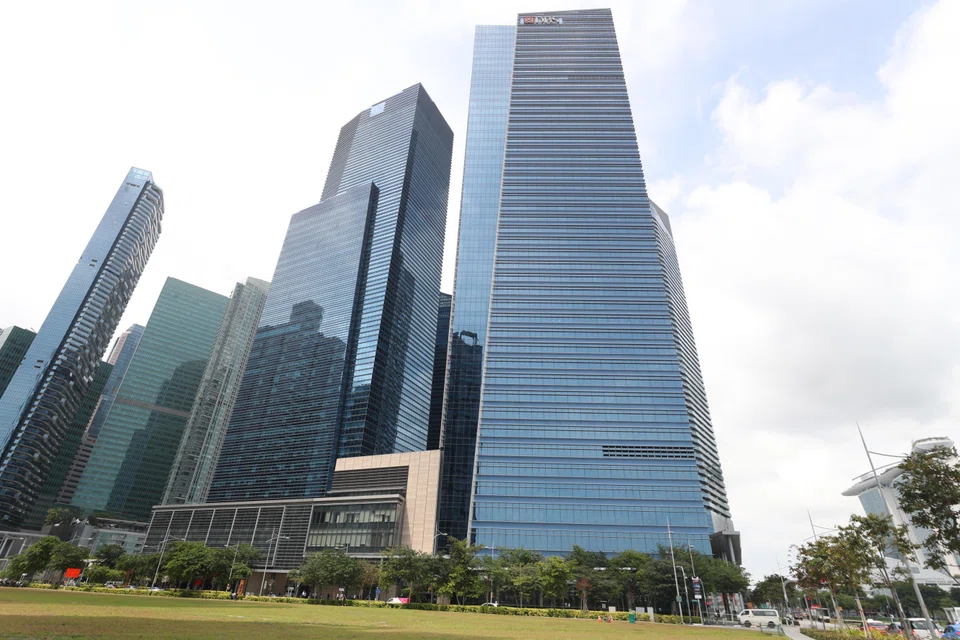
    • The year's largest real estate deal in Singapore so far is the sale of a one-third share in MBFC Tower 3 by Hongkong Land to Keppel Reit for S$1.45 billion.
    • The year's largest real estate deal in Singapore so far is the sale of a one-third share in MBFC Tower 3 by Hongkong Land to Keppel Reit for S$1.45 billion. PHOTO: BT FILE

    [SINGAPORE] Favourable financing terms and firm fundamentals will fuel investor appetite for Singapore commercial real estate, after a year buoyed by big-ticket office and industrial deals, analysts said.

    Real estate investment sales for the first three quarters of the year in Singapore totalled US$9.1 billion, an 11 per cent increase from the same period in 2024, data from JLL showed.

    That’s not counting three major deals announced in December: the sale of Hongkong Land’s one-third stake in Marina Bay Financial Centre (MBFC) Tower 3 to Keppel Real Estate Investment Trust (Reit) for S$1.45 billion; Brookfield’s acquisition of eight industrial properties from ESR for S$338.1 million; and the sale of Clementi Mall for S$809 million.

    Office and industrial deals were the flavour of the year; interest in the living and hospitality sectors also picked up.

    Throughout the region, declining funding costs, combined with asset repricing, is narrowing bid-ask spreads and bringing more assets to market, particularly from sellers looking to rebalance portfolios, said Christine Li, Knight Frank’s head of research for the Asia-Pacific.

    Benjamin Chow, head of real estate research for Asia at MSCI, noted that while there are still concerns about the pace of global growth and the eventual impact of the tariffs on individual markets, the outlook is a lot more positive today than earlier in the year.

    The largest Singapore real estate deal of the year so far is Hongkong Land’s MBFC stake sale.

    Other major office deals included City Developments Ltd’s (CDL) sale of a 50.1 per cent stake in the South Beach mixed-use project to its Malaysian partner IOI Properties Group at an agreed property value of S$1.38 billion; and CapitaLand Integrated Commercial Trust’s (CICT) CapitaSpring acquisition for S$1.05 billion.

    CapitaLand Investment (CLI) group chief operating officer Andrew Lim said: “Demand for well-located Grade-A office space in the Central Business District core remains strong, with limited new supply and sustained flight-to-quality trends as occupiers prioritise premium office space.”

    While office sales dominated in deal size, the industrial sector accounted for the largest proportion of Singapore transaction volume between Q1 and Q3 2025, at 25 per cent, according to CBRE.

    “The decline in interest rates to their lowest levels since 2022 has boosted investment appetite and investors are keen to deploy leverage to acquire quality income-generating assets,” said Michael Tay, CBRE Singapore advisory deputy managing director and head of capital markets.

    Commenting on Brookfield’s latest acquisitions from ESR, Dylan Chua, director of Singapore industrial capital markets at CBRE, said industrial real estate is appealing as it is viewed as a defensive growth sector benefiting from long-cycle demand and resilience against market volatility.

    “Occupiers in this space are typically large corporates and multinational companies with longer lease terms and strong credit profiles. This translates into highly predictable cash flows and deep liquidity, even during periods of market stress.”

    Expectations of continued rental growth sustains interest in industrial assets, Tay added.

    Knight Frank’s Li pointed to prime logistics properties, data centres and specialised manufacturing facilities drawing more interest.

    Among those picking up Singapore assets this year was EZA Hill, which led a consortium purchase of five industrial and logistics properties for S$329 million from CapitaLand Ascendas Reit.

    Frank Ng, chief investment officer of EZA Hill, said it remains cautiously optimistic about the outlook for the logistics and industrial sectors in South-east Asia as the region adapts to shifting supply chain networks brought about by the US tariff situation.

    “We’re also seeing growing interest in cold storage facilities given the rise of e-commerce in perishable goods and the continued focus on food security, particularly in Singapore,” he said.

    Brookfield Asset Management was active, too, acquiring three assets from Mapletree Industrial Trust for S$535.3 million and sweeping up another eight properties from ESR for S$338.1 million.

    Andrew Lee, BlackRock’s head of investments for Singapore real estate, said the living sector also offers resilient demand drivers and the ability to capture rental growth.

    Notably, BlackRock actively bought assets in the living sector this year, teaming up with YTL to acquire Citadines Raffles Place for S$280 million in May. In the same month, a BlackRock-led consortium also acquired Momentus Serviced Residences Novena for just over S$100 million.

    “Serviced apartments serve a strong market within Singapore, catering to short-term stays and longer-term stays for guests preferring larger-format accommodation,” said Lee.

    “The sector is backed by compelling fundamentals, with residential rents having grown significantly since 2019, coupled with a high occupancy of 80 to 90 per cent and limited supply coming to market.”

    Rental demand for residential properties has also strengthened as a result of punitive additional buyer’s stamp duty measures on foreign buyers, CBRE’s Tay said.

    Hotels will present opportunities, with tourism receipts projected to reach between S$47 billion and S$50 billion by 2040.

    Full-year hotel transaction volumes are projected to reach US$1.2 billion for Singapore, a jump of more than 60 per cent from 2024, JLL said. It expects hotel investment activity to remain stable, with volumes reaching around S$1.3 billion in 2026.

    Hybrid hotels with extended-stay components have attracted private-equity investment-seeking yield enhancement and operational flexibility, while luxury boutique hotels appealed to high-net-worth investors, the consultancy said.

    “Singapore also saw a surge in boutique hotel transactions such as Duxton Reserve and 21 Carpenter, reflecting a strategic shift in investor appetite towards trophy assets of a more palatable quantum,” said Tan Ling Wei, senior vice-president of investment sales at JLL’s hotels and hospitality group.

    Hunting overseas

    Value-add strategies now dominate the fundraising landscape for Asia-Pacific-focused real estate funds, outnumbering core and core-plus strategies, said Knight Frank’s Li.

    “Managers are leaning into sectors where they can create or unlock income growth. Through-the-cycle sectors, particularly data centres, living sectors and life sciences are likely to be in demand for both their income-producing and defensive qualities,” she said.

    Pamela Ambler, JLL’s head of investor intelligence for the Asia-Pacific, said Japan remains a top destination for Singapore investors, with consistent appeal across different asset classes, reinforcing its position as a safe-haven market offering stable yields and institutional-grade investment opportunities.

    In August, Mapletree Pan Asia Commercial Trust divested two office buildings in Japan for 8.7 billion yen (S$78.7 million); in November, Keppel and Keppel DC Reit acquired Tokyo Data Centre 3 for 82.1 billion yen.

    Singaporean investors have been particularly active in multifamily assets, investing US$1.3 billion in living assets in Japan, Ambler said.

    GIC is said to have purchased two portfolios of multifamily assets worth 49 billion yen from Japanese developer Samty Holdings in September. CapitaLand Ascott Trust in August bought three rental housing properties in Japan for four billion yen.

    Said CLI’s Lim: “Expanding economic opportunities in cities like Osaka and Kyoto continue to attract young professionals, students and expatriates from Japan’s suburbs and outside the country, driving demand for lodging and living assets.”

    Australia was also on the radar of Singapore-based investors this year. Mapletree entered Australia’s student housing market in August with plans to develop an 835-bed property on a site it acquired in Perth.

    “Australia has attracted robust investor interest due to its large student population, limited supply and counter-cyclical features,” a Mapletree spokesperson said.

    In October, Keppel Reit announced it was buying its first pure-play retail asset, Top Ryde City Shopping Centre in Sydney, for A$393.8 million (S$334.8 million).

    Hamish MacDonald, BlackRock’s head of Asia-Pacific real estate, said: “While the (Australia) market is traditionally concentrated in office and retail dominated by Reits and asset managers pursuing ‘develop-to-core’ strategies, this creates an opportunity for value-add investors to differentiate by targeting sectors such as self-storage (and) life sciences… that are under-supplied locally and earlier in their structural growth journey.”

    In China, Mapletree Pan Asia Commercial Trust said in December that it will sell Festival Walk Tower for HK$1.96 billion (S$328.1 million).

    CapitaLand listed its first China Reit, CapitaLand Commercial C-Reit, in September.

    “We continue to see opportunities in China’s retail sector, underpinned by supportive government policies and abundant capital market liquidity,” said CLI’s Lim.

    As Knight Frank’s Li summed up: “For investors, the opportunity lies in allocating capital towards the most resilient sectors and submarkets, as well as building the operational capabilities needed to generate alpha as the market and funding cycle normalise.

    “In other words, 2026 is a year for value hunting, not bottom fishing.”



