

Two election narratives colliding: Harris’ future hope vs Trump’s dark present
AS THE Democrats hold their national convention in Chicago this week, there are several ways to analyse the current status of the 2024 US presidential election. You can, for example, try to figure out who is winning in which state or you can attempt, on the other hand, to sense the “vibes” being sent by the electorate.
But under any interpretation, it is clear that Democratic presidential candidate Kamala Harris and her running mate Minnesota governor Tim Walz have dramatically reshaped this year’s race to the White House, flipping within weeks the narrative of the 2024 election.
Looking at the electoral map, the changes are quite impressive, as we consider that the winner in November will come down to the seven battleground states of Arizona, Georgia, Michigan, Nevada, North Carolina, Pennsylvania and Wisconsin.
While President Joe Biden trailed Donald Trump in several key battleground states last month, Vice-President Harris is now leading Trump by four points in Michigan, Pennsylvania and Wisconsin in the latest New York Times/Siena College poll.
Other polls show Harris in a statistical dead heat in Arizona and Georgia, and that she has a chance of winning North Carolina, a state that Trump carried in 2020.
The race still remains tied. But that the Harris-Walz presidential ticket may now have a chance to win a traditional red state, Georgia, and another – North Carolina – that tends to lean to the Republican side, are clear indications that the Democrats are gaining electoral momentum.
Recall that only a few weeks ago when Trump was running against Biden, there was some talk that the Republican nominee could win blue states, such as New Jersey and perhaps even New York, and that his position was secure in the purple state of Virginia. But these do not seem to be realistic scenarios anymore.
That the opinion polls have shifted in Harris’ favour has to do a lot with the excitement that she and her running mate are drawing among members of the Democratic Party’s electoral base, in particular Blacks, women and young voters.
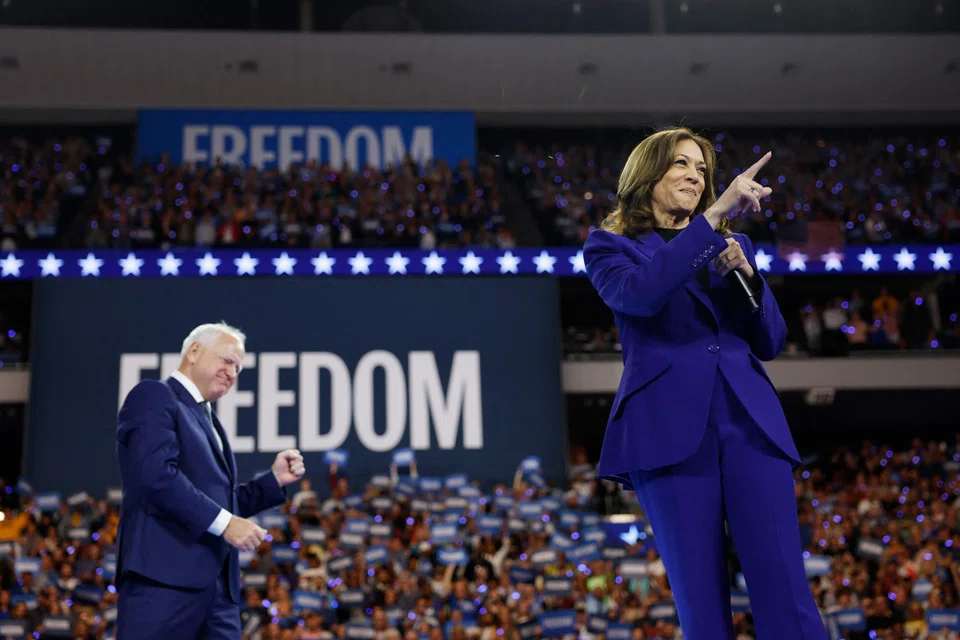
Running as the new-generation candidate with a message that places an emphasis on the future, Harris and Walz are drawing huge and enthusiastic crowds and raising large sums of money.
The 78-year-old Trump was able to market himself as the “younger” and more energetic candidate running against the elderly and cognitively impaired Biden. Trump was supposedly the strong leader facing a weak president.
Now the story line has been transformed. It is Harris who is the younger and more dynamic candidate, facing an aging man who is flailing and is in some ways unhinged in many of his comments. He has been thrown off track by the candidate switch from Biden to Harris, and has been unable so far to develop a coherent message in responding to the new political realities.
A woman of colour who is the daughter of an Indian mother and a father from Jamaica, Harris represents something new and exciting, a changing and diverse America, a land of opportunity, as opposed to the same old white men who have been dominating American political and cultural life forever.
Moreover, the narrative advanced by the Harris-Walz team is that of optimism about the future. They are the “joyful” candidates addressing enthusiastic crowds, smiling, laughing, having a good time, while celebrating multiculturalism and gay rights, and highlighting the principle of “freedom” when it comes to abortion rights.
Trump’s narrative, on the other hand, is depressing, if not dystopian; dark and foreboding. It is of an America that is in decline. It features images of rising unemployment and shattering urban crime; illegal immigrants taking American jobs and raping its women; Muslim terrorists around every corner and the Chinese taking over the world. When was the last time that you have seen Trump laughing?
Against the backdrop of the Covid-19 epidemic, bad economic news, growing political polarisation at home and deadly wars abroad, the last few years have been quite depressing for many Americans, and the last thing they need are public figures telling them that their lives are horrible and will get even worse.
From that perspective, the Harris-Walz campaign may provide a breath of fresh air to the American people. To put it in simplistic terms: Harris is a rock star; Trump is a washed-out Las Vegas entertainer.
Ironically, because she is unknown to many Americans, they can project into her their hopes and aspirations. And since the election is in three months, they will not have enough time to get tired of her. They certainly had enough of the Donald and are not demanding an encore.
Harris will use the national convention and especially her address on Thursday (Aug 22) to introduce herself to the American people. The goal of Trump and the Republicans is to define her before the voters get a sense of who she is.
The Republicans have tried to do this in recent days by accentuating the progressive credentials of Harris and Walz, depicting them as radicals and “leftists”.
And they particularly have had an opportunity to do that after Harris introduced some of her economic plans. She amplified her campaign’s populist message that she was “fighting for the people” by calling to ban “price gouging” through government price controls.
Her plan also includes a proposal to eliminate medical debt and cap prescription drug prices, and for a child tax credit and incentives for first-time homebuyers.
The Republicans responded to her initiatives by bashing them as “socialist”, if not “communistic”. Their message is aimed at independent and centrist voters who may dislike Trump, but who are also most wary of politicians advancing a progressive agenda.






