

Chocolate Finance takes S$500 million hit from 2 weeks’ run of redemptions; looking to return to business as usual
CEO sees the orderly manner in which platform handled the deluge of withdrawals as a success

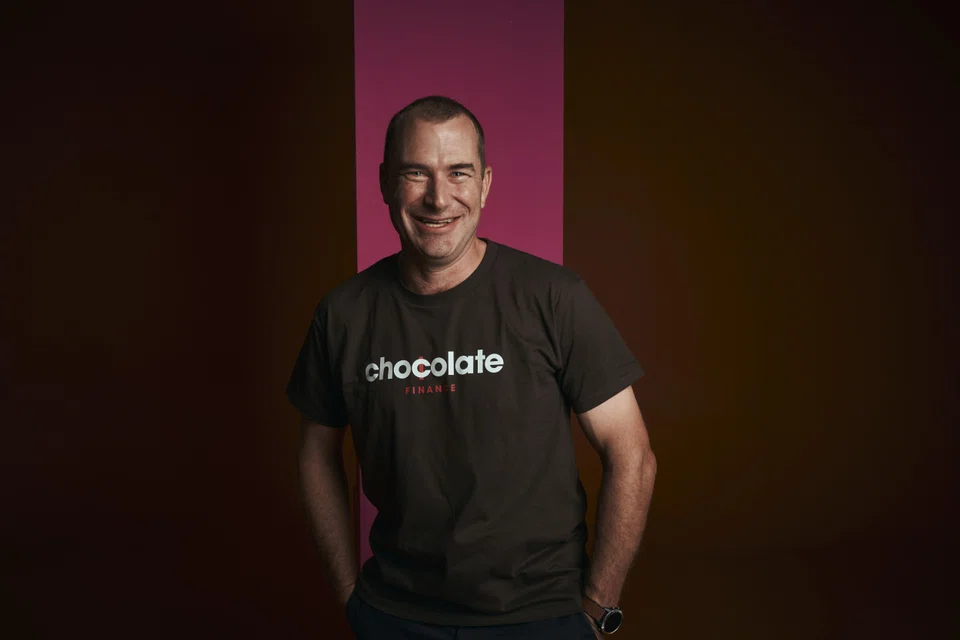
[SINGAPORE] Around S$500 million in net withdrawals were made by Chocolate Finance’s customers – slashing the firm’s assets under management (AUM) by some 40 per cent – amid a run over the past two weeks.
But founder and chief executive Walter de Oude is adamant that it was in no way a “meltdown”.
In fact, he sees it as a success that the asset manager’s platform was able to handle the deluge of withdrawals in an automated and orderly manner.
“I’m really, really proud of the robustness and resilience of our business and systems as we’ve gone through a really, really crazy week,” he told The Business Times.
Communications failure
The genesis of Chocolate Finance’s troubles, arguably, lay in its decision to pull the plug on transactions via payment services provider AXS.
As part of its customer acquisition strategy, Chocolate Finance had a partnership with rewards platform HeyMax, offering a two-mile-per-dollar reward for all spending categories, including bill payments.
Chocolate Finance’s withdrawal from AXS meant that customers could no longer pay their bills using the platform’s debit card.
However, de Oude claims that some customers were exploiting and abusing the HeyMax-Chocolate Finance partnership via AXS payments.
“We had people spending S$300,000 on bill payments and cycling money and paying insurance premiums on other people’s behalf, and just general misuse,” he said.
Admittedly, this was just a small proportion of customers, de Oude noted. “But I absolutely agree that our knee-jerk reaction to that could have been managed much better.”
He admitted that Chocolate Finance’s communication around the halting of AXS payments was “a mess”.
This prompted some customers to head for the exit. And more mayhem ensued as Chocolate Finance later paused instant withdrawals and Visa debit card transactions.
The asset manager said that a temporary pause was required, as a spike in withdrawals would eat up its liquidity buffer of funds and lines of credit. It also needed to restore its float with Visa before it could resume transactions.
Chocolate Finance and its founder came out to assure customers that their money was not at risk at any point, and that it was a “matter of managing increased transaction volumes”.
By this time, however, the “bank run” was well under way.
Lessons learnt
De Oude said that he now wants to get back to “business as usual”.
He reiterated that customer monies are safe and that withdrawals were processed as requested.
At the two-week mark since the start of the incident, de Oude pointed out that Chocolate Finance is seeing more money coming in than going out, resulting in a net growth in AUM compared with last week.
“The immediate learning from this is that customers don’t read the fine print, although Chocolate Finance has done everything it’s supposed to do as an asset manager,” he said.
Perhaps more should have been done to make it clearer to customers how the platform worked under the hood, he added, rather than having them rely on the frequently asked questions (FAQs) or terms and conditions available on Chocolate Finance’s website.
The FAQ section on its website has been updated, with additions including an answer to the question: “What happens if instant withdrawals are paused?”
The Monetary Authority of Singapore (MAS) worked with Chocolate Finance throughout the process, releasing its own statements on the matter.
After this incident, it is unlikely that anyone will mistake Chocolate Finance for a bank. To be clear, Chocolate Finance is not a bank, but a fund manager with a capital markets services licence from MAS.
For now, however, the focus for Chocolate Finance is to get back to normal, and that requires some regulatory checks.
“(The) next step for us is just to make sure that the regulators remain comfortable that things are in order,” said de Oude.
Meanwhile, Chocolate Finance is looking to continue its top-up programme, with the current programme set to end after Mar 31.
This will be the third time the asset manager is extending the incentive programme, which is done on a three-month basis.
Under this top-up programme, Chocolate Finance supports the quoted rates – 3.3 per cent per annum on customers’ first S$20,000, and 3 per cent on the next S$30,000 of investments. The platform undertakes to top up any shortfall during the “qualifying period”.
The programme is designed to smooth out returns, with Chocolate Finance taking a fee of up to 2 per cent after the portfolio delivers its target return. This incentivises the firm as well, to design a portfolio that returns above the target yield.
“Chocolate Finance benchmarks its rates against three-month fixed deposits in the market; it looks for bond funds that generate more than that and constructs its portfolio to make sure that customers can earn the target yield, but also have enough that Chocolate Finance can make some money,” said de Oude.
As time passes and confidence returns, the CEO expects to see more money inflows again.
It might take a while for Chocolate Finance to earn back customers’ trust, but de Oude points to feedback from some customers saying that they will be back as soon as things get back to normal.
“In two to three months’ time, when all the dust is settled and everything is clear, people will look at this saga as a demonstration of our strength and capabilities, rather than the current overreaction,” he added.
TRENDING NOW

Once staunchly pro-China, Malaysian Chinese businesses are now distancing themselves from Beijing

Could stablecoins be the future of money?

Grab CEO’s wife Chloe Tong on life with Anthony Tan and finding her purpose

Malaysia suspends sale of Chery Omoda 5 after viral incident; Singapore cars not affected

