Emergency care is the springboard for Hope
Besides spreading services to other Asean countries, it is eyeing sea ambulance service
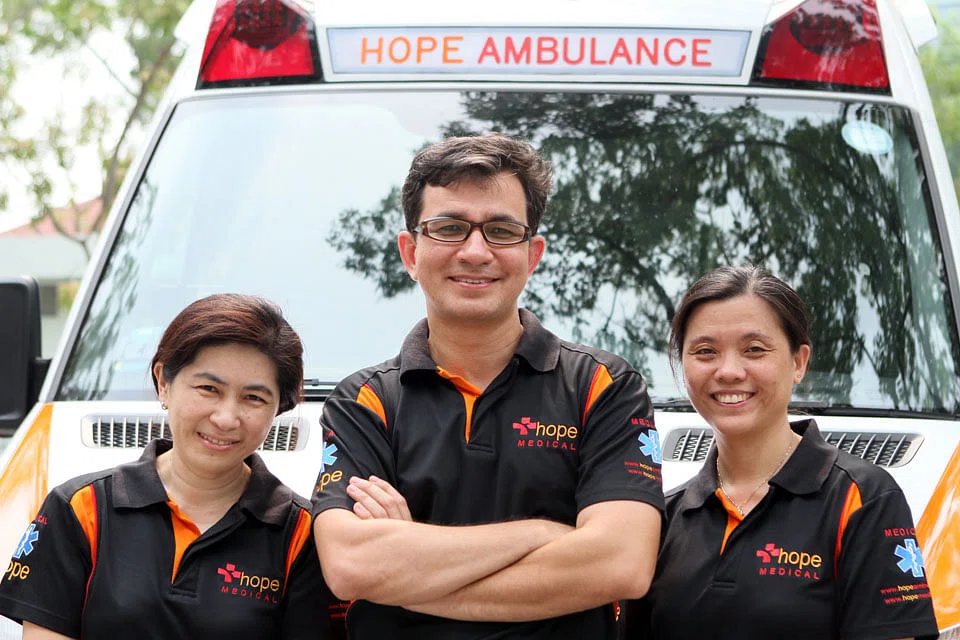
THERESA Yeap, co-founder of event emergency services firm Hope First Response, did not expect her staff to double over the past year to its current headcount of 120.
The company's profits have also been climbing steadily since then. From pulling in a little above S$1.5 million in 2014, it now expects to make about S$2.5 million this year, with a projected growth rate of 30 per cent for the following years.
"It's exciting, electrifying and petrifying all at the same time," she said. "There's a lot of self-satisfaction from these achievements, but at the same time it's not easy."
For a company with no business development department, Ms Yeap - who prefers the title "director of operations" to the more flashy "CEO" - credits an internal culture of togetherness for its growth over recent years.
"If you want to instill compassion, commitment and care, you have to be the role model," she said, of her position as staff overseer.
The company first started out providing emergency care for outdoor events such as marathons and cycling races. Since then, they have branched out to contracts under the Singapore Civil Defence Force and the Singapore Armed Forces, and are beginning to extend their services to some neighbouring Asean countries.
Hope First Response was founded in 2009, under the larger company Hope Ambulance, which Ms Yeap started to complement her experience as a flight nurse with the Singapore General Hospital.
Hope Ambulance was established six years prior with the help of her husband, Dr Charles Johnson, and sister, Josephine Ham, to provide specialised transport for airlifted patients from aircraft to hospital.
The ambulance service was set up to allow healthcare workers to have more control over the transfer of patients from their location to the hospital, she said. Both Ms Yeap and Dr Johnson have worked as flight medical staff, and she and her sister were trained as intensive care nurses.
"My mother was a nurse as well," she explained. "She always said if you can't be a doctor, you must be a nurse before you pursue any other career."
But Ms Yeap seems to have also taken after her father, a businessman, by building her own company from the ground up, now known conjointly as the Hope Group.
What started out as an extension of the original ambulance service is now the Group's largest sector.
"Moving forward, I think the next big thing we're going to do is the sea ambulance service," Dr Johnson, Hope's medical director, said.
At the moment, however, the Hope Group is focusing on its growing list of clients. "We don't actually have a marketing team," Ms Yeap said. "Everything is just word of mouth, and we have more than enough to keep us extremely busy."
She added that she and her fellow co-founders were not even aware of the Emerging Enterprise Award, and only registered for it at a client's suggestion, not thinking that they would be shortlisted as one of the 14 finalists. Hope's directors attribute the company's organic growth to its standard of empathy, which is applied to all levels of staff. Each member of staff has the directors' personal mobile phone numbers, Dr Johnson added. On weekends, some even bring their children to the office while they remain on call.
Employees at Hope have contacted the two for help with personal emergencies before, but have never once misused their mobile numbers, he continued. "We've realised that when you give your staff that level of trust and respect, they know that you care," he said. "They will in turn care for patients at the same level that you care for them."
Ms Yeap added that she sometimes accompanies her staff on the ground, even though her job as director places her in the office, to provide support. "We don't have to, but I feel that being there motivates them in a sense, in that they see you and can talk to you," she said. "There is rapport and it builds their confidence."
Apart from the paramedics, who must first be professionally trained and certified, their company takes in "anybody, from all walks of life," to join its team, she added.
"We give them a second chance at a career and put a purpose in their work," she continued, listing off her staff's previous stints as hawker centre vendors, managers, retirees, ex-convicts and taxi drivers.
New hires start out with general tasks for one to two years, which gives the managing staff time to identify their interests and capabilities. Then, they are put into divisions that match best with their skills. This respect for others is also reflected to the company's customers, as most of Hope First Response's clients are repeats, or have been introduced by word of mouth,
Ms Yeap said. She recalled a job in 2010, when the company, still in its infancy, was contracted by Alexandra Hospital to help with medical assistance for the annual mass cycling event OCBC Cycle. Event organisers often pay private ambulance services for a "generic plan" to assist with first aid and medical care, she said, although the type of event was often an overlooked factor.
"A cycling event has very different challenges from a running event, a swimming event. We went to the course and marked out what we call 'hot spots,' where accidents were most likely to happen, and we stationed more staff there just in case," she said.
The organisers saw Hope First Response's response to the challenge, and liked them enough to call them back for every OCBC Cycle since then.
Alexandra Hospital has also given them full rein over the event, Ms Yeap added. "We always tell clients that we're in this together," she said. "If something happens to the patient, I feel that I've not done my work properly."