Jumbo crafts recipe for success in China
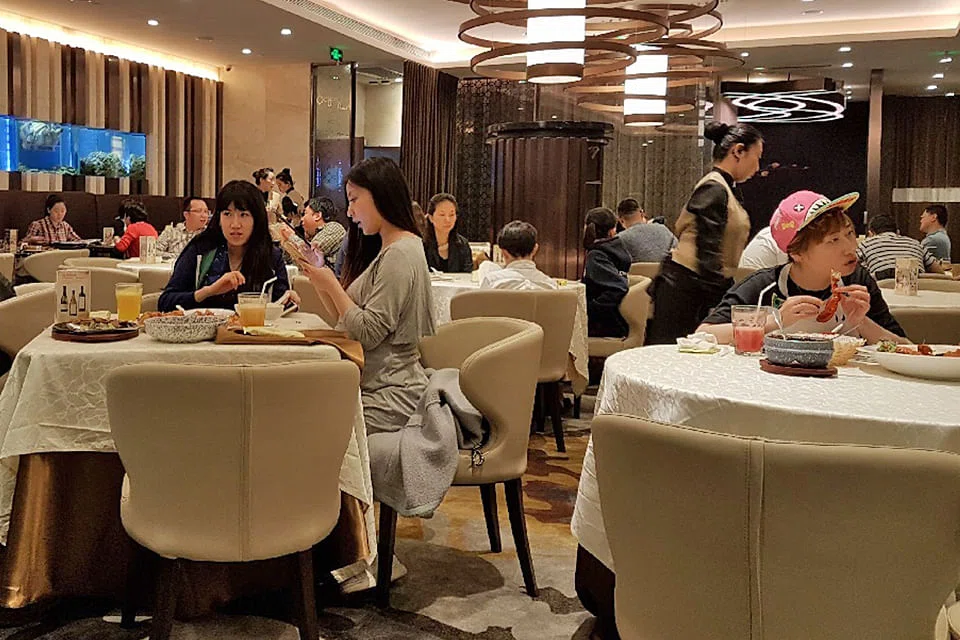
Hong Kong
FOR many years, Jumbo Group has had the right ingredients for its famed chilli crab. But now it also has a recipe for success in China.
The growing confidence in its China business since opening its first Shanghai restaurant in 2013 is helping the group to diversify from Singapore and grow its business abroad.
"We will slow down the growth local (sic) and focus on overseas expansion, through self-operating or franchising," Jumbo CEO and executive chairman Ang Kiam Meng told The Business Times.
The company's revenue went up by 11.4 per cent - or S$14 million - from S$122.8 million for the fiscal year ending in Sept 2015 to S$136.8 million in 2016 "due mainly to revenue contributions from our two new Jumbo Seafood outlets in Shanghai", which opened in August 2015 and January 2016.
Net profit also jumped 46.3 per cent to S$15.5 million for the 2016 fiscal year ending Sept 30. .
Jumbo's Shanghai restaurant last year accounted for 15 per cent of group revenue, up from 8 per cent in the 2015.
"Leveraging on our three years of operational success in Shanghai, we intend to expand our brands to other major Chinese cities. We will explore suitable opportunities such as the opening of new outlets, acquisitions, joint ventures or strategic alliances with partners who can further strengthen our market position," said Mr Ang.
"Positive industry trends in Shanghai such as consumer affluence and a willingness to spend on food continue to serve us well. Looking ahead, we will focus on cost rationalisation and improving workflow processes, manpower utilisation and IT applications to increase productivity, efficiency and lower operating costs."
Jumbo has expanded quickly since first entering China, but has been careful not to overexpand, said DBS group research analyst Alfie Yeo.
"Jumbo has no lack of interest by third parties wanting to carry their brand name. But the company is making sure that it does not overexpand too quickly, which can compromise food quality," Mr Yeo told BT.
It is this well-calibrated approach to growth in China that has served Jumbo well, said Maybank Kim Eng analyst Gregory Yap.
"China has been a good experience for Jumbo, but it was a calculated experience," he told BT. "They first tested the market with their first outlet at IAPM Mall, opened in Nov 2013, with the second and third not opened till Aug 2015 and Jan 2016, respectively . . . By that time, they knew from the roaring success of IAPM Mall that their seafood business will do well in China, with the only variable being location."
He added that Jumbo entered the China market at just the right time and was able to ride on trends..
"Mainland Chinese, especially city folks, were also looking for something different, and many have travelled in South-east Asia. Therefore, South-east Asian food - such as chilli crab - fit the bill," he said.
While Jumbo is looking into adding another seafood restaurant back home, he reckons the market here is getting saturated.
"China therefore will remain the centre of attention for Jumbo management," said Mr Yap.
Earlier this month, Jumbo announced that it had entered into its first franchise agreement that would bring its brand to Vietnam, and Mr Yap foresees the group getting "more franchise agreements sealed in the next six months", potentially in Beijing and Shenzhen.
"Franchisees will also be attracted to the Jumbo franchise because of the high ROI (return on investment) which is derived from a proven food concept and Jumbo's proven ability to pack the chilli-crab hungry crowds in," he said
But overseas expansion also comes with risks.
One obvious risk, according DBS' Mr Yeo, could be Jumbo's "inability to capture various local tastes with its dishes". Still, he is optimistic about the group's prospects.
"We are positive over longer term for Jumbo and have a buy recommendation for the stock. While Singapore's business is expected to be stable, we see growth coming from regional developments which include mainly expansion into China and to some extent other parts of Asia," he said.
For Mr Ang, pacing and planning the group's China expansion will be crucial.
"Every city in China is different in terms of culture, taste and preference. Any China city is a much bigger market than Singapore. We should focus our resources to explore fully the market potential of a target market . . . (and) maximise our resources to generate maximum value for the company," he said.
"We can't be greedy by going into too many cities and spread our resources too thinly and become unproductive. In simple terms, if Jumbo were to open 10 restaurants, we will choose 10 restaurants in one city rather than one restaurant in each of 10 cities."