

Listening well in a chorus of data
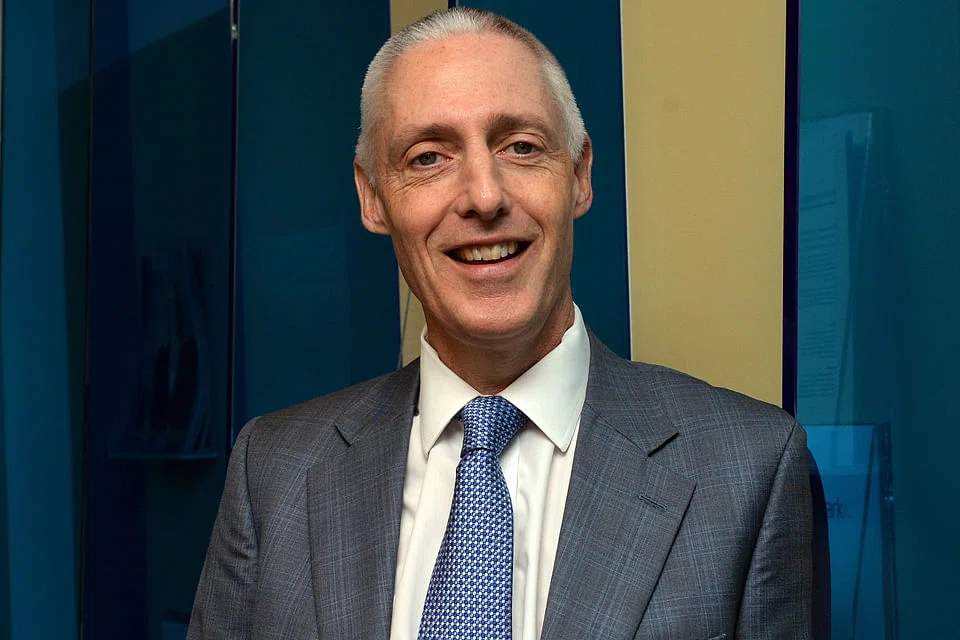
Markit's focus on quality sets it apart from its competitors, says co-founder and president Kevin Gould.
Singapore
BUSINESSES exist to serve their customers' needs. But what exactly do customers need? It does not take a genius to figure out the answer, according to Markit co-founder and president Kevin Gould. Listen.
"I'm not going to pretend to you that we're clever," said Mr Gould, whose firm provides financial information services. "We're not. We're really not. We just listen ... When do we start thinking about a new pricing service? When do we think there's critical mass? Just listen. When enough people start talking about a problem, you move to solve the problem."
The financial information services firm was founded in London in 2001 with support from Canadian bank TD Securities, for which three of its founders, including Mr Gould, were working at the time.
Trying to figure out what problems need solving has been a core pillar of Markit's rapid growth over the years. In fact, the first problem that the founders sought to solve was one that they faced themselves.
"In TD we were essentially a very aggressive hedge fund," Mr Gould said. "TD, as you probably are aware, is a pretty conservative institution, and has fared very, very well through the crisis and out the other side because its risk management techniques were so strong."
"As we were trying to expand the business that we were doing inside TD, we needed to provide our risk management group with the data that they needed to oversee us," he explained. "To really be able to understand what we're doing, they needed a lot of data. As they went out into the market, they said, go look for that data, but couldn't find it. Didn't exist. So inside TD, we started to create techniques to collect data."
What Mr Gould and his co-founders did was to figure out a way to price credit derivative swaps (CDS), which at the time was a growing over-the-counter market that was beginning to play a bigger role in credit markets. But the preponderance of bilateral transactions made it hard for investors to get a good grasp of what the actual market value was for these instruments that they were using increasingly. It did not take long for Markit's co-founders to figure out that they were not the only ones facing obstacles.
Creating transparency
"Part of it was, I think, persuading the banks that creating transparency at that time was probably a good thing for them," Mr Gould said. "And why a good thing? Because they themselves were having problems marking their own books, so they had a risk management issue themselves internally. If they had that risk management issue, then all of their customers certainly had that risk management issue."
Of course, Mr Gould's commandment to "listen" to customers works only if the customers are willing to talk, and getting that to happen requires earning the customers' trust. At the core, that means delivering products that work well.
"We worked very, very hard with the major financial institutions who were doing most of the trading at the time to agree to hand over something that they'd never parted with before, which was where they were pricing most of these instruments," Mr Gould said.
"The first concept of the company was creating transparency where there wasn't any. This was an over-the-counter market, bilateral trading everywhere, no exchange, no transparency. No one really knew where anything was. And along we came, and for the first time in what was then the credit derivatives market and parts of the bond market, we started to aggregate data, make that data available to everybody."
Markit has leveraged that foot in the door into a sizeable empire with 3,600 employees in 10 countries, drawing comparisons to older and more established rivals such as Bloomberg or Thomson Reuters. Singapore government-owned investment company Temasek Holdings has a substantial stake in the company.
"Where we sit today is I think unbelievably positioned, where we have got major sell-side institutions as our customers," Mr Gould said. "Every major global bank is a customer of ours, and we've very deeply penetrated inside those institutions. On the other side, we have . . . buy-side financial institutions who are our customers who we are very close to. And then around the edges . . . looking in, regulators, who we are very close to, auditors, consultants and so on that we're close to, and we sit right in the middle of all of those conversations."
Along the way, Markit expends significant effort in making sure that it has "deep expertise" in whatever area in which it operates.
"As a result of that expertise, it means that customers as a whole want to talk to us. They want to share their problems with us. So there's a level of trust that we've built up with both buy side and sell side that they're very prepared to sit down at a table and discuss their problems with us. That gives us and affords us the opportunity to listen to all of that, assimilate those ideas and solve."
Mr Gould is particularly excited about the possibility for Markit to help financial institutions with their due diligence and compliance when it comes to acquiring new customers. The aftermath of the Global Financial Crisis has created a mountain of regulations and a spike in compliance costs for banks. Client onboarding involves many similar processes that are replicated from one bank to another, and is therefore a ripe area for Markit to create efficiency, Mr Gould said.
"If I think about two banks here, Standard Chartered for example," he said, for purely illustrative purposes, "Standard Chartered wants to onboard a hedge fund in Singapore. It has to go and get a tonne of information and upload it about the hedge fund - who the directors are, where it's incorporated, tax forms, dadadadada - tonnes and tonnes of information. But Standard Chartered's got to go and upload all that same information, as does Goldman Sachs, as does UOB, anybody who wants to trade. They're all uploading the same information, and they've got armies of people trying to chase down that information. Why don't we do that once?"
Mr Gould, who has relocated to Singapore, said that it makes sense to pursue that initiative in Singapore because of the stringent rules set by the Monetary Authority of Singapore (MAS).
Big initiative
"It's a big, big initiative for us," Mr Gould said. "This is, across the industry, billions of dollars are being spent . . . In this instance, around client onboarding, MAS has definitely been at the forefront and is definitely transparent around everything they want to do, and they're pretty damn strict. They set the highest standards. So for us to come here and solve for the standards here, and sit with banks and truly understand every piece of data they need to satisfy the MAS, that means almost inevitably we've reached the highest common denominator. And if we replicate that process in other jurisdictions, we will meet the standards of each of those jurisdictions because the standards here are so high."
Mr Gould takes pains to explain that Markit's focus on quality sets it apart from its competitors. "If you think about many organisations that offer a lot of data and transparency, they do it as a byproduct of something else. Many of the big data providers are really terminal providers, or they're providing some other solution. Where we started was, no, no, no, we're a data provider, and so we strive every single day to get to the highest quality of data. Because if I don't have the best data, they're going to buy from Bloomberg. So I have to have the best quality data, otherwise they're getting it from somewhere else. So we're always trying to be, for want of a better word, the Ferrari of data."
TRENDING NOW

Singapore updates renewable energy certificate standard to tackle greenwashing; unveils new solar efforts

Director of PR firm sacked for secretly recording internal meeting loses wrongful dismissal claim

Indonesia says gas export cuts to Singapore remain within contract terms
Time for MAS, SGX to scrutinise issue managers

