

Singapore fund investors paying above median fees: report
They face twin evils of front-loaded fees and ongoing expenses; but research report says Singapore scores on regulatory framework, sales practices
Singapore
COMPARED to their global peers, investors in Singapore are paying higher-than-average fees on their funds, a report from investment research firm Morningstar revealed. This is due to front-loaded fees and ongoing expenses.
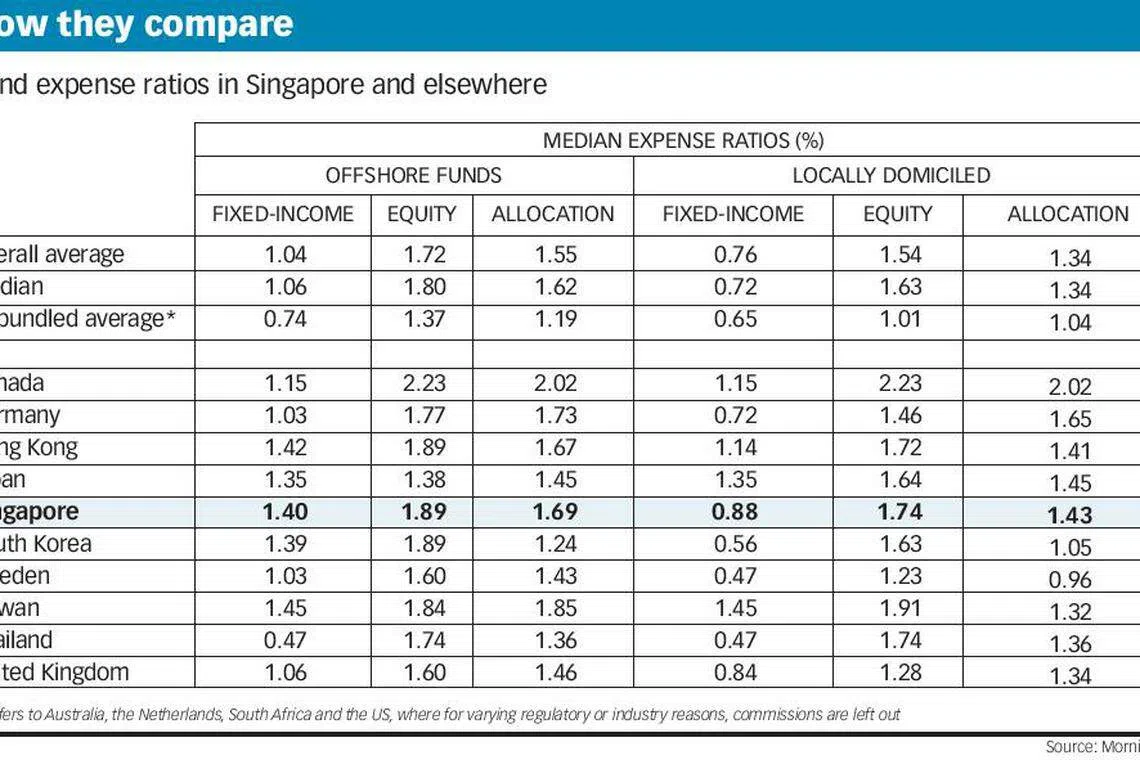
The median expense ratio for funds domiciled in Singapore is 0.88 per cent a year for fixed income funds, 1.74 per cent for equity funds, and 1.43 per cent for mixed "allocation" funds - about 0.1 to 0.15 percentage point higher than the median in 25 countries surveyed.
For fixed income funds from foreign jurisdictions that are sold here, fees at 1.4 per cent are higher by about 0.35 percentage point.
Higher fees and expenses landed Singapore a "below average" grade for the category in Morningstar's biennial Global Fund Investor Experience Study. However, it was "above average" in its regulatory and taxes framework, as well as its sales practices.
The Central Provident Fund is cited for offering many investment choices. The Supplementary Retirement Scheme was noted for encouraging individuals to save through tax benefits. Meanwhile, the "balanced scorecard framework" to regulate the remuneration of financial advisers was a positive development noted.
Overall, Singapore was ranked "average" in terms of the experience it offers to investors, compared to a "C" the last time round. Morningstar has replaced its letter grades with a five-point scale in this report, and noted Singapore's grade has improved from the last survey.
Singapore scored an "average" grade in disclosures, and there is room for improvement there, said Anthony Serhan, Morningstar's managing director of research strategy in the Asia-Pacific.
He told The Business Times that monthly reporting of complete portfolio holdings is becoming the standard. In 10 countries surveyed, more than two thirds of mutual funds report holdings to Morningstar monthly.
More frequent disclosures can help distributors sell funds better, he argued. "You can start drawing more of a connection, letting people know they have exposure to some of those names they see in the newspaper."
He added that with more transparency, Morningstar can also analyse trends in the styles of the funds better. Fund managers should also disclose how much of their own money is invested in the funds they manage, he said.
On the issue of high fees, industry-specific factors have been said to play a part.
Funds here are distributed mostly through banks in a commission-based model, which add a one-off sales charge of a few percentage points of assets. Fund houses themselves grumble that half of the annual management fee they charge goes to distributors as trailer fees.
By contrast, fees are the lowest in places where funds are not allowed to charge entry fees, such as in Australia, or where rebates to advisers are banned, like in the Netherlands.
Other pressures have piled on fund managers, as passively managed index funds are outperforming actively managed ones in a bull market.
Kelvin Goh, head of investments at OCBC Bank, told BT that fees are just a part of a set of factors investors have to consider before making an investment decision.
"Considerations like product suitability and their risk profile are also important factors in the investment journey, and any investment decision should be made in consultation with a trusted, licensed financial adviser," he said.
The bank will continue to innovate to keep fees affordable and investments accessible for investors, Mr Goh added.
To improve disclosure standards, he suggested that the fund prospectus should use simple, jargon-free language.
Fund managers like Yeo Seng Chong of Yeoman Capital Management do not believe in disclosing portfolio holdings. "We only disclose stocks exited entirely, whether successful or not," said Mr Yeo, who runs a S$200 million Asia value fund.
"It also brings a lot of competition. We're in the small cap space, we work hard for an idea, there is no reason why we should give it away."
On fees, he said that customers need to examine their net-of-fees returns in both the short and long term. "In the end, it's a free world. The manager providing the service needs to convince the customer he's worth all that," Mr Yeo said.
"If you have poor service, poor processes, you can charge zero but it's still a loss to the customer."
TRENDING NOW

Nvidia prepares to oust Jensen Huang after news of second affair, with executive: reports

Higher rates, weaker spending: Is the Philippines entering stagflation?

Special dividend for SIA’s 80th anniversary? CEO says extra payout will need board’s nod
Genting Singapore Q3 net profit falls 42.2% to S$54.7 million on softer premium gaming

