Embracing innovation and change helps propel growth at International SOS
Singapore
IN just 32 years, medical and travel security risk services company International SOS has grown from a US$0.5 million company to a US$1.5 billion company. That's a whopping 3,000 times its initial size.
Yet, the homegrown company continues to grow yearly, helped by major trends, such as globalisation, an increasingly mobile workforce, digitalisation and rising terrorism.
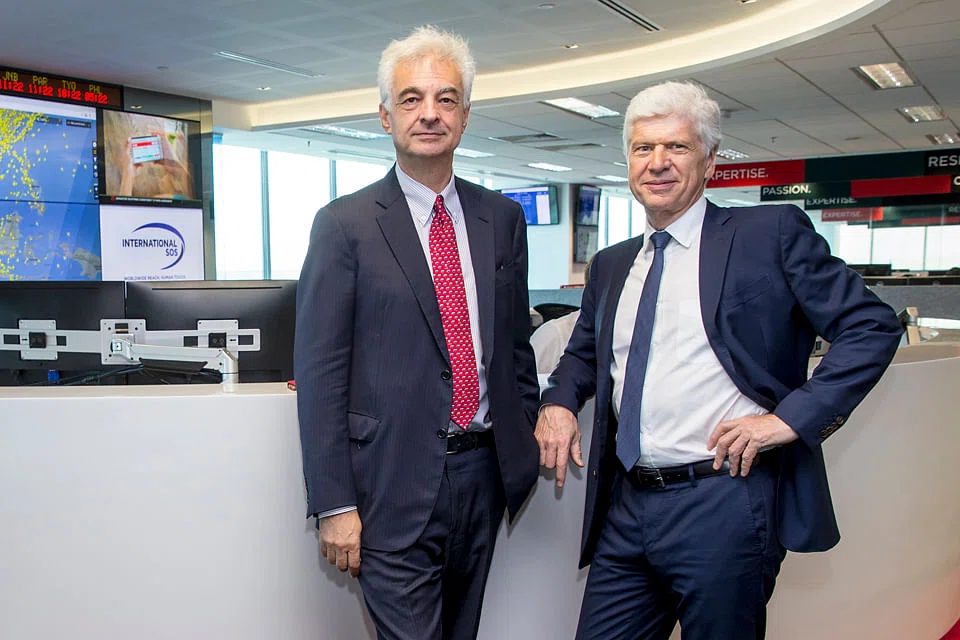
As the two founders of the company, which started off as AEA International in Singapore back in 1985, shares their success story, one thing that became apparent is how quickly the company adapts.
After all, being nimble, flexible and spontaneous are critically important attributes during emergency medical assistance and evacuation missions - a specialty that International SOS is known for worldwide.
As a market leader, International SOS has 10,000 corporate clients and serves 82 per cent of the Fortune Global 100 companies, 68 per cent of Fortune Global 500 and 78 per cent of The Global 100, which ranks the world's most sustainable firms.
Besides corporations, it also serves educational institutions by ensuring the safety and well-being of students travelling overseas.
International SOS co-founder Arnaud Vaissie tells The Business Times: "Innovation is in our DNA. We continuously evolve. That's why we lead the industry because we change and we innovate faster than our friends."
Mr Vaissie, who is also the chairman and chief executive officer, says: "I guess the entrepreneurial spirit of the company is very alive. We value innovation, we value change. And we realise survival is linked to the pace of change. And we keep changing very quickly."
One classic example would be how quickly the company - first in the world then - built a portable medical isolation unit (PMIU) to transport severe acute respiratory syndrome (Sars) patients here in 2003. It was put together in just seven weeks, from design to the final product.
"Our job is to help our clients stay productive," says Mr Vaissie. Beyond medical evacuation, the company's suite of services now includes mitigating travel, medical and security risks for its clients, with its "duty of care" concept and prevention as its core.
In this era of disruption, the privately held company also sees itself innovating according to changing trends and clients' demands.
Says Mr Vaissie: "We strongly believe that digital transformation and data analytics are going to be the core of what our clients expect going forward. Today, we are developing a lot of tele-health services for our clients, so that they can have access to video and self-help services." Recently, the company launched managed security services, whereby it proactively monitors the developments when a crisis happen, establishes the first contact, keeps the clients and their employees informed of the situation and proposes solutions.
Mr Vaissié says: "Once you digitalise, you can venture into a lot of things. You can do the work from around the world, and no longer from one location. So we really can take full advantage of our size and global resources because we can pool resources from anywhere, at any time."
An example would be how two doctors located at two different locations can work on the same client case together at the same time as they can share data real-time, making it more efficient and cost-effective. It is also able to provide the most appropriate resources from around the world.
Data analytics is another area that the company is looking at. In May, the company won four awards, including the Best Use of Data Analytics within Global Mobility, from the Forum for Expatriate Management (FEM) 8th Americas Expatriate Management and Mobility Awards (EMMAs).
And with data comes the need to safeguard it, which is where cybersecurity becomes increasingly crucial.
Says Mr Vaissie: "It is an area that we need to manage internally so as to make sure that we have data integrity. Because data integrity today is fundamental, most particularly in healthcare. This is where data don't lose value as time goes by.
"Purely business-wise, data has a short term value. You know what your competitor is doing, for example. But after a week or months, that has no value anymore.
"In healthcare, if you know of the health of someone, it may have value for the entire lifetime of this individual. So data integrity in healthcare is even more important than in other fields. Because the value of health data may not diminish with time. It may even increase with time.
"So data confidentiality, data security, data integrity in healthcare and data privacy is (at) the heart of what we do. So we spend a lot of money on cybersecurity."
Medical evacuation continues to be a very important part of what the company does. Although the segment represents only one per cent of the entire business, it is still one medical evacuation every 30 minutes.
Pascal Rey-Herme, co-founder and group medical director of International SOS, says: "It is growing because the population is growing. It is not growing as fast as the population because with prevention, with digitalisation, you are able to do more without moving the patient.
"What's important is to move at the right time, so not to wait long, or not to move prematurely."
With improved technology, more sophisticated equipment is onboard, so "we can do more in an aircraft than we were doing before".
Mr Vaissie says that the business of saving lives does not allow for many mistakes and the company has tremendous resources and experience to deal with "tremendous experiences".
"We have, I believe, the best experts in the world to do so," he says.
But this does not mean it can be complacent because things are changing quickly, he notes.
"It is a continuous fight for improvement. In our world, like in any other activity, the second you believe that you are good enough, you start declining. I think we are rather humble in this regard," he says.
BT Infographics: Fair winds