

Thinking beyond the checklist
SMU business school's new dean sets his sights on building entrepreneurial thinking in his students
Singapore
NAPOLEON I, borrowing a phrase from Scottish philosopher Adam Smith, famously described Britain as "a nation of shopkeepers", implying that the British were small-minded.
Singapore is in that kind of spot right now, says the freshly inaugurated dean of the Lee Kong Chian School of Business of the Singapore Management University (SMU).
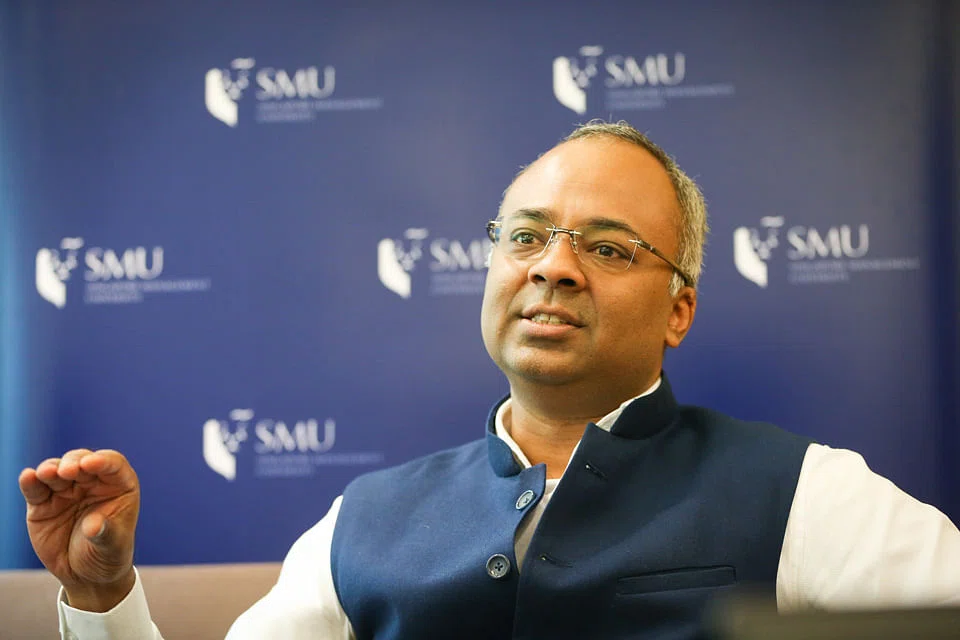
Gerard George, aged 43 and into the third month in his new job, told reporters on Thursday: "If we were to mock Singapore, we would say it is a nation of bankers and real-estate developers."
But he said: "What we would like to become is a nation of entrepreneurs."
Some clarification is in order here. Entrepreneurship in the sense he used it is not specific to starting companies; rather, it is about developing an entrepreneurial mindset:
"The country is missing a big trick about how it thinks about entrepreneurial thinking. We make a list of all the things we want to do and we say okay, check, we've done that. It's a list-building mentality. It's not an opportunity-framing mentality - which is what entrepreneurial thinking is about."
To him, living by a checklist is stifling; an entrepreneurial mentality, on the other hand, operates in multi-fold ways.
It is precisely this way of thinking that Prof George intends to build up in the Lee Kong Chian School of Business. Having begun a five-year-term as dean on Jan 1, he has made it a priority to oversee and develop a new course in the school next semester - one titled "Managing in a VUCA Context".
(For those who stumble over the acronym, VUCA stands for "Volatile, Uncertain, Complex and Ambiguous.)
In a business school, a course title embodying this term - coined by the US Army War College - will teach students about the nature of change, how to analyse problems and operate in fluid situations.
Imbuing the students with entrepreneurial thinking is key, he said of the course, the brain child of his predecessor, Professor Howard Thomas.
With Prof George at the helm, the school is now developing several case studies to create situations that will require entrepreneurial thinking of those undergoing the course.
Under his leadership, the business school is also ramping up its entrepreneurship initiatives. For example, it is now organising a week to celebrate the entrepreneurship culture and has begun matching its students with internships and projects in the Biopolis/Fusionopolis cluster, home to Singapore's biomedical and high-tech startups.
A British national and a professor of innovation and entrepreneurship, Prof George was previously the deputy dean of the Imperial College London's Business School. He is also the editor of the Academy of Management Journal, a flagship publication in the field of management.
He said he hopes to raise his students' overseas exposure, which will broaden their perspective. This is "not just a visit to some place and becoming global", he said; he wants to rope in more university-exchange partners and dovetail overseas programmes with his students' career choices.
Most importantly, he is urging them to look beyond the usual hotspots of Silicon Valley, Tokyo and Sweden, and venture into the region.
"Even though we have neighbours that are very close, students could still develop a better understanding of the region and see what the problems are. It is not the same as seeing it on television or in print. For Singapore's future, we've got to understand our neighbours," he said.
Last September, he unveiled plans to put the Lee Kong Chian School of Business among the world's top 20 schools; it is now in 58th place in the Top 100 Worldwide Business School Rankings done by the University of Texas at Dallas.
He definitely believes that you cannot beat Apple by trying to be more like Apple. The way he sees it, his business school will not stand out if it simply models itself on its Western counterparts.
He said: "We have to embrace being Asian, not become more like Imperial College or Stanford University. We have to build something uniquely Asian and leverage that to be the best in the region. By doing so, we will automatically be in the top 20."
For the wider business community in Singapore, Prof George hopes to bring to the table his experience as programme director for the London Stock Exchange's Elite programme, which provides company founders, chief executives and executive teams of high-growth companies with a tailored portfolio of business-support tools, education services and access to a select group of business advisory and investment partners. For more than two years, the programme supported 36 small and medium-sized enterprises (SMEs) through their next stage of growth; six are in the process of listing on the London Stock Exchange.
Prof George is now in talks with statutory boards such as the Singapore Economic Development Board and Spring to build a joint platform for local SMEs. There are about 183,000 SMEs in Singapore, but such mediums are still absent.
In the next six months, he hopes to bring 20 SMEs with shared industry experiences on board the programme. "Growing local companies may very well provide future listings and fill the pipeline for the Singapore Exchange," he said.
TRENDING NOW

VietJet hit with global asset freeze in FitzWalter dispute

FCT, NLB to turn Causeway Point’s former cinema space into reading hub in mall revamp
Family offices ‘kept captive’ by relationship managers turn to independent advisers, direct deals

Olivia Lum, ex-CFO not giving evidence in their Hyflux trial

