Singapore beefs up muscle in solar and energy storage
The Energy Market Authority is also making it easier for consumers to sell excess solar energy back into the grid
Singapore
SINGAPORE is taking its new energy ambitions a step further by developing its solar forecasting capabilities, enhancing a scheme for selling excess solar energy and installing an energy storage testbed on the grid.
This comes as Deputy Prime Minister Teo Chee Hean estimated at an industry event on Monday that solar energy could eventually reach up to 20 per cent of Singapore's energy mix.
Asked what he envisioned Singapore's energy mix to be like in 10-20 years during a question-and-answer session at the Singapore International Energy Week, Mr Teo noted that Singapore has limited options for alternative energy, but is "moving aggressively" in solar.
Under the government's current plans, solar could grow to about 6 per cent of the energy mix, he said, but if Singapore pushed the boundaries it could reach up to 20 per cent. The Republic currently has installed solar capacity of 145 megawatt-peak (MWp), compared to the monthly peak system demand of about 7,000 megawatts.
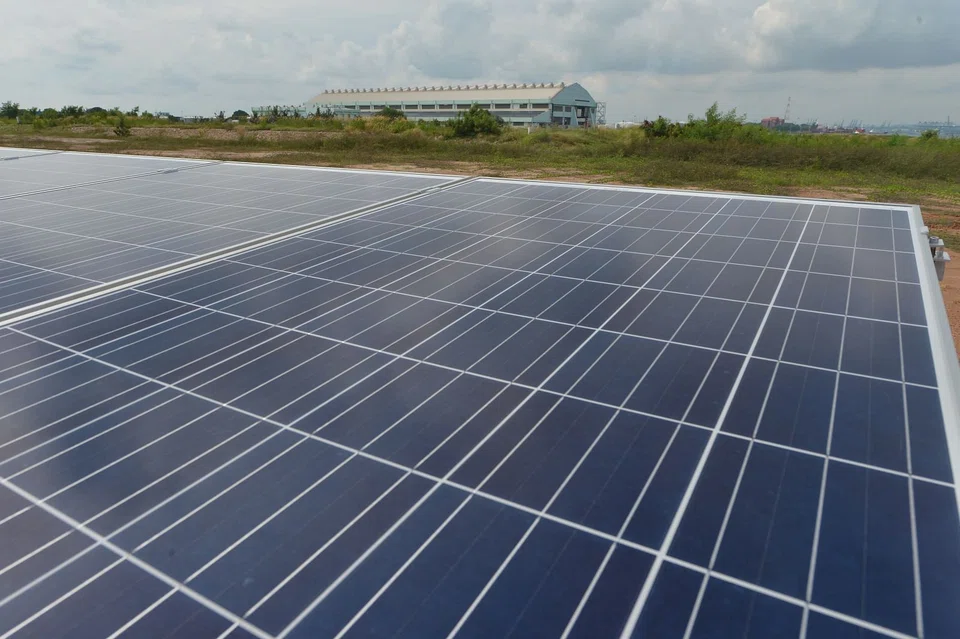
In his speech earlier, Mr Teo noted that Singapore is already test-bedding floating solar panels on reservoirs and installed moveable solar panels on vacant land on Jurong Island. It also hopes to deploy solar panels on vertical building surfaces in future.
A study by the Sustainable Energy Association of Singapore has showed that solar energy can contribute up to two gigawatt-peak by 2020 - a quarter of Singapore's projected peak electricity demand, he added.
Separately, the Energy Market Authority (EMA) announced on Monday that it is awarding a S$6.2 million research grant to a consortium led by the National University of Singapore (NUS) to develop solar forecasting capabilities.
Despite Singapore's sunny climate, forecasting solar power output in the country, especially over long-time horizons, is challenging as cloud cover and humidity affect the amount of energy produced by solar panels.
Extensive cloud cover on rainy days could, for instance, cause significant drops in solar power output. Such events, if not properly accounted for, may lead to imbalances between electricity demand and supply, said EMA.
To keep power supply stable, its power system operator will need to know the solar power output ahead of time in order to take appropriate actions to balance the grid, especially as Singapore integrates more solar energy into the grid, said its chief executive Ng Wai Choong.
The researchers will use techniques in weather prediction, remote sensing, machine learning and grid modelling to improve the accuracy of solar output forecasts and grid management.
Besides the NUS, the consortium comprises Solar Energy Research Institute of Singapore (Seris), the Centre for Remote Imaging, Sensing and Processing (CRISP) at NUS, A*Star's Experimental Power Grid Centre (EPGC), and the Singapore-MIT Alliance for Research and Technology's Centre for Environmental Sensing and Modelling (Censam).
The EMA is also enhancing its Central Intermediary Scheme, under which consumers sell excess solar output into the wholesale energy market. While consumers generating over one megawatt now need to register as a market participant with the Energy Market Company to do so, this cap will be raised to 10 megawatts. With the enhancement, about 10 installations with inverter capacity between 1MWac and 10MWac can now sell excess electricity into the grid through grid operator SP Group instead, thus avoiding unnecessary hassle.
EMA and SP Group are also stepping up their grid management capabilities by awarding two Singapore-led consortiums the right to implement the first utility-scale energy storage systems in the Republic.
Energy storage systems help to facilitate the deployment of renewable energy sources such as solar as they regulate the intermittent nature of their power supply.
The two consortiums, led by CW Group and Red Dot Power, will receive about S$17.8 million in grants to build the two systems which use lithium-ion and vanadium redox flow technologies respectively. The two were selected out of more than 10 international consortiums from the US, Europe and Asia that submitted competitive bids.
CW Group, a wholly-owned subsidiary of Hong Kong-listed CW Group Holdings Limited, will be working with Nanyang Technological University, while Red Dot Power is working with National University of Singapore, ST Kinetics' subsidiary Singapore Test Services, and German-American technology company Younicos.
The test bed is expected to be operational for three years at two substation locations in the north and north-eastern part of Singapore. They will have a total capacity of 4.4 megawatt-hour, which could power more than 330 four-room HDB flats for a day.
The two technologies will be evaluated for their performance under Singapore's hot and humid climate.The test bed will also help establish clear technical guidelines for deployment of energy storage systems in future, such as grid connection and safety requirements for installation, said the EMA.
Said Mr Ng: "Insights from this test bed would be useful for Singapore to learn how storage could enhance the stability of our grid, provide quick response capacity and improve operational flexibility."
The agency is exploring how to couple energy storage with solar forecasting capabilities to enable greater deployment of solar in Singapore, he added.