Milkiway AI powers Singapore’s preventive care goals with its health report software
Clerical is aimed at reducing the administrative burden on healthcare professionals
 Add BT as a preferred source
Koh Kim Xuan
DeeperDive is a beta AI feature. Refer to full articles for the facts.
[SINGAPORE] The prevalence of chronic illnesses, such as diabetes and heart disease, is set to rise as Singapore’s population ages and unhealthy lifestyles become more common.
The 2024 National Population Health Survey showed that one in three Singaporeans has chronic hypertension or hyperlipidaemia.
National initiatives such as HealthierSG have been pushing for preventive care over reactive treatment, which has put a significant administrative burden on family physicians. It also adds between three and four hours of daily documentation, contributing to clinician burnout.
While preventive screenings and lifestyle modifications have been proven to reduce risks, most health screening reports are jargon-heavy and lack personalised, actionable guidance that can be useful for patients.
To address these challenges, physician-founded health technology company Milkiway AI has developed Clerical, an artificial intelligence (AI)-powered health report check-up system. It generates accurate, personalised reports for wellness centres to facilitate preventive care.
Accounting for the needs of patients and Singapore’s healthcare system, Milkiway’s design leverages AI to improve workflows within healthcare systems and enhance accessibility of health information.
Navigate Asia in
a new global order
Get the insights delivered to your inbox.
Improving processes
Compared to traditional software that largely relies on physicians to manually contextualise information and create reports, Clerical integrates AI architecture to structure raw clinical data into evidence-based insights that healthcare professionals can use.
The software’s natural language processing (NLP) capabilities extract and structure data from various sources of medical information, such as laboratory reports and clinical inputs. This enables downstream reasoning in creating patient insights, going beyond summarised text generation.
Large language models then identify patterns and account for patient history to interpret medical data in a clinical context, with safety constraints and guidelines embedded in the AI.
SEE ALSO








The software is integrated into existing electronic medical records and clinical management system networks, facilitating frictionless and rapid adoption of the software across healthcare centres.
With all of this, Clerical generates recommendations tailored to individual patients’ disease risk and medical histories. It automatically calculates clinical scores, such as the Framingham 10-year Risk Prediction, to estimate cardiovascular disease risk, and generates multilingual reports with colour-coded risk stratification and layered jargon-free explanations.
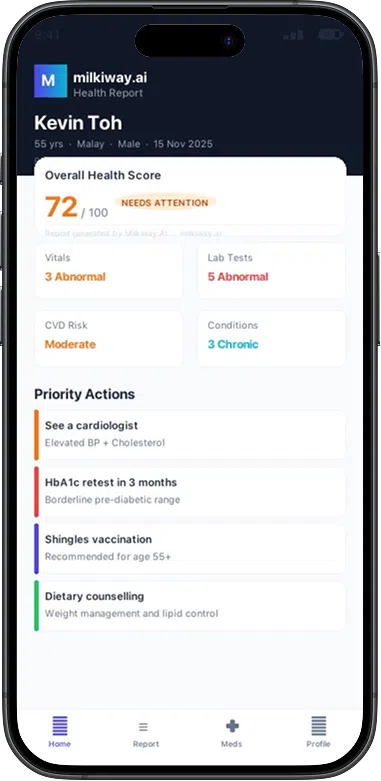
The software offers more than 300 clinically validated and ready-to-use recommendations, accounting for populations across different regions, sexes and ethnicities.
To date, it has been used to screen over 2,000 patients through Singapore-listed healthcare providers in the Republic.
Automation through Clerical reduces report generation and clinical decision-support time to under 10 seconds per case. This represents a time savings of over 99 per cent, allowing healthcare professionals to focus on essential work that involves direct patient care.
Human-in-the-loop validation
While report and insight generation are automated, Clerical acts as an AI co-pilot to healthcare professionals, who ultimately validate and decide on treatment plans for patients.
Recommendations generated are modifiable and auditable, enabling physicians and nurses to review, modify and approve AI-generated interpretations and recommendations before releasing them to patients.
Health professionals, therefore, maintain clinical oversight, mitigating AI hallucination risks and ensuring compliance with local healthcare standards.
In addition to ensuring medical accuracy, physicians and nurses may further tailor the software’s existing recommendations to reflect the cultural practices, dietary requirements and religious considerations of individual patients.
Decoding Asia newsletter: your guide to navigating Asia in a new global order. Sign up here to get Decoding Asia newsletter. Delivered to your inbox. Free.
Copyright SPH Media. All rights reserved.