Asean and Singapore crucial to India, says Modi at Singapore Lecture
He says India will engage with Asean, including S'pore, as his country builds the India of its dreams
Singapore
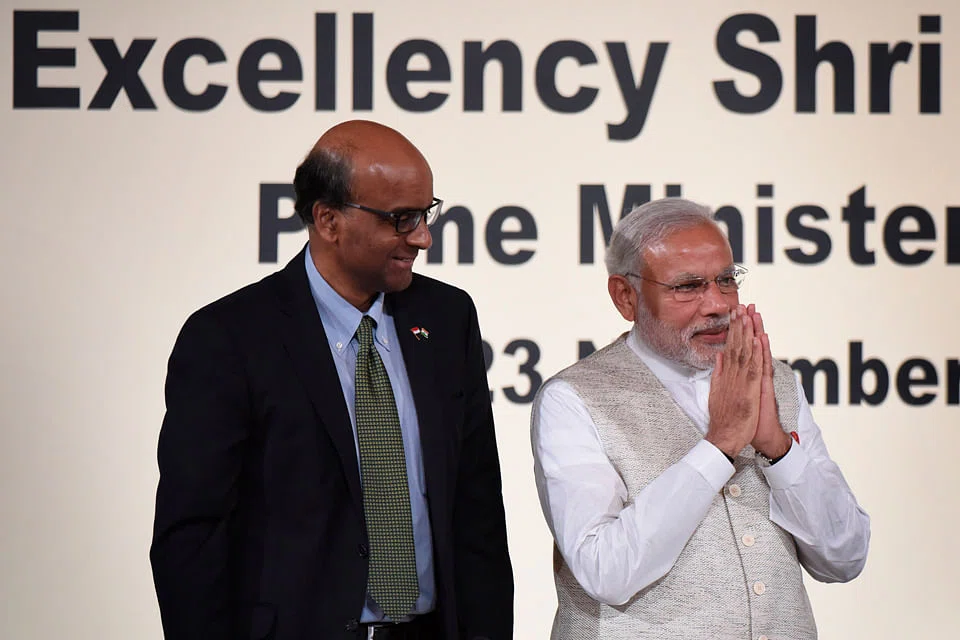
LAYING out a broad roadmap of India's foreign policy, Prime Minister Narendra Modi said on Monday that as his country engages with the Asia under its "Act East" policy, the Asean region in general - and Singapore in particular - will be "at the centre" of this policy, as India is bound to this region by "common policies and shared ties".
The leader of Asia's third-largest economy, in Singapore on a whirlwind two-day tour, was delivering the 37th Singapore Lecture organised by the Iseas-Yusof Ishak Institute.
Giving a broad overview the Act East policy, which he set in motion to build on the earlier "Look East" policy upon coming to power 11/2 years ago, he was fulsome in his praise for Singapore.
Reiterating India's and his own close ties with the Republic, he said few nations in the world can celebrate their first 50 years of existence with the sense of pride and satisfaction that Singapore deserves. He noted that Singapore has taught India (and other nations) many things - that the size of a nation is no barrier to the scale of its achievements, that the lack of resources is no constraint to innovation and inspiration.
Praising Mr Lee Kuan Yew, whose state funeral service he attended in March, Mr Modi said, in the late elder statesman, India had a well-wisher who believed in the country and its potential: "For me, he was a personal inspiration; I drew many lessons from his Singapore story."
He added that he understood from Mr Lee that the "transformation of a nation begins with a change in the way we are".
"It is as important to keep your city and surroundings clean as it is important to build modern infrastructure... The Swacha Bharat (Clean India) campaign is not just a programme to clean our environment; it's to transform the way we think, live and work. Quality, efficiency and productivity are not just technical terms, but also a state of mind and way of life."
He noted that the two countries had been together at "many crossroads of time". When India started liberalising in the early 1990s, Singapore became India's springboard to the world and gateway to the east.
"Today, Singapore is one of our most important partners in the world. It is a relationship that is as strategic as it is wide-ranging. It has comprehensive defence and security relations, it grows out of shared interests and a common region."
Mr Modi named Singapore as both the biggest investment source and investment destination for India, and also the world's most connected nation. "Singapore is the largest trading partner in South-east Asia and popular destination for tourists and students."
Now as we build the India of our dreams, Singapore is a major partner in the enterprise with world-class human resources, smart cities, clean rivers and clean energy, he said.
The Indian Prime Minister noted that as the Asean community leads the way to regional integration, India is looking for closer interaction with it, and that India has frameworks for regional cooperation with almost all the countries in the region.
"We must uphold the rules and norms of shared behaviour. We must build our collective future to build our shared future, not on the strength of a few, but with the aspirations of all," he said.
He added that terrorism is a major challenge, both in terms of recruitment but also in choice of targets. The world must speak in one voice, we must do more, he said.
Mr Modi added: "We must work hard to realise our vision of an Asian century."
Prime Minister Lee Hsien Loong and Foreign Minister Vivian Balakrishnan were at the lecture, along with more than 1,000 diplomats, government officials, representatives from education institutions and delegates from India. The lecture was chaired by Deputy Prime Minister Tharman Shanmugaratnam.