

Govt will follow 'due process' in weighing future of Oxley Road property: Lawrence Wong
Singapore
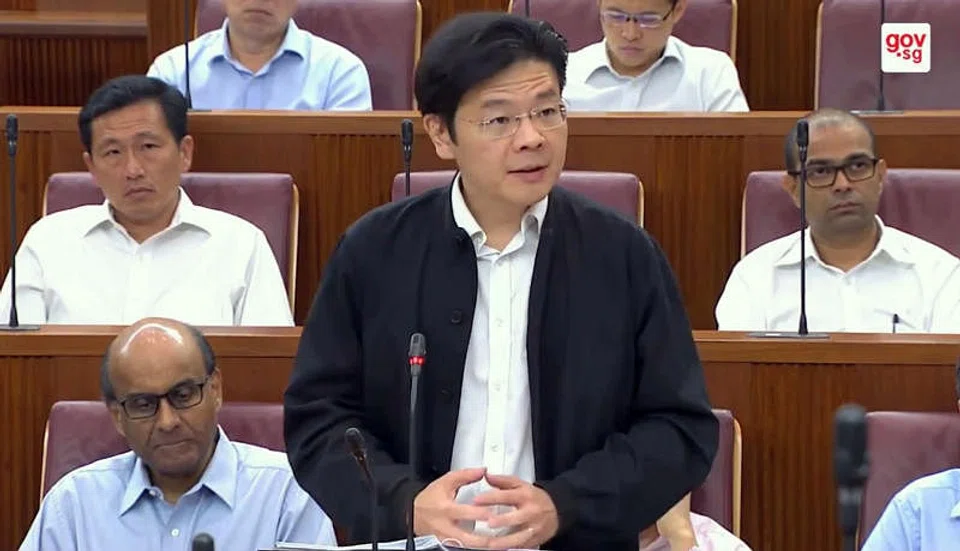
GOVERNMENT agencies follow a "due process" when they assess the architectural or heritage merit of the late Lee Kuan Yew's former home, Minister for National Development Lawrence Wong told Parliament on Monday.
If there is a need, the government will have the final say in the conservation or preservation of 38 Oxley Road, he added.
"The government undertakes a rigorous assessment process for all such properties before deciding whether or not to conserve or preserve them."
Several government agencies had been studying the significance of the Oxley Road property, and this was even before a Ministerial Committee chaired by Deputy Prime Minister (DPM) Teo Chee Hean was set up to discuss future options for the house.
The government's due process entails studies into the historical, cultural, social and religious significance of a property of interest, its national importance, architectural merits and rarity.
Next, agencies consider the planning considerations for the property and its surroundings. This includes looking into technical regulatory requirements that may affect the form of preservation or conservation proposed for the property; agencies also review the allowable uses of the site.
Arising from the planning studies, agencies may also review the need for the government to acquire the property for conservation or preservation, said Mr Wong.
Armed with such "important baseline information", the government then considers the next step for all such properties. At this stage, it also seeks views from relevant stakeholders. If the government decides to conserve or preserve a property, its owner will be given the opportunity to respond.
"But the final decision for conservation or preservation lies with the government," said Mr Wong. "We should follow this due process for all properties with architectural or heritage merit, including 38 Oxley Road."
He also told Parliament of the predicament that the National Heritage Board (NHB) found itself amid the ongoing dispute between Prime Minister Lee Hsien Loong and his younger siblings over the future of the house.
The agency's predicament arose out of a signed agreement, called a deed of gift, comprising artefacts from 38 Oxley Road. The items were to have been included in an exhibition on Singapore's founding fathers.
In his statement, Mr Wong sought to refute allegations of abuse of power made over the past few weeks by PM Lee's younger siblings over the deed of gift.
The deed, signed on June 8, 2015, allowed PM Lee's brother Lee Hsien Yang and sister Lee Wei Ling, the executors of the late Mr Lee's estate, to donate the artefacts to the NHB for the exhibition, called "We Built A Nation".
Mr Lee Hsien Yang had alleged that PM Lee, in obtaining a copy of the deed, had overstepped in his capacity as prime minister into what was a private family dispute.
Mr Wong, then minister of Culture, Community and Youth overseeing NHB's operations, told Parliament on Monday: "NHB was caught in a difficult position. It had signed the deed and accepted the gifts. But it wasn't clear if the executors were properly empowered to enter into the deed without first consulting all beneficiaries."
PM Lee had stated, in his address to the Parliament before Mr Wong's, that although he saw the deed as Prime Minister, he had every right to ask his family members how the deed came about. "It is nonsensical to say that because I saw the Deed in my official capacity, I could not raise the matter with a family member," he said.
"If I come across anyone doing something wrong - even family, maybe especially family - it is my duty to put a stop to it and set them right if I can."
Mr Wong told Parliament that the deed, the terms of which were insisted upon by the younger Lee siblings, was not based on NHB's standard agreement.
Firstly, the siblings reserved the right to buy back the artefacts at S$1 so long as Lee Kuan Yew's house at 38 Oxley Road was not demolished.
Secondly, they wanted to display in the exhibition only the first part of the clause in the late Mr Lee's will about demolishing the house. They did not demand that the second part, which sets out Mr Lee's wish for the house should it not be demolished, to go on show as well.
This was a main concern for Deputy Prime Minister Teo Chee Hean, who was asked by PM Lee to handle matters relating to the deed.
Mr Wong said that DPM Teo believed that NHB, as a public institution, "should remain neutral, and should not be drawn into a private disagreement, or be used to present a particular point of view which was incomplete".
The manner in which the deed was finalised was also peculiar, noted Mr Wong. Lee Suet Fern, Mr Lee Hsien Yang's wife and also a director on the NHB board, was involved in the discussions between NHB and the executors; her law firm also helped in the process of finalising the deed.
But keeping in mind the artefacts' significance, and the need to conserve the items, NHB signed the deed on June 8.
Mr Wong then shared with PM Lee a copy of the deed on June 12, some days after PM Lee's then-lawyer Lucien Wong wrote to the siblings to demand to see a copy of the deed.
Mr Wong said PM Lee felt the terms of the deed were onerous to NHB.
And, as a beneficiary of the estate, PM Lee's consent had not been sought for the donation.
But after weighing all the factors, and considering that NHB had already signed the deed, DPM Teo and Mr Wong agreed that having the artefacts exhibited outweighed any potential controversy that was likely to arise.
Later on June 25, Mr Wong was notified by PM Lee that he had written, in his private capacity, to the executors that, notwithstanding his position on the deed of gift, he would not object to the exhibition. This gave NHB the green light for the exhibition to go ahead, but as NHB needed more time to prepare, it sought the executors' consent to push back the opening date of the exhibition.
Originally planned to open on Aug 6, 2015, "We Built A Nation" opened seven weeks later on Sept 21.
Key points by Mr Wong
READ MORE:






