

Greece won't bow to 'politics of submission'
New PM wants "viable, mutually beneficial solution" with creditors, even as he halts privatisation of main port
Athens
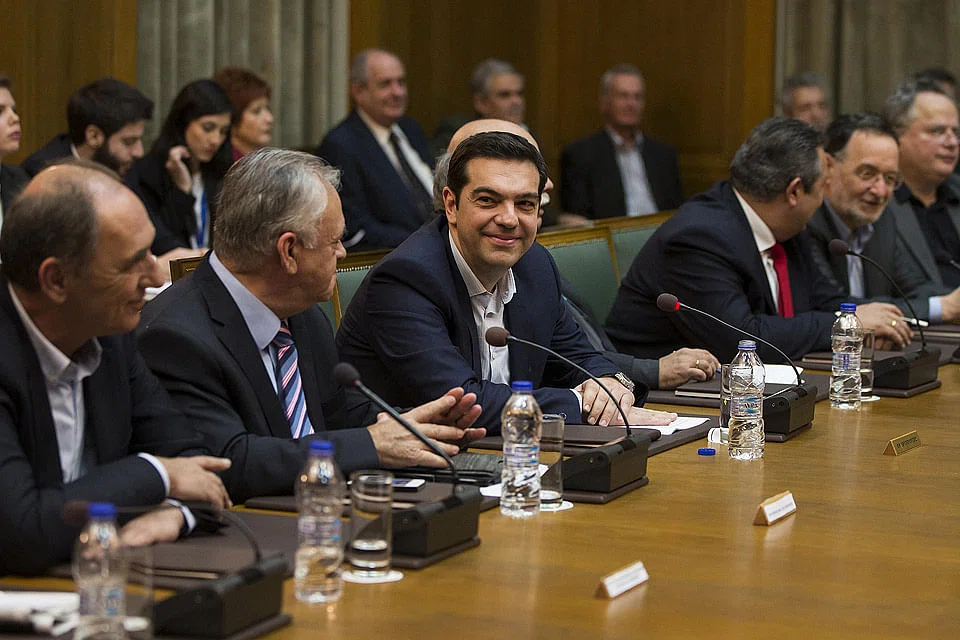
GREECE'S radical new Prime Minister Alexis Tsipras warned on Wednesday that it would no longer blindly submit to the EU and demanded a "fair" deal with its creditors.
Mr Tsipras said that he wanted a "viable, mutually beneficial solution" to the "humanitarian disaster" that he claimed his country has suffered as a result of the austerity imposed by it creditors.
In a speech to the Cabinet - his first since taking office - the 40-year-old premier insisted that Greece's new leaders were no longer willing to bow to the "politics of submission", in a clear swipe at Brussels and the International Monetary Fund.
"Our people are suffering and demand respect . . . we must bleed to defend their dignity," Mr Tsipras said.
But the new government's radical anti-austerity agenda has alarmed financial markets, reviving fears that Greece could crash out of the eurozone.
Greek stocks fell 6 per cent in midday trade - after losing 3 per cent the previous day - and yields on 10-year bonds also rose above the symbolic barrier of 10 per cent.
And in another move that spooked markets, the government halted the privatisation of Greece's main port, Piraeus, which Chinese shipping giant Cosco had planned to turn into its new European hub.
After his Syriza party stormed to power on Sunday, Mr Tsipras forged a coalition with the nationalist Independent Greeks (ANEL), who are equally opposed to the fiscal cuts imposed over the past five years in return for bailout loans. In a sign that the new government will take a hard line in haggling over the US$269 billion EU-IMF package, Mr Tsipras named left-wing economist Yanis Varoufakis as finance minister.
A fierce critic of the conditions imposed by creditors, Mr Varoufakis argues the country's shattered economy will never recover until they are relaxed.
The new ruling coalition - who together have 162 seats in the 300-member parliament - must address an end-of-February deadline set by the EU for Greece to carry out more reforms in return for a seven-billion-euro (S$10.75 billion) tranche of financial aid from the bloc and the IMF.
Mr Tsipras, who has vowed to reverse many of the severe spending cuts and other measures that Greece's creditors insist on, must soon decide whether to delay the deadline.
Greece's European partners have been quick to stymie the prospect of debt forgiveness, with German Chancellor Angela Merkel's spokesman saying that Greek membership of the eurozone "means . . . sticking to its previous commitments". However the EU's governing body indicated on Wednesday that it was willing to show flexibility with the new Greek leaders to keep the debt-stricken nation in the eurozone.
The European Commissioner for Economic and Financial Affairs, France's Pierre Moscovici, said that he ruled out any "break" between the European Commission and the new Greek administration, the French daily Le Parisien reported on Wednesday.
The Commission and the European Union are willing to seek "less intrusive, more flexible forms of cooperation" with Athens, the paper quoted him as saying.
"What we all want is that Greece recovers, creating growth and jobs, that it reduces inequality, that it can deal with the problem of its debt and remains in the euro area," he said.
The head of the eurozone finance ministers, Jeroen Dijsselbloem, will visit Athens on Friday "to get to know" Greece's new leaders, his spokeswoman said.
But in a newspaper interview on Wednesday, a member of Germany's Bundesbank central bank warned Athens of "fatal consequences" if it rejected the bailout terms.
"If the continuation of the programme of aid for Greece is called into question . . . Greek banks would lose access to central bank funds," Joachim Nagel told the German business daily Handelsblatt. "It would have fatal consequences for the Greek financial system."
Mr Tsipras' Syriza party wants to spend 1.2 billion euros to immediately increase the minimum wage and pensions for the poorest.
However, the IMF extended an olive branch to the new government, saying that it was prepared to continue its support to the country.
Greece's economy is set to emerge from recession after shrinking by a quarter in five years, a slump that has left one in four out of work.
Many Greeks say that even if Mr Tsipras can deliver on a fraction of what he has promised, their lives will improve. AFP
TRENDING NOW

Grab CEO’s wife Chloe Tong on life with Anthony Tan and finding her purpose
Stocks to watch: DBS, DFI Retail, Frasers Property, Clint, ESR-Reit, Centurion, Coliwoo
DFI Retail to bag US$340 million, Starbucks business in Asia in deal with Maxim’s Caterers
Green fuels, autonomous ships: How Singapore is future-proofing its shipping industry

