

Europe markets continue to rise as Greek banks re-open
London
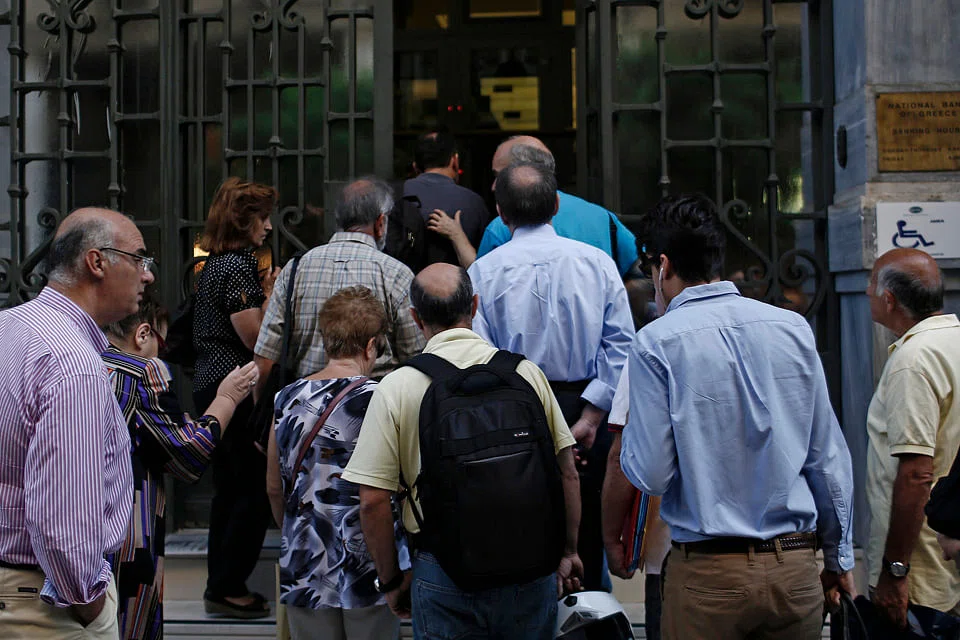
EUROPEAN stock markets continued their upward path on Monday after the European Central Bank's (ECB) 900 million euro (S$1.34 billion) loan enabled Greek banks to open.
Meanwhile, the country's Syriza coalition government repaid 6.25 billion euros owed to the ECB and the International Monetary Fund, using the seven billion euro loan granted last week by the EU.
Since their pre-deal lows, share indices in Spain and France are up by 12 per cent, in Germany by 6.4 per cent and in Italy by 4.9 per cent. Greek 10-year bond yield fell to 10.8 per cent from a peak of almost 12 per cent and Spanish and Italian 10-year yields are currently 1.93 per cent. Despite the sizeable relief rally, analysts say there is a long way to go as Greece must meet negotiation terms for the 86 billion euro bailout and since there is a lot of opposition in the country and speculation that there will be an election in October.
Capital controls remain and the terms of cash withdrawals change from 60 euros a day to 420 euros a week, that is identical payouts over a week but with less queuing. Wire transfers abroad will still be forbidden. Businesses will now be able to deposit cheques and an estimated 200,000 Greeks can have access to their safety deposit boxes again.
Tourists and other foreigners in Greece can continue to withdraw as much cash as their debit card limits allow.
German Chancellor Angela Merkel said on Sunday the capital controls, expected to last for several months, were "not a normal life" and that negotiations should begin on a new bailout, expected to be worth up to 86 billion euros.
She ruled out a classic debt reduction, known as a "haircut", but said that other ways could be found to reduce the burden once Greece had finalised its third bailout.
"A classic 'haircut' of 30, 40 per cent of debt cannot happen in a currency union," Mrs Merkel told ARD German television. "The only option is to go down a common path with Greece."
The bad news is that prices of goods within Greece surged as a value-added tax levied on a wide range of products and foodstuffs jumped from 13 per cent to 23 per cent.
These included processed meat products, minced beef and other basic products. These increases are taking place. Moreover, tourist hotel and restaurant bills have risen by 8 per cent and this increase plus worries about strikes and possible riots are forecast to damage a key export industry, already in decline.
Syriza also has to deliver on promised privatisation, including a potential sale of Greece's regional airports. The party has agreed to the creation of a new privatisation fund under external supervision, but details are required on the running of the fund. A sizeable number of Syriza lawmakers oppose privatisation.
According to Trading Economics, Greece's debt to GDP (gross domestic product) in April was 177 per cent, and real growth 0.2 per cent after six-year shrinkage of 25 per cent. Economists estimate a further deterioration, especially during the three weeks that banks were closed.
The Athens Chamber of Commerce's 275,000 businesses have closed over the past five years, reducing the number to 675,000. In April, unemployment was 25.6 per cent, youth unemployment 53.2 per cent and inflation negative 2.2 per cent.
The chamber estimates that more than 200,000 skilled Greeks, many of them graduates, have left since 2010, mainly for Germany, the UK and Scandinavia. According to some unconfirmed anecdotal reports, as many as 35,000 doctors have left.
Most analysts believe that a general election is likely in September or October.
An eventual Greek exit from the eurozone continues to be a very possible scenario of several investment banks, especially if implementation of the latest austerity measures proves to follow the dismal failures of the past five years.
Read more on the Greek crisis here
TRENDING NOW

S$7 billion wiped off OCBC value as shares slide 5.2% in heavy trade

Grab CEO’s wife Chloe Tong on life with Anthony Tan and finding her purpose
Brookfield denies accusation it cut Soilbuild out of Mapletree deal
8 public officers referred to police over property buys near unannounced MRT stations: Chan Chun Sing

