New Indonesia ministers face host of challenges
Worries persist they're unable to overhaul departments, let alone steer a national policy
Jakarta
THE new Cabinet of Indonesian President Joko Widodo is drawing mixed reviews amid worries the slate of names may be ill-equipped to address the country's slowing economy or the woeful state of its infrastructure and services.
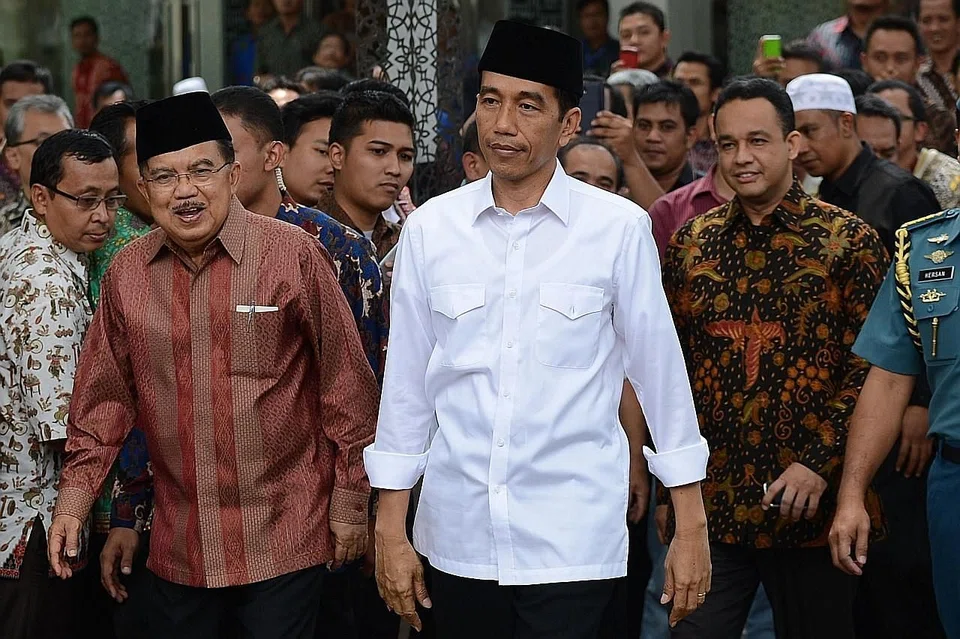
Mr Joko's 34-member "working Cabinet" was inaugurated on Monday after repeated delays amid criticism that he failed to live up to promises to deliver an administration free of patronage politics.
Instead, some of the country's most powerful ministries were doled out according to party loyalties, underscoring for many the limits of Mr Joko's authority in his own party - the Indonesian Democratic Party - Struggle.
"This is the best he can do," said Philips Vermonte, head of the department of politics and international relations at the Centre for Strategic and International Studies in Jakarta. "He's accepted he's not the strong man in the party."
If anyone is the strong man in the party, it seems to be its chairwoman Megawati Sukarnoputri, the daughter of independence leader Sukarno and one-time president herself. The country's most powerful ministries including home affairs, defence and state-owned enterprises were given to her loyalists.
Last month, Mr Joko promised to more or less evenly split posts between professional politicians and technocrats. The line-up that was unveiled on Sunday at the presidential palace was heavily in favour of party affiliates: 21 in all, according to analysts.
But the line-up contained what some saw as inspired choices as Mr Joko searched far beyond Jakarta for fresh talent who can address some of the country's biggest headaches.
In the coming weeks, Mr Joko is expected to boost investment in infrastructure and services for the poor and pay for it by hiking the price of subsidised fuel, which gobbles up about a fifth of government spending.
Mr Vermonte says the odd mix of party hacks and virtual unknowns may reflect a deal struck with Ms Megawati in which he gave up a few key ministries to cast the net wide for several smaller portfolios.
"Jokowi is trying to find new talent in the hope of finding people who aren't tainted (by corruption)," Mr Vermonte said.
One example? Susi Pudjiastuti. Ms Pudjiastuti got her start in life selling fish at auction in West Java with little more than a middle-school education. She eventually expanded her business to become an exporter of fish products and to operate a small airline.
Ms Pudjiastuti becomes the minister of the country's new coordinating ministry for maritime affairs at a time when the creaking port system is driving up the cost of logistics in this sprawling archipelago. Shipping executives routinely observe that it can cost more to ship a container domestically than it does from Jakarta to Amsterdam.
Incoming trade minister Rachmat Gobel is the chairman of the Gobel Group of companies, whose holdings include a joint venture with Japan's Panasonic. The pick may bode well for the country's efforts to lift exports of manufactured goods and rely less on commodities.
The new transport minister, Ignasius Jonan, hails from the state-owned rail company PT Kereta Api, where, over five years at the helm, he boosted the company's safety record and service while turning in a profit.
The country's new foreign minister is Retno Marsudi, who is the country's first woman in the job. Eight women in all hold portfolios - a record.
"People are wondering who are these people? They don't register on the list of cocktail parties," said Kevin Evans, a long-time analyst of Indonesian political affairs in Jakarta. "They're self-made. They have no political baggage."
But worries persist that in the search for the new and the untarnished, Mr Joko has opted for lightweights unable to overhaul departments, let alone steer a national policy.
Bambang Brodjonegoro, the incoming finance minister, is an ineffective technocrat and may lack the stomach to crack heads in Cabinet, some analysts say. Mr Gobel is a successful industrialist but he will face the challenging task of unwinding five years of nationalistic trade policy such as the mineral ore export ban, a challenge that may not agree with his skill set.
In defending his choices of ministers, Mr Joko explained at a press conference that people will learn their jobs, using his own metamorphosis from furniture salesman to president as an example. Analysts seem to be content to wait and see how the political neophytes fare after years of drift under outgoing president Susilo Bambang Yudhoyono.
While some of the unknowns may face a steep learning curve, Mr Joko's election is proof of the appetite for change, said Mr Evans. "The bigger risk would have been business as usual."