

Restructuring yoke to weigh on Singapore this year: DBS CEO
2015 is a crucial year, but he believes the US economy can power Asia's export engines
Singapore
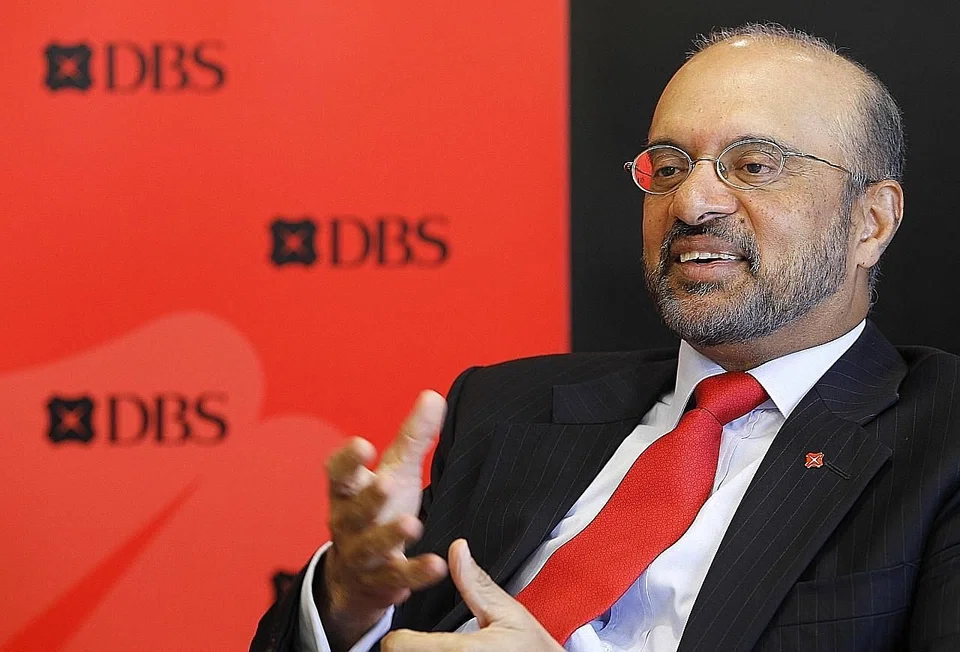
SINGAPORE'S efforts to restructure its economy will become even more critical this year, amid concerns over easing inflation and the weakening of economic prospects here and abroad, the chief executive of DBS Piyush Gupta suggested on Wednesday.
Speaking to private-banking clients at a seminar, he said: "2015 is a very, very important year for our country. It's important because this whole scope of transitioning the economy and restructuring the economy is very sensitively poised."
He pointed to two "deflationary drives" in Singapore - the push to raise productivity, particularly in manufacturing, and the cooling measures for the property market.
"To be able to do that (restructure the economy) and, at the same time, make sure that the rest of the economy doesn't tumble, is not going to be easy," said Mr Gupta, who added that he believed Singapore's property price correction to be just about "halfway done".
Referring to DBS' dialogues with small and medium-sized enterprises (SMEs) among its clients, he said: "It is quite clear that in some sectors, people are struggling, and so you run the risk of hollowing out if you don't get this thing right."
Mr Gupta noted, though, that Asia's export engines can be powered by the continued strength in the US economy. "The fundamentals are really not that bleak. There is some degree of resilience that I see in the global economy," he said.
If, and where, there is weak demand, companies would have to absorb higher wage costs, rather than pass them on to consumers by raising prices of their goods and services.
Singapore's headline inflation was negative in November. Economists dismissed it as a technical deflation, but the numbers translated to five consecutive months of disinflation - or a deceleration in price gains. Part of this was caused by lower accommodation costs, reflecting the soft housing rental market brought on by regulations to cool property prices.
Worries over deflation will surface as debt in real terms rises. Consumers may then postpone spending in hope that prices would fall further.
Advance estimates for Singapore's Gross Domestic Product last year came in at 2.8 per cent, in the lower half of the government's forecast range. This was much weaker than the 3.9 per cent growth in 2013. Meanwhile, Singapore's level of productivity shrank 0.5 per cent in the first three quarters of 2014.
When these factors are taken together, the odds of an easing in monetary policy in Singapore have gone up. This comes as global economies such as that of the eurozone, Japan and China, also seek to fend off deflationary or disinflationary pressures by loosening the supply of money, DBS Group's wealth management and private bank chief investment officer Lim Say Boon, who also spoke at the seminar, said.
Against this backdrop, DBS is remaining overweight on equities in general, said Mr Lim, who named China as the bank's "preferred monetary easing play in Asia".
While the US market has been the strongest among the global markets since 2009, its run may not be over, said Mr Lim, who expects the Fed to raise rates only in the second half of this year - and at a gradual pace.
Quantitative easing played a part in boosting equity prices as it suppressed the yields of assets, but corporate America has also delivered strong earnings, he said.
He was less sanguine about European equities in the short term, saying that European businesses have not shown the same earnings strength as US companies have.
He urged caution over high-yield corporate bonds, as risks over defaults could rise.
Mr Gupta also flagged the Chinese high-yield bond market, noting that corporate bankruptcies - which he had expected earlier last year - were beginning to come through. "In China, you have to be very, very, thoughtful about counterparty selection."
TRENDING NOW

Far East Organization’s The Serra Residences sells less than a quarter of units released at average S$3,460 psf

Philippine power giant First Gen rebuffs foreign offers, plans up to US$2.6 billion in expansion

Once staunchly pro-China, Malaysian Chinese businesses are now distancing themselves from Beijing

Is stagflation returning? That mostly depends on the Iran war

