

Singapore looks into common QR code for cashless payments
MAS says industry taskforce may, by year's end, be ready to implement universally-accepted code for fast, easy payments with smartphones

Angela Tan
Singapore
BY the end of this year, Singapore may have a common quick-response (QR) code through which users can make payments by just scanning those squiggly squares with their smartphones.
A successor to the vertical bar code, a common QR code promises to bring Singapore closer to its dream of becoming a Smart Nation - one where cashless payments are embraced by both young and old.
On Tuesday, the Monetary Authority of Singapore (MAS) said that an industry taskforce it co-leads with the Info-communications Media Development Authority (IMDA) will look into developing the common QR code for Singapore (SGQR), which comes with standardised specifications to accept both domestic and international payment schemes.
The taskforce also involves the Housing Development Board (HDB), National Environment Agency (NEA), Spring Singapore, as well payment providers like Alipay Singapore E-Commerce, Nets and EZ-Link. Non-government partners include Singtel, UnionPay International as well as financial institutions like DBS Bank, OCBC Bank, United Overseas Bank, Mastercard and Visa.
The taskforce will look into the governance structure and implementation strategy for QR payments.
MAS said establishing interoperable electronic payments and developing a common QR code for Singapore were two key topics that the Payments Council discussed at its inaugural meeting on Aug 11.
The rollout of a common QR code was announced by the Smart Nation and Digital Government Office (SNDGO) on Aug 20. E-payments was listed as one of five strategic national projects the government is undertaking to transform Singapore into a Smart Nation.
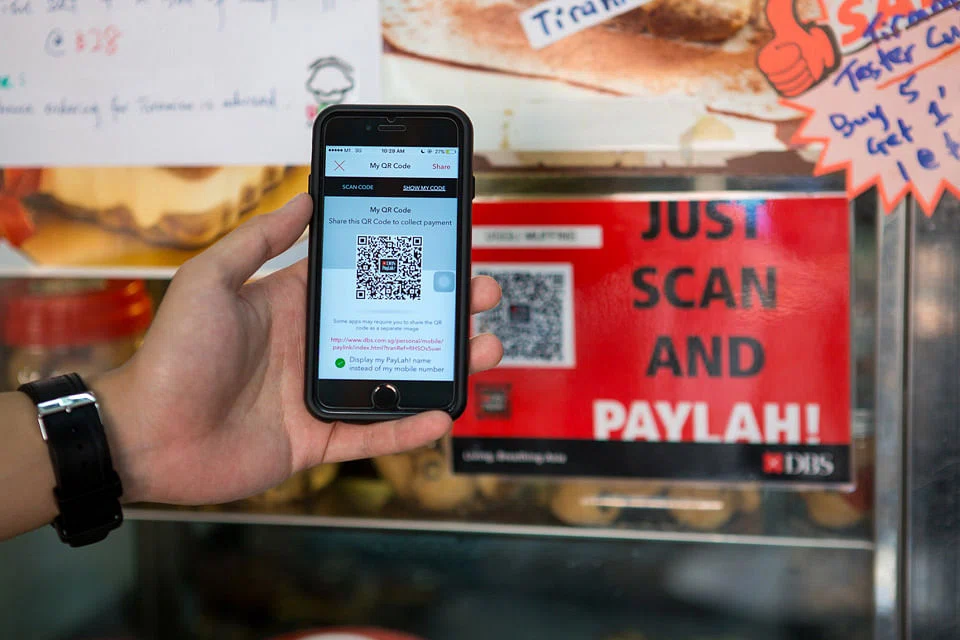
The use of e-payments is growing in Singapore. For example, since the government-linked DBS Bank introduced QR code payments in April and launched its partnership with ComfortDelGro taxis to encourage commuters to pay via QR codes, the bank has had more than 15,000 QR code transactions per month via DBS PayLah!.
But with the variety of e-payment solutions available, interoperability has become an issue as the systems do not "talk" to one another.
Pranav Seth, who heads the E-Business, Business Transformation and Fintech and Innovation Group at OCBC Bank, said: "Diverging standards, leading to multiple QR codes at points of sale, lead to confusion for both consumers and merchants on what payment instruments to use, and how to use them. This slows down the pace of cashless adoption and the displacement of cash."
The Council noted that debit and credit card schemes work well for large merchants and retailers, but that these solutions are often not feasible for smaller merchants, who prefer an infrastructure-light and cheaper solution. For them, a QR code-based payment system is a practical and convenient alternative.
MAS said: "It would help make payment transactions simple, swift, seamless and safe for everyone."
Mr Seth agreed. In fact, he believes the early-adoption stage is an opportune time for Singapore to standardise the industry as a whole and avoid confusion.
"In addition, we believe that for Singapore to go truly cashless, we need to avoid fragmentation by closed-loop systems. In a closed loop system, the merchant and customer need to be on a single bank or organisation to facilitate the payment.
"We prefer open, nationwide infrastructures that have universal acceptance across Singapore, and on which multiple bank users can ride together.
"Hence, for our customer-to-merchant payment app, OCBC Pay Anyone, we are working with Nets and other international schemes to provide universal acceptance."
Ravi Menon, who chairs the Payments council and is managing director of MAS, said that, at the end of the day, the goal is "to make the payments experience efficient for businesses and delightful for everyone, including the young and elderly".
READ MORE: E-payments use in S'pore only scratching surface: PayPal
TRENDING NOW

Government to bring forward raising of retirement age, give employers more financial support to create flexi-load jobs
If Europe goes to war, the fallout will be felt in East Asia
Former minister Maliki Osman, Revolut chairman join Asia Gulf Holdings advisory board

Small nuclear reactors could boost the Asean Power Grid: GE Vernova executive

