US charities fear big drop in donations from middle classes
Washington
MANY US charities are worried that the tax overhaul bill signed by US President Donald Trump last Friday could spur a landmark shift in philanthropy, speeding along the decline of middle-class donors and transforming charitable gift-giving into a pursuit largely left to the wealthy.
The source of concern is how the tax bill is expected to sharply reduce the number of taxpayers who qualify for the charitable tax deduction - a big driver of gifts to nonprofits. One study predicts that donations will fall by at least US$13 billion, about 4.5 per cent, next year. That decline is expected to be concentrated among gifts from the middle of the income scale. The richest Americans will mostly keep their ability to take the tax break.
That could create new winners and losers in philanthropy. Nonprofits have long noticed that the wealthy are more likely to cut big cheques to support museums and universities, while smaller donors tend to give to social service agencies and religious organisations. Charities fear that this shift could change how the public views donating and alter the priorities of nonprofits.
"The tax code is now poised to de-incentivise the heart of civic action in America," said Dan Cardinali, president of Independent Sector, a public-policy group for charities, foundations and corporate giving programs. "It's deeply disturbing."
The tax bill's treatment of charities led the Salvation Army to express serious concerns, and it is why United Way opposed the legislation, as did the US Conference of Catholic Bishops.
Mr Cardinali's group turned its home page - normally a place for a feel-good story - into a call to protest, with the banner headline: "KILL THE TAX REFORM BILL."
At the United Way, there is widespread concern because middle-class donors are the charity's "bread and butter", said Steve Taylor, vice-president for public policy at United Way Worldwide.
The charity's average annual gift is US$379, mostly from people who pledge during workplace campaigns to have US$5 to US$10 a week deducted from their pay cheques.
United Way has big donors, too, who drive up that average, such as the nearly 30,000 people who give US$10,000 a year. They are known as Tocqueville donors, named for the French writer who in the 1830s remarked on the American affinity for forming private groups to address public needs.
Mr Taylor worries that the tax bill will force United Way to change whom it targets for fundraising. "We don't have any choice but to look to those higher-end donors more. We have to," he said. "But it's not really what we want to do, and it's not really healthy for the charitable sector in America."
No one expects the middle class to stop giving to charity. But the tax code changes are projected to affect the size and timing of those gifts, said Una Osili, economics professor at the Indiana University Lilly Family School of Philanthropy. But no one knows how the changes will play out. "We really haven't had a significant change like the one we're describing now," she said.
A higher percentage of Americans give to charity than vote. Last year, gifts from individuals made up nearly three-quarters of the US$390 billion donated to philanthropies, outpacing the money flowing from foundations, bequests and corporations. And the tax code has encouraged these gifts since the charitable deduction was created in 1917.
The average charitable deduction has hovered around US$4,400 in the past few years, according to Internal Revenue Service data. The deduction allows taxpayers to avoid paying federal income tax on the donation if they itemise their taxes.
But the number of people who qualify for the charitable deduction is projected to plummet next year from about 30 per cent of tax filers to as low as 5 per cent. That is because the new tax bill nearly doubles the standard deduction and limits the value of other deductions, such as for state and local taxes. The biggest change is expected to be among households earning US$75,000 to US$200,000 a year - a bracket in which more than half of filers itemised their taxes under the old code.
Over two days last summer, several leaders from the philanthropic world, including Mr Cardinali, pleaded their case to Representative Kevin Brady, the main tax bill writer in the House. They also were fighting to preserve the Johnson Amendment, which bars nonprofits from endorsing political candidates.
In Mr Brady's office, the nonprofits pushed to make donations a universal deduction available to anyone, regardless of whether they itemise their taxes. This would have been a major expansion, but also the only way to preserve the deduction's power. Mr Brady sounded sympathetic but argued that people would soon have more money to donate because of the economic growth driven by the bill's tax cuts, Mr Cardinali recalled. A House Ways and Means Committee staffer agreed with that account.
The universal charitable deduction also died in the Senate, where Senator James Lankford proposed it. Mr Lankford said that he was disappointed but that the projected price tag was too high for a bill filled with tax cuts. "You couldn't get enough senators to buy in," he added.
The Republican tax changes come at a time when charities are already worried about the fate of small donors. "That's a trend that has mirrored wealth inequality - the skewing of giving towards fewer but larger donations," said Benjamin Soskis, research associate at the Center on Nonprofits and Philanthropy.
The new tax code further reduces the privileged status of charitable gifts, treating them the same as purchases from Walmart for the vast majority of taxpayers.
"The government has always seen fit to reward the goodness of Americans with a tax incentive," said Ron Busroe, development secretary at the Salvation Army. "Now, that's being taken away."
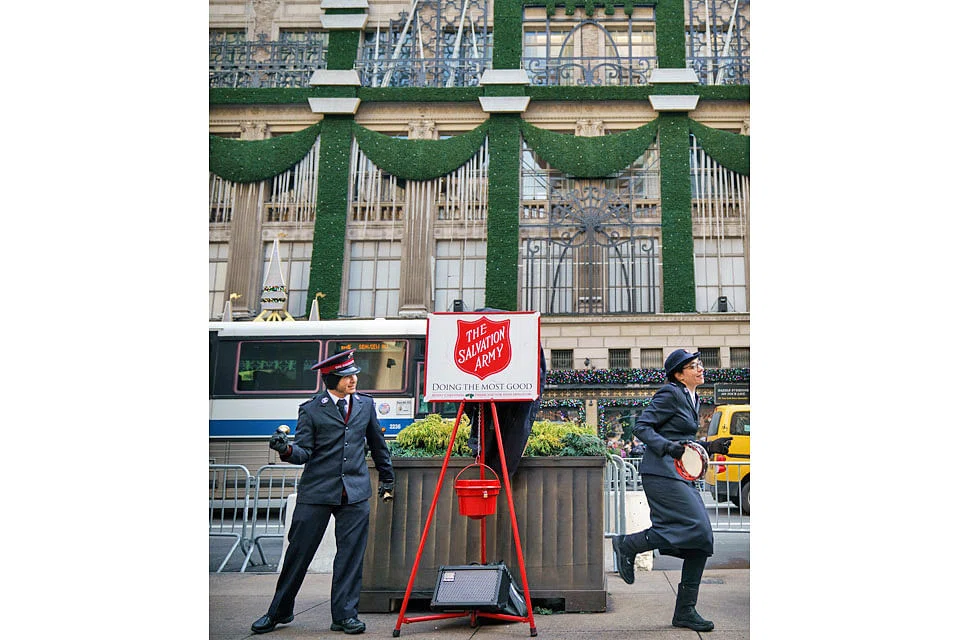
The Salvation Army relies on both ends of the wealth spectrum for donations. In 2004, the organisation received a US$1.5 billion bequest from the estate of Joan Kroc, the billionaire widow of McDonald's owner Ray Kroc. But the group also has 23,000 red kettles set up across the country with bell ringers asking for spare change during the holidays. Those bring in about US$150 million each year.
Now, the charity is facing "a significant shift", Lt Col Busroe said. He expects a surge in online donations in the dwindling days of 2017 as people race to make gifts while they can still claim the deduction. The Salvation Army typically raises more in the last two days of the year than in all of November. "We don't anticipate seeing that at the end of 2018," he added.
The traditional surge in December donations - dwarfing all other months - "tells you everything you need to know" about whether the tax code affects charitable gifts, said Mike Geiger, president of the Association of Fundraising Professionals. WP