Deepening bilateral ties
VINCENT WEE speaks to German Ambassador Michael Witter about how German-Singapore relations have developed over the years
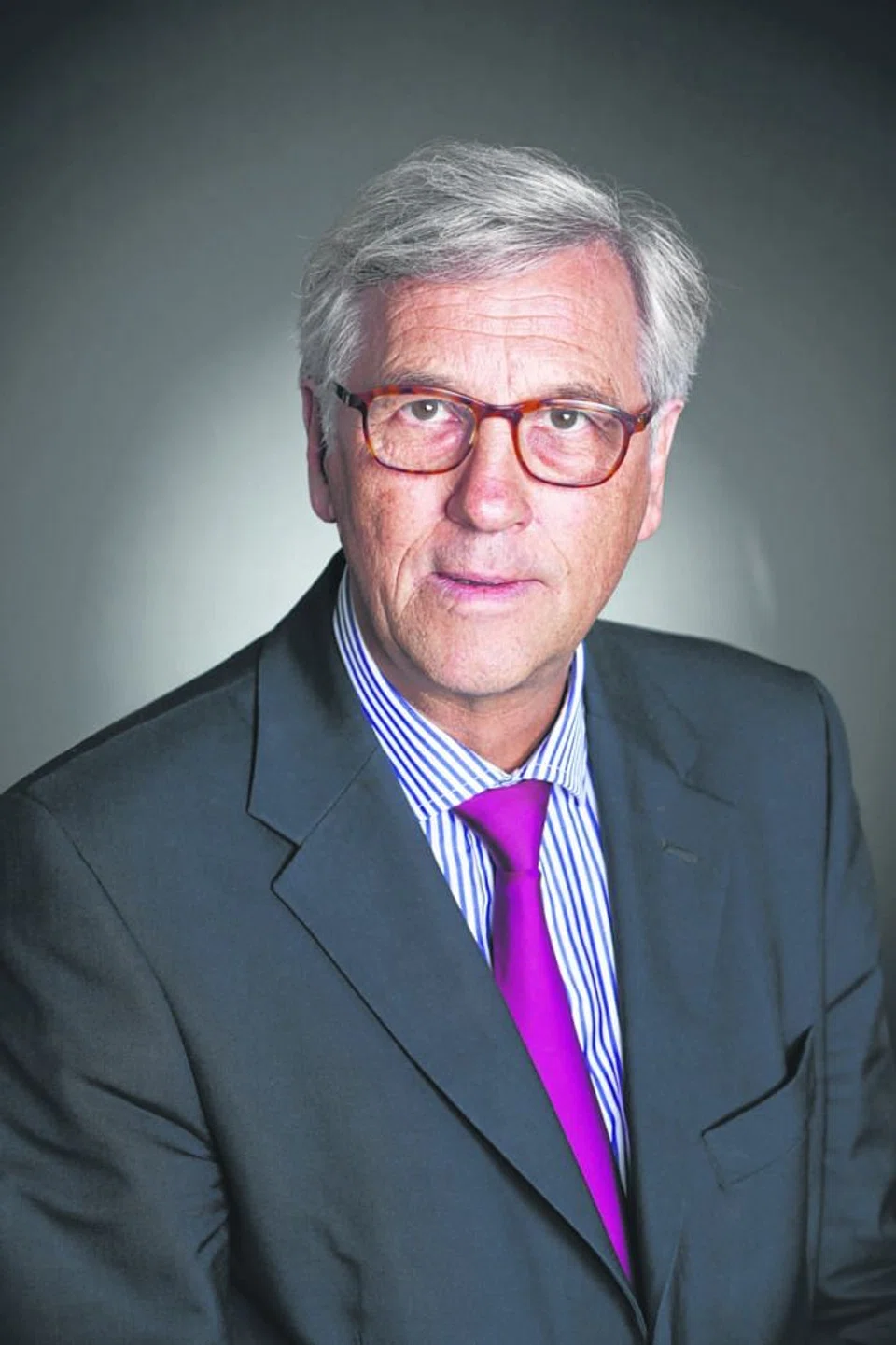
BT: Singapore and Germany have enjoyed good bilateral relations for many years. Can you summarise these relations and your view on them?
Dr Witter: Over the decades, Singapore-German relations have included vivid exchanges in the political, economic, cultural and, more recently, scientific spheres.
We have had many meetings of the respective heads of state and government as well as at the ministerial level. President Tony Tan Keng Yam visited Germany for the second time a few weeks ago in the context of the Annual Lindau Nobel Prize Winners Meeting at Lake Constance, where he also met Chancellor Angela Merkel again. Federal Foreign Minister Frank-Walter Steinmeier visited Singapore in 2008, accompanied by a large business delegation.
Prime Minister Lee Hsien Loong was the first foreign visitor that Chancellor Angela Merkel received in Berlin after taking office in 2005, and they met again in Singapore in 2011 and at The Hague last March.
Singapore's first prime minister Lee Kuan Yew and former chancellor Helmut Schmidt had already met in 1978 and have maintained their friendship since.
We are looking forward very much to next year's 50th anniversary of our diplomatic relations, which we will celebrate less than three months after Singapore's 50th birthday as a sovereign state. Germany recognised Singapore's potential already back in 1965!
BT: Trade and economic relations play an important role in bilateral ties with Singapore being Germany's key economic partner in Asean. How important is this and in what ways and how do you see this relationship developing going forward, especially as the FTA (free trade agreement) comes into force?
Dr Witter: Singapore is by far the number one hub for German companies in South-east Asia. More than 1,400 of them operate here. This figure increases annually by almost 100. Most of them do business not only with the city-state, but also with the Asean region and beyond. This particularly applies to small and medium-sized enterprises. They enjoy the rule of law and profit from Singapore's strategic location and infrastructure. The Singaporean-German Chamber of Commerce, which celebrates its 10th anniversary this year, effectively supports their efforts.
The German Centre hosts more than 140 of them. Back in 1995, it was the first of its kind worldwide. It is thus no surprise that Singapore is Germany's largest trading partner in Asean, and vice versa Germany is Singapore's largest trading partner in the European Union (EU).
With the entry into force of the EU-Singapore Free Trade Agreement, trade relations will become even more intense, in particular in the services sector. As for trade in goods, while most European products already enjoy zero tariffs here, Singapore companies will profit even more over the next five years when tariffs for the remaining product lines will be eliminated.
BT: Singapore is also a key partner for Germany in the Asian region in terms of foreign policy goals, where the two countries share wide agreement on many issues. How do you see this going forward and what are some key highlights of this element of the relationship?
Dr Witter: Germany appreciates Singapore's first-hand political and economic insights in Asia and in particular in Asean, as one of its founding members and an advocate of intensified regional cooperation. Vice versa, we are ready to share with Singapore our German experience within the EU, a cornerstone of German policy. Our countries believe in the rule of law, both at home and in international affairs. International conflicts, eg territorial disputes in the South China Sea, should be resolved on the basis of international law, in particular the UN Convention on the Law of the Sea, and not by means of force. Germany supports the EU's dedication further to intensify its relations with Asean and to strengthen its role in other regional fora. We believe that the EU has a lot to offer. The EU and Germany are ready to share their experiences in regional economic cooperation and integration, as well as in regional confidence and security-building measures.
BT: Cultural and people-to-people ties have also been strong through institutions such as the Goethe Institute and other organisations. How has this grown over the years and have you seen greater interest in cultural exchanges on both sides?
Dr Witter: In 1990, Singapore and Germany signed a cultural agreement and since then our cultural ties have grown even stronger with Singaporean artistes and musicians performing in Germany and Germans performing in Singapore. We are thrilled that many of the events we are organising in Singapore - like the German Film Festival - attract a growing number of visitors.
The most recent cultural highlight was the very successful - and sold-out - performance of Peter Pan by the Berliner Ensemble during the Singapore International Festival of Arts.
The German European School was founded back in 1971 as a small German school with only six students. It is now a significant international school with 1,500 students and it plays an important role promoting German and European culture in Singapore.
The Goethe Institute has registered an increase of demand for German language classes over the years. The Goethe Institute just opened its new premises on Neil Road a few months ago, with the German Academic Exchange Service located in the same building. There is also a well-quipped library with German books and films as well as a library and a restaurant serving international cuisine "with a German touch". We thus now have a "one-stop shop" for German culture in Singapore!
I am particularly pleased that private partners are also contributing a great deal in promoting German culture in Singapore: we are now looking forward to the Onegin performance of the Stuttgart Ballet at the end of October - the initiative of a Singaporean who studied in Germany many years ago. This shows how important people-to-people ties are when it comes to cultural exchanges.
BT: There have also been developments in research and educational exchanges. How can these be further enhanced?
Dr Witter: Singapore stands for innovation and is a symbol of dynamism. It, therefore, is an ideal environment for research and education. The Technische Universität München (TUM), one of the most renowned German technological universities, has already set up two very active and vibrant branches in Singapore: TUM Asia and TUM CREATE, which is a centre for electro-mobility jointly set up with Nanyang Technological University.
We are also proud of more than 60 Singaporean-German university cooperations, which we plan to enhance even further. Fraunhofer, Europe's largest German-based organisation for applied research, has an outstanding research centre in Singapore, the Fraunhofer IDM@NTU. To deepen the research collaboration between Singapore and Germany, we are currently aiming to expand the capacity of Fraunhofer in Singapore.
Now that the German Academic Exchange Service (DAAD) has welcomed its new director to Singapore in July after a long vacancy, I am also convinced that we will see a rising number of undergraduate and graduate students benefiting from DAAD exchange programmes, scholarships and grants.