

A trade body's Singapore story
Singapore International Chamber of Commerce has continued to be part of the country's fabric and aims to look forward rather than back.By Victor Mills
SINCE its founding in 1837, the Singapore International Chamber of Commerce (SICC) has been at the heart of the business community in this country. Its niche as Singapore's longest-serving, wholly independent voice of the private sector is as relevant today as it was 178 years ago. SICC's mission is simple and unchanged: to represent business interests in the greater interest of ensuring a vibrant economy in Singapore.
From representing first mainly British and then wider European business interests up to World War II, SICC represented multinational corporations (MNCs) predominantly in the first 20 years of Singapore's independence. Since then, the Chamber's membership has grown much more diverse and more representative of Singapore's business community today.
SICC members represent more than 20 industry sectors and 40 nationalities, and are roughly equally split between MNCs and small and medium enterprises (SMEs). This is entirely healthy and this diversity of membership is at the heart of the Chamber's reinvention of itself in the 21st century.
Having started life as a severe critic of the East India Company administration and its successor in the colonial government, SICC has been a constant supporter of Singapore's post-independence governments. This is largely because governments since 1965 have understood just how central continued business success is to Singapore's continued success. Indeed, it is no exaggeration to say that successive business-friendly governments in the last 50 years have worked and continue to work to build and maintain a vibrant economy.
This is because a vibrant economy is a prerequisite for the city-state's very existence and the livelihood of its citizens and residents. Singapore's economic miracle in the last 50 years did not happen by chance and is not on auto-pilot in 2015. It still needs to be worked on by government, business and workers.
This goal is best expressed in and achieved by Singapore's unique form of tripartism made up of employers, government and workers represented by unions. This system has provided both fair employment terms and industrial peace which, in turn, has made possible sustained investor confidence and economic growth.
Singapore's astonishing economic growth in the last 50 years has also been made possible by ensuring Singapore has well-equipped and trained armed forces to protect its citizens, residents and the country's business community. We can all sleep well at night because the Singapore Armed Forces are on guard.
The Chamber and its members support the unspoken work of National Servicemen (NSMen) by releasing them for duty and by appreciating them and the reasons for it.
Indeed, SICC has, on occasion, gone further to demonstrate its commitment to Singapore. In November 1966, the Ministry of Defence asked the Chamber to finance the equipment and training of a girl's pipe band. This was done in time for 1967's National Day Parade.
More importantly, SICC supported the National Wages Council right at the start because of the value and importance of tripartism to Singapore's success.
Examples galore
There are so many examples of how the Chamber continued to be part of Singapore's fabric in the years following the country's independence. It is worth mentioning a few.
From making a donation to the Singapore Symphony Orchestra's Endowment Fund in 1983 to commissioning a gold CD of orchestral music in 1997. This was to celebrate the 160th anniversary of the Chamber and was launched by then-prime minister Goh Chok Tong.
Again, in the 1990s, SICC recommended to the government that employment for expatriate spouses and children be permitted on the basis it was good for them and for Singapore. The government changed the employment guidelines to allow expatriate spouses and children to work if they so chose.
In 1995, the government announced that Central Provident Fund contributions would no longer be allowed for non-citizens. The Chamber appealed at this loss of tax-free savings for expatriate workers. The government responded by delaying implementation and, in 2000, in setting up the Supplementary Retirement Scheme and allowing expatriates to contribute.
Medical tests for Employment Pass holders were required but it did not make sense for initial tests to be done in Singapore, especially if long distances were involved for potential job candidates. SICC raised this issue with the government which agreed that initial medical tests could be done outside Singapore and all subsequent ones be completed in Singapore. This is another example of business-friendly policies and a government prepared to listen. Mutually beneficial private dialogue is the order of the day between SICC and the government.
SICC was also instrumental in the establishment of the Singapore Institute of Directors and in its early days the Institute's staff worked out of the Chamber's office.
Raffles' 'successor'
What about the future of the Chamber? Let me answer that question by an instructive example from SICC's past.
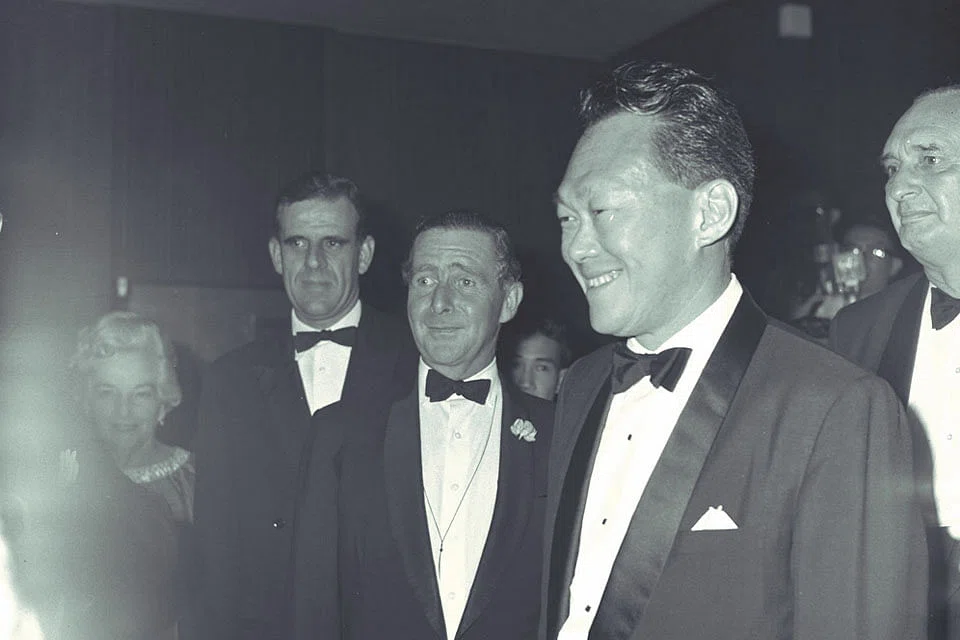
On Feb 6, 1969, 150 years to the very day, the Chamber held a dinner to celebrate the 150th anniversary of Sir Stamford Raffles' founding of Singapore in 1819. The guest of honour was then-prime minister Lee Kuan Yew. It is worth quoting what RG Bennett, chairman of SICC, said: "My Chamber, Sir, wishes to follow you in looking forward rather than back, in planning and working for the future rather than holding on to the easy prizes of the past."
Mr Bennett went on to praise Mr Lee as Raffles' successor. Mr Lee commented that he was flattered, if a little apprehensive, at comparisons with Raffles. Mr Lee went on to say that if in 50 years' time Mr Bennett's successor would be equally fulsome in his praise then it would be an immense satisfaction to him even if he should be in some other world.
We all know that Singapore and we are here today because of Mr Lee and his extraordinary team whose leadership is a textbook case of drive, persistence and focus.
At the same dinner, Mr Lee also spoke about his vision for Singapore's future: "Our future is what we make of it and we will use to best advantage the factors in our favour."
As usual, Mr Lee's words were prescient. They are as relevant today as they were in 1969 for both Singapore and for SICC, its longest-serving Chamber.
TRENDING NOW

Government to bring forward raising of retirement age, give employers more financial support to create flexi-load jobs
Indonesia stocks suffer worst plunge in nearly 30 years as MSCI proposes standalone status
If Europe goes to war, the fallout will be felt in East Asia
Natural gas to stay for the long haul beyond 2050: Singapore International Energy Week panellists

