

AIIB set to open for business this year
But the Beijing-based bank has spelt out little so far about its mission and geographical focus
Tokyo
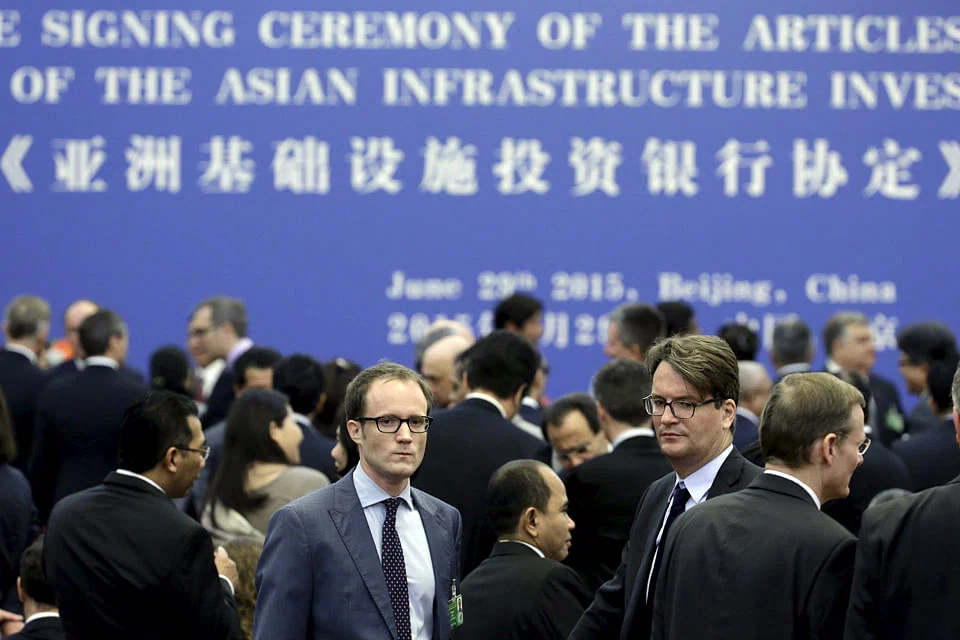
THE Asian Infrastructure Investment Bank (AIIB) is finally "signed, sealed and delivered". Its Articles of Agreement were endorsed on Monday by 50 founding member countries, and all that remains now is for the AIIB to finish staffing up and open its doors for business by the end of this year.
Yet while the 34-page document detailed shareholding and voting rights of the 50 founding members (plus those of seven awaiting approval of their legislatures before signing) as well as explained the governance structure of the bank, it had little to say about the AIIB's core mission. "The purpose of the Bank shall be to foster sustainable economic development, create wealth and improve infrastructure connectivity in Asia by investing in infrastructure and other productive sectors, and to promote regional cooperation and partnership," it said.
The AIIB's website, meanwhile, says only that the bank will stress projects involving energy and power, transportation and telecommunications, rural infrastructure and agricultural development, water supply and sanitation, environmental protection, urban development and logistics.
This appears to have left the door open to future interpretation by the AIIB's Board of Governors, its directors, and to management as to where the geographical focus of the Beijing-based bank should be (beyond the fact that it will be in "Asia and Oceania").
Interesting, some say, is the fact that India and Russia are respectively second and third shareholders behind China. India's share reflects the fact that it is the world's seventh largest economy but Russia's position (as the 15th largest economy) is seen as strategically significant. "I see this as part of the shift to Asia of Russia, and the strategic convergence of Russia and China on a wide variety of issues," former Goldman Sachs Asia vice-president Kenneth Courtis told The Business Times. "Also, Russia is a big player in Central Asia and a significant one in East Asia."
The Moscow Times noted, meanwhile, that "Russia's prominent position in the bank comes as Moscow boosts diplomatic and economic ties with Asia amid a confrontation with the West over the crisis in Ukraine. Russia has also promoted efforts to build partnerships outside the group of multilateral lenders established with US backing after World War II".
Russia's prominence within the AIIB has also to be seen within the context of the fact that Moscow will be a key player in the so-called BRICS Bank (or New Development Bank) - which will also include China and India alongside Brazil and South Africa, a former senior official of the International Monetary Fund told BT.
Others suggest that the prominent positions of India and Russia among AIIB shareholders is more accident than intention. "The only others with the financial hardware to (take second and third slots in the AIIB) are Japan and the US but neither is ready to join at the moment," one high-level US source said.
"Both were promised top slots - Japan as number two and the US number three," the source added. But it was clear, others point out, even before countries began signing up to join the AIIB that the US and Japan were opposed to the bank, on "governance" and other grounds and would not join.
Calculated according to the Articles of Agreement, China will have voting shares of 26 per cent in the AIIB and a capital stock share of 30 per cent, India 7.51 per cent and 8.5 per cent, and Russia 5.93 per cent and 6.6 per cent, a Chinese diplomatic source told BT.
(The difference between the shares of capital stock and voting power reflects the fact that 15 per cent of voting rights were allocated equally to founding members, regardless of equity stakes, in order to dilute somewhat the dominance of a few leading shareholders.)
This gives the three a total of 40 per cent of votes in the bank. They cannot dictate policy, as the AIIB Articles require an "affirmative vote (of) not less than three quarters of total total voting power", but they do have an effective controlling interest, while China has a power of veto.
The AIIB's Articles also make provision for any number of "special funds" to be established with the bank for equity and other investments, which appears to open the door to specially directed funding by the bank. The Asian Development Bank (ADB) similarly has "special funds" that are largely financed by Japan.
In addition to its US$100 billion of authorised capital, the AIIB will have powers to borrow, like other multilateral development institutions. But BT understands that, initially at least, it will derive borrowed funds chiefly from China, including Hong Kong, rather than other international capital markets.
Policymaking at the AIIB appears to be largely in the hands of the president (expected to be former Chinese deputy finance minister Jin Liqun) and one or more vice-presidents. There will be a Board of (12) Directors but they will be non-resident, while the Board of Governors which appoints them has only "annual" statutory meetings.
Where the relatively small core of leading shareholders (which also includes Germany and South Korea as well as Australia among the top half-dozen) chooses to direct the AIIB's focus has yet to be spelt out, but China's attention appears to be centred firmly on Eurasia.
China's President Xi Jinping has repeatedly linked the AIIB's founding with that of the US$40 billion Silk Road Fund that China established earlier this year and which will be dedicated to directing funds into transport, power and other linkages between Asia and Europe.
"The 'One Belt and One Road' - the Silk Road Economic Belt and the Maritime Silk Road - represent paths towards mutual benefit that will being about closer economic integration, spur infrastructure development and create new economic and employment growth," Mr Xi has said.
These two in tandem are likely to be forces shaping what widely known North-east Asia expert Kent Calder terms the "New Continentalism" in Eurasia. "I think they are quite ambitious in terms of what they want to do," he suggested to BT in an interview.
"China," Prof Calder wrote in his book The New Continentalism, is "aggressively building infrastructure westward from its east coast for a variety of domestic reasons, aided by technical developments such as high-speed rail and ultra high voltage power transmission".
This, say some, links with what are also likely to be among the objectives of the AIIB and the Silk Road Fund, while the interest of Kazakhstan (and other Central Asian republics among AIIB shareholders) in establishing a new development bank there points to further Eurasian cooperation which could extend to the European Investment Bank.
"I think the geo-political transformation (in the region stretching from North-east Asia through the Central Asian republics and into Europe) is quite crucial," said Prof Calder, director of the Reischauer Center for East Asian Studies at SAIS/Johns Hopkins University in Washington. "The collapse of the Soviet Union, the rapid growth of China and the catalyst of the Ukraine crisis and the estrangement of Europe ... are throwing Russia into the arms of China in a situation where the Eurasian Continent is much more open, and is deepening relationships."
Prof Calder points to the opening in recent months of new railway links between Europe and China and the establishment of an oil pipeline between China and Russia as evidence that cooperation among countries of the region is becoming "more structural" nowadays.
It was against this background that Mr Xi last year announced in Kazakhstan China's interest in the idea of a Central Asian Development Bank, notes Yuqing Xing, a specialist in regional affairs at Japan's National Graduate Institute of Policy Studies in Tokyo.
Shortly after, however, Mr Xi announced China's intention to form the AIIB and the Silk Road Fund. "Now, we hear nothing about the Central Asian Development Bank," Mr Xing commented to BT. "This is because of geo-politics," he added. "Central Asia is Russia's backyard."
To what extent the AIIB might share with the Silk Road Fund the role of financing infrastructure across the vast Eurasian continent is unclear. But European nations, led by Britain, that rushed to sign up for membership of the AIIB earlier this year, may have had this prospect in mind, say some.
European Union members have an interest in providing financial as well as infrastructural and logistical services to the AIIB, and in the case of the UK and Luxembourg, in providing a venue for AIIB regional offices. This was likely another driver behind their rush to join, sources say.
The Chinese Parliament has meanwhile just ratified the creation of the Shanghai-based BRICS Bank. The bank will fund infrastructure and other development projects in the BRICS countries, and reportedly each nation will have an equal say in the bank's management. Its initial capital will be US$50 billion.
The separation of responsibilities among the AIIB , the Silk Road Fund and the BRICS Bank (let alone their relationship with established multilateral development institutions such as the ADB and the World Bank) is yet to be worked out, but it may not overlap to the extent assumed since the AIIB's formation was announced, sources say.
TRENDING NOW

Simba admits exceeding spectrum limits amid failed M1 deal; full-year profits surge 277%

Temasek’s Wan Chee Foong to helm PIL, Lars Kastrup to be board adviser

He built the Vingroup empire. Now South-east Asia’s richest man is handing some key roles to his sons

One-third of Singapore-listed firms at risk in severe AI downturn: MAS

