

Mr Lee spotted China's growth potential early
He was the only one who personally met all five of modern China's top leaders, and kept friendly relationships with them.
Hong Kong
ONLY one person personally met all five of the top leaders of modern China, and maintained friendly relationships with each of them. This person was also the first head of state to be accorded the privilege of seeing China's terra-cotta army, two years after its discovery in 1974. He also brokered the ice-breaking talks between China and Taiwan, which Beijing regards as a renegade province, in a historic event that took place in Singapore in 1993.
China President Xi Jinping called Mr Lee Kuan Yew "an old friend of the Chinese people" in his condolences to the Lee family. Chinese Premier Li Keqiang, speaking on behalf of the Chinese government and people, credited Mr Lee for his contributions to China-Singapore relations and to China's reform and opening-up that Premier Li said would definitely go down in history.
Mr Lee's contributions to China's extraordinary rise have been well noted. Even within China there is no disputing that the Singapore model, matched with Mr Lee's vision for its future, has given the Chinese elite not only inspiration but also a practical template to work on just as China was emerging from behind the bamboo curtain to embrace the outside world.
"Singapore's experience has been an inspiration to China," says Tang Qifang, an associate director of China Institute of International Studies in Beijing. "Because of the size of China's population, we need to adapt the experience to our reality, a much bigger country with a large population. It's impossible to succeed just by copying another country's experience."
Praise from Chinese media
Mr Lee's foresight in spotting China's growth potential earlier than others has provided much encouragement to the Chinese leaders, Ms Tang notes.
His impact might be felt more in China's economy than in its politics. In recounting the highlights of Mr Lee's visits to China - 33 in all since his first in 1976 - Chinese state media and scholars were consistent in their assessment of Mr Lee's influence in China, marked with effusive praise. He was hailed as a world-class strategist and China's "pure friend".
It goes well beyond good diplomacy on the part of China to present such an concerted outpouring of respect paid to Mr Lee. For more than two decades, China had despatched to Singapore some 30,000 top officials, among them former President Jiang Zemin, on learning pilgrimages such as classes tailored to train Chinese mayors. People's Daily said such training was aimed to help officials "learn how to fly".
In all, Mr Lee met then-ailing Mao Zedong, Deng Xiaoping, Jiang Zemin, Hu Jintao, and Xi Jinping. Wen Wei Po, a Chinese state newspaper, chronicled Mr Lee's particularly close relationship with paramount leader Mr Deng.
Mr Lee had four public meetings with Mr Deng who was desperately seeking help when experimenting on a ground-breaking open-door policy. Mr Lee dispensed many a timely advice. In their second meeting, Mr Lee praised the successful conclusion of the Communist Party's Third Plenary Session of the 11th Central Committee, held in December 1978, and the principle of "four modernisations" it enshrined to mark the dawn of the open-door policy. Mr Lee then predicted that China's economic development would promote trade and investment in South-east Asia as well as the whole of Asia.
Shortly after Mr Deng made his famous speech in Shenzhen calling officials to open up and learn from experiences of other countries, "in particular Singapore's", Mr Lee led a delegate to visit the Yangtze River Delta in September 1992. Two years later, the prototype for Chinese industrial parks was born in the shape of Suzhou Industrial Park.
The park's success has been partly blunted by the establishment of a cheaper Chinese copycat park nearby, but today it is still responsible for 15 per cent of the Suzhou city's GDP and it remains an import-and-export manufacturing base for both Chinese companies and multinationals. Still the biggest cooperative project between the two countries, the park saw production value growing 8.3 per cent in 2014 to a total of 200 billion yuan (S$44.4 billion).
In Hong Kong, Mr Lee had the ears of not just Chris Patten, the much-loved last governor in the colonial days, but also of its successive political leaders. On Sunday, former chief executive Tung Chee Hwa travelled to Singapore as a representative of the city to attend Mr Lee's state funeral. Mr Tung said he had known Mr Lee for decades and has "learnt much from his wisdom and unique insights" on a wide range of topics.
Many in Hong Kong recall Mr Lee's unfailing judgement about the possibility of a coming political stalemate as a consequence of ineffective communications between China and Hong Kong over the actual implementation of the "one-country, two systems". He expected, back in 2000 in a speech at a ceremony to receive a honourable doctorate from the Chinese University of Hong Kong, that "the chief executive and the people of Hong Kong will find themselves locked in a frustrating process of attrition with the centre".
Forewarning on thorny issues
His other prediction about Hong Kong playing just the role of an economic model for China and eventually becoming just another Chinese province like Guangdong remains to be borne out.
Unusually, however, Mr Lee, famously unsparing in sharing his views, said it was hard for him to predict what next for the policies under China's President Xi. But he did warn China well ahead about several thorny issues before they became all too stark to ignore.
In an interview with Caixin magazine back in 2006, he suggested that internal turmoil or political collapse would ensue if China could not resolve internal conflicts such as the widening wealth gap, the stark economic disparity between coastal and inland provinces and between urban and rural regions, as well as public discontent due to rampant corruption.
A fourth-generation Chinese immigrant, Mr Lee's great grandfather moved the family out of China to seek a better future nearly 200 years ago, but Mr Lee is still remembered fondly at his ancestral home in the same traditional brick house built on a hillside village by his great-grandfather in 1884.
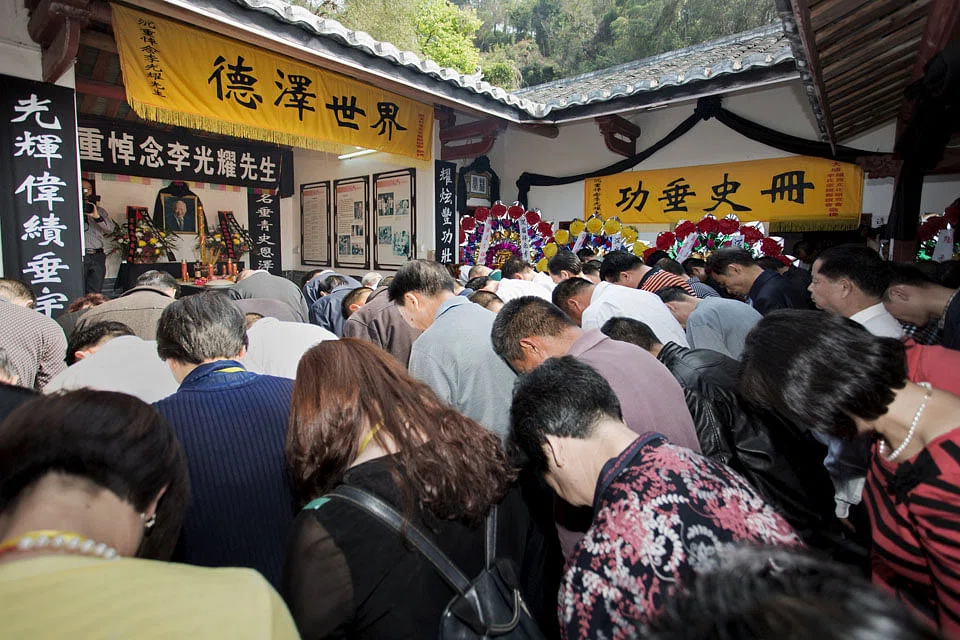
On Sunday, more than 3,000 people attended a memorial held in the village in Meizhou city of Guangdong province. The village will soon see the completion of a Lee Kuan Yew memorial museum.
TRENDING NOW
Knight Frank’s Tan Tee Khoon leaves firm, Nicholas Keong takes over auction business
Keppel Energy, Sembcorp Utilities and Tuas Power to supply biomethane in pilot project
GovTech retrenches another 38 staff in second round of layoffs
Take-up of new private homes dives 45% in Q3 as prices accelerate with 1.4% rise

