

Singapore on right track in using AI for hospitality sector
Robots and big data can beat the labour shortage and identify trends and issues.
FEW countries have achieved as much success, and on so many different fronts, as Singapore in the past few decades. From economic growth and access to education, home ownership and healthcare, the list of achievements is a very long one. All this can be attributed to one key aspect: long-term vision.
There is always a long-term plan behind any initiative, regulation or policy framework. This approach has especially been a big driver of growth for the tourism and hospitality sector. Despite being a relatively small country, with almost no natural resources, Singapore has become one of the most visited places in the world.
However, the sector is being transformed. Advancements in technology, especially in artificial intelligence (AI) and robotics, are changing the way the industry operates. This presents a unique opportunity for Singapore to establish itself as a global leader on this front.
LEANING IN
The hospitality sector has traditionally been a manpower-intensive industry. Every aspect of running a hospitality organisation has needed a human touch - from checking in a guest at a hotel and delivering the room-service orders to cleaning the room and checking out the guest, human interaction is what people have come to expect at every level.
The Online Travel Reservation and Management System (OTRAMS) says that labour costs account for more than half of the hospitality industry's operational costs.
However, the sector's fast-paced expansion, coupled with Singapore's relatively small population, has made it difficult for companies to meet their manpower requirements. This is where advancements in robotics can plug the gap.
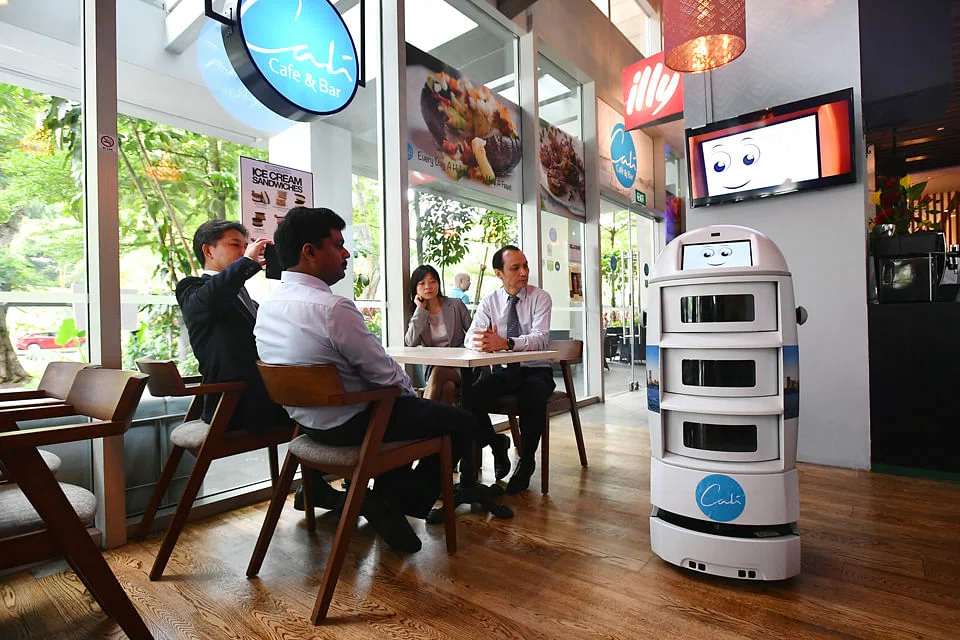
Service robots are already making their way into the industry. The Government Technology Agency reports that Park Avenue Rochester Hotel has deployed two service robots called Techi, which clean up after hotel guests have departed; they also deliver trolleys of duvets, pillow cases and towels to more than 300 rooms. This pair of robots can do the work of three full-time employees, helping to plug the manpower shortage. Other establishments are also latching on to this trend.
The use of robots is likely to move from service to interaction as well. Singapore's home-grown humanoid robot receptionist, Nadine, made her debut at the ArtScience museum's exhibition earlier this year. Developed by Nanyang Technological University, she can recall faces and conversations she has had before, just like human receptionists.
Alleviating the manpower-shortage issue aside, technology can improve productivity and efficiency across the entire value chain of a hospitality operation. To begin with, companies in the hospitality industry deal with thousands of different consumers, each with their own unique requirements and tastes.
Technology enables companies to capture this data and analyse it to understand consumer preferences, enabling them to curate personalised experiences for guests - something that travellers today particularly value and cherish.
Through big-data analytics, companies can spot trends and turn them into potential opportunities as well. Equally important, companies can spot potential issues and address them before they flare up.
Analytics also has an overarching use in optimising operations. Take for example, yield management in hotels.
Companies are always looking at ways to ensure that each room sells at its optimal price. This depends on multiple factors - demand versus supply, major events and travel disruptions, for example - factors which the company has little or no control over. Predictive-data analytics can help hotels better understand potential trends and price their rooms accordingly, thus raising their overall yield.
Singapore has recognised the opportunity on this front. Various stakeholders - from private players to educational institutions and government - have all taken steps in the right direction.
The Singapore Tourism Board (STB) recently concluded a crowd-sourcing initiative for innovative solutions to address key issues and opportunities in the sector. It has asked companies to submit their proposals for solutions rooted in big data and analytics, artificial intelligence, cognitive computing, robotics, material sciences or other relevant technologies. Selected proposals will be funded by STB for up to 70 per cent of the qualifying costs, so they can deliver feasible prototypes for trial and eventual implementation if the trial is deemed successful.
Apart from funding support, STB will also conduct networking and business-matching sessions to connect technology-solutions providers with hotels and travel agents. These sessions aim to help technology-solutions providers better understand the industry's challenges and to find pilot users as partners in developing their solution prototypes.
AI-POWERED
Meanwhile, the National Research Foundation (NRF) has said it will invest up to S$150 million in a new national programme aimed at boosting Singapore's AI capabilities over the next five years.
Under AI.SG, Singapore-based research institutes will partner AI startups and companies developing AI products to grow knowledge in the space, create tools and develop talent to power the country's AI efforts.
The initial focus areas for AI.SG are supposed to be finance, city-management solutions and healthcare.
However, the government's backing of the technology and the willingness to commit serious money towards its development will help create an ecosystem that will improve the technology and help various other industries, including hospitality, along the way.
Before we know it, Singapore will not just be one of the most visited tourist destinations, but also among the smartest ones. Once again, it is the long-term vision of Singapore that will make this possible.
TRENDING NOW
32 companies, 6 individuals bag accolades at Singapore Corporate Awards 2026

He built the Vingroup empire. Now South-east Asia’s richest man is handing some key roles to his sons
URA to review guidelines on floor space to give developers more design flexibility: Chee Hong Tat
Chagee, Mixue and Luckin won the market. Sustaining their edge is the harder part

