Thailand's rice saga and fall of Yingluck Shinawatra
It is a lesson for future leaders of Thailand and other countries to steer clear of any policy resembling market manipulation.
IT was simple maths for former businesswoman and prime minister of Thailand, Yingluck Shinawatra, to win the July 2011 election and lead the Pheu Thai Party: guarantee the procurement price of rice paddy for farmers at 15,000 baht (around US$450 or S$600) per tonne. This was 4,000 baht above the rate set by the previous Democrat Party and nearly double the global market price. Since almost 40 per cent of Thailand's labour force is in agriculture, the majority of whom are rice farmers, Yingluck sailed to victory and was sworn into office on Aug 10, 2011.
The strategy was a simplistic but unrealistic three-step process: buy rice from farmers at inflated prices, stockpile it to reduce global supply which would drive up global prices, and resell it later at a higher price to recover the initial outlay.
At the time, Thailand was the largest rice exporter in the world, controlling 30 per cent of the market. Yingluck thought this large market share was large enough to manipulate global prices. Whether it was naivety, political pandering, poor judgement, or likely a combination of all three, this plan backfired spectacularly as other countries, notably India and Vietnam, promptly filled the Thai void from the end of 2011 to 2013.
By the end of 2013, Thailand was holding onto 17.5 million tonnes of rice, running out of places to store it, and confidence in its quality was diminishing globally. Concurrently, exports bottomed out in 2013 at 39 per cent lower compared to 2011. In order to make back the money the government was spending, milled rice prices would have had to be around US$830 per tonne, instead of the 2012 average of US$573.
Official figures of the total cost of the plan have not been released by the government but estimates range from US$8 billion to US$20 billion. Overall, though, this programme is not that expensive. There are countless examples of governments around the world investing in much costlier failed projects. So where is the controversy? How did this lead to the downfall of Yingluck?
The cost of the programme is not the main reason why Yingluck eventually faced impeachment. The political tension in Thailand goes back almost a decade earlier to when Thaksin Shinawatra, Yingluck's older brother and former prime minister, was removed in a military coup and convicted of corruption. He now lives in exile for if he returned to Thailand, he would have to serve two years in jail for corruption. Opponents of Yingluck claim she is a mouthpiece for her exiled brother and represents elite corruption that prevailed then in Thailand. Several factors occurred during the end of 2013 to mid-2014 that resulted in her being impeached. She is now facing up to 10 years in jail.
On Dec 9, 2013, the opposition Democrat Party representatives in the House of Representatives left their seats. This triggered Yingluck to dissolve the entire House. The reasons for the opposition party leaving the House do not relate to the rice pledging scheme. Two other events prior to Dec 9 occurred that heightened political tensions in Thailand.
First, in early November 2013 Yingluck tried to pass an amnesty bill that would have absolved her brother Thaksin's previous crimes allowing him to return to Thailand without going to prison. This ultimately did not pass. Second, in late November 2013, Yingluck disregarded a decision by the Constitutional Court that a draft amendment to the constitution allowing relatives of representatives to be elected senators was unconstitutional. This also did not pass, but provided the opposition another example of Yingluck fostering a government run by her political elite supporters. By this time, protests in Bangkok were occurring and growing in size.
On Dec 9, when the House of Representatives no longer existed, the authority of the Minister of Finance to authorise payments on the rice pledging scheme had to be stopped completely. On Jan 31, 2014, the government defaulted on its payments to the farmers for money owed to them from the October 2013 harvest. On Feb 18, 2014, the National Anti-Corruption Commission of Thailand released a statement charging Yingluck with negligence and dereliction of duty pertaining to the rice pledging scheme. This did not remove her from office, rather it triggered further proceedings on her impeachment. The failure of the rice pledging scheme, and the absence of payments to the farmers, galvanised the movement as the people protesting now included those who elected Yingluck to office initially.
If these events were not enough, a "Judicial Coup" occurred on May 7, 2014 that effectively removed Yingluck from office. This related to the removal of Thawil Pliensri, shortly after Yingluck's 2011 election win, as National Security Chief, replacing him with her brother-in-law. The Constitutional Court asserted this move was an abuse of power since Mr Pliensri was not negligent fulfilling his duties.
All these culminated in the military coup that occurred on May 22, 2014, which completely removed the government and placed the military's General Prayuth Chan-ocha in charge to this day.
Although there were multiple events that led to the coup and removal of Yingluck, the rice pledging scheme is still the most threatening to her future political aspirations and freedom. On Jan 23, 2015 the National Legislative Assembly (NLA), largely backed by the ruling junta, impeached her, prohibiting her from participating in Thai politics for the next five years and triggering a trial with Thailand's Supreme Court.
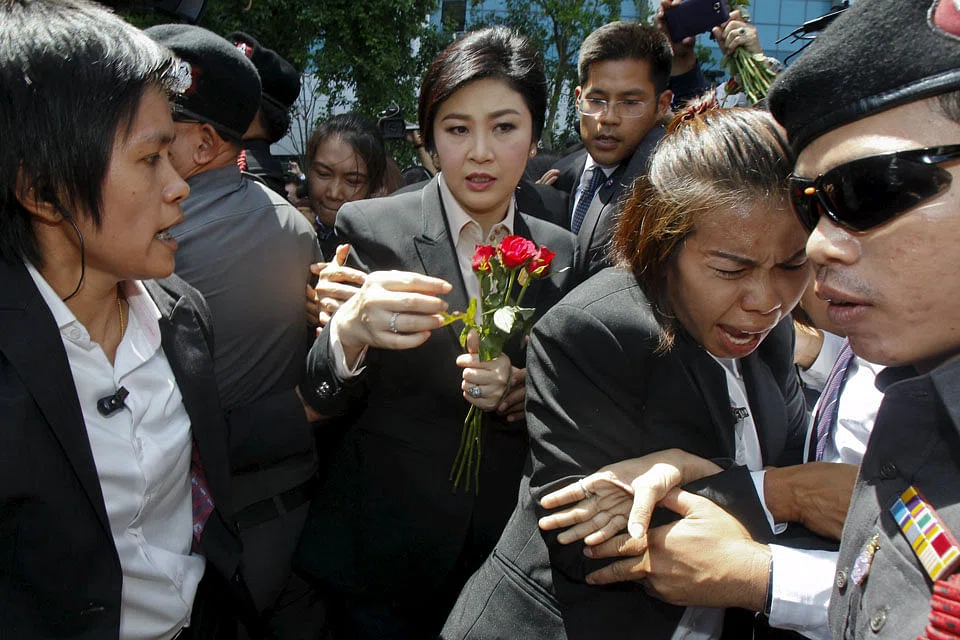
Yingluck attended court on May 19, with many supporters also in attendance, and pleaded not guilty to the charges related to the rice pledging scheme. She is being charged with dereliction of duty and negligence to stop graft, which resulted in taxpayer losses estimated at around US$15 billion. The trial could last up to a year. The court set bail at about US$900,000, and forbids her from leaving Thailand without court approval. Yingluck vowed not to leave the country like her brother did years earlier to evade jail.
The outcome for Yingluck appears bleak and most analysts anticipate she will be convicted. If she receives the maximum sentence of 10 years, it will be politically volatile. It may rally her supporters and incite violence while Yingluck sits in Thai prison perceived as a martyr. If the sentence is too weak, Yingluck could reignite pro-Thaksin/Yingluck supporters for the anticipated 2016 general election. Any unrest would not only threaten the Thai people, but could damage the work the military has done to regain the confidence of the international community that Thailand is a safe and stable place worthy of foreign tourists and investments.
Hopefully future leaders of Thailand and other countries will take note of the failures of Thailand's rice pledging scheme and steer clear of any policy resembling market manipulation. Although Yingluck's future has yet to be determined, one thing that can be concluded from this episode is this: You cannot have your rice, eat it and make a profit as well.