Listed developers face hefty short-term debt
The 80 property firms on SGX have to pay S$23.5b within a year, amid record vacancies
Singapore
SINGAPORE'S listed developers and real-estate investment trusts (Reits) face their heaviest burden of near-term maturities on record just as home prices drop.
In their latest filings with Singapore Exchange (SGX), the 80 property companies on the bourse reported a combined S$23.5 billion of borrowings that have to be repaid within a year, Bloomberg-compiled data show.
The looming debt wall comes as the vacancy rate for condominiums has soared to the highest since 2006, pushing prices to the lowest in almost two years, according to data from the Urban Redevelopment Authority (URA).
Savills plc predicts that refinancing for homebuilders and Reits will be more challenging as Singapore's economy slows, with expansion cooling to 2.4 per cent in the second quarter, from 4.8 per cent in the previous three months.
Population growth on the island is at a 10-year low and Standard & Poor's expects home prices to fall further.
"We're at that point in the cycle when every quarter you're seeing selling prices come down a little bit and secondary market transactions aren't very active," Kah Ling Chan, a property analyst at S&P in Singapore said. "I suspect we haven't seen the bottom yet."
Developers of residential homes are suffering not so much from lower selling prices than "collapsed" sales volumes, said Alan Cheong, a senior director of real-estate research at Savills in Singapore. Secondary home sales have plunged to the lowest since 2003 in the first quarter, according to URA data, and as business slows, builders with less pre-sales money to finish projects have to rely on loans, boosting short-term borrowings, he said on Oct 2.
Despite the weaker demand, the number of new residential dwellings being built remains high. Units under construction reached a record in the second quarter of 2013 and some 65,270 apartments were in the pipeline as at June 30, URA data shows.
Regulatory measures have been introduced to damp the market. Between 2009 and mid-2013, the Monetary Authority of Singapore implemented eight rounds of property cooling measures to address its concern that the low interest rate environment would lead to a property price bubble, Moody's Investors Service said in an Oct 6 report.
"Appetite to buy is already curbed" and rents could fall further, S&P's Ms Chan said. "We haven't seen the full impact yet."
The 42 listed developers on SGX reported S$13.4 billion of short-term borrowings in their latest filings, 42.5 per cent more than a year earlier, data compiled by Bloomberg show. City Developments Ltd (CDL) posted debt of S$1.66 billion in the second quarter, 48.6 per cent more than at the end of 2013. Second-quarter net income fell 33 per cent, it said in August, and the company is looking to expand overseas to offset declining demand in Singapore.
CDL's S$500 million of bonds due next September and sold to investors at par in August 2010 are trading at 101.2 per cent of face value, down from 101.25 at the end of last year, DBS Bank prices show. It sold S$100 million of 10-year 3.78 per cent notes earlier this week.
A spokeswoman for CDL said that the company has a strong financial position, noting its cash of S$3.4 billion and 33 per cent net gearing ratio.
The three-month swap offer rate, a measure of borrowing costs in Singapore, touched 0.2561 per cent on Sept 16, the highest since June 2013.
Reits are in better shape than listed developers because they started refinancing with longer tenor debt ahead of rising interest rates, according to S&P. "For the Reits, I don't see a major problem yet," Ms Chan said. "The bigger players are still getting good rates and valuations haven't fallen dramatically."
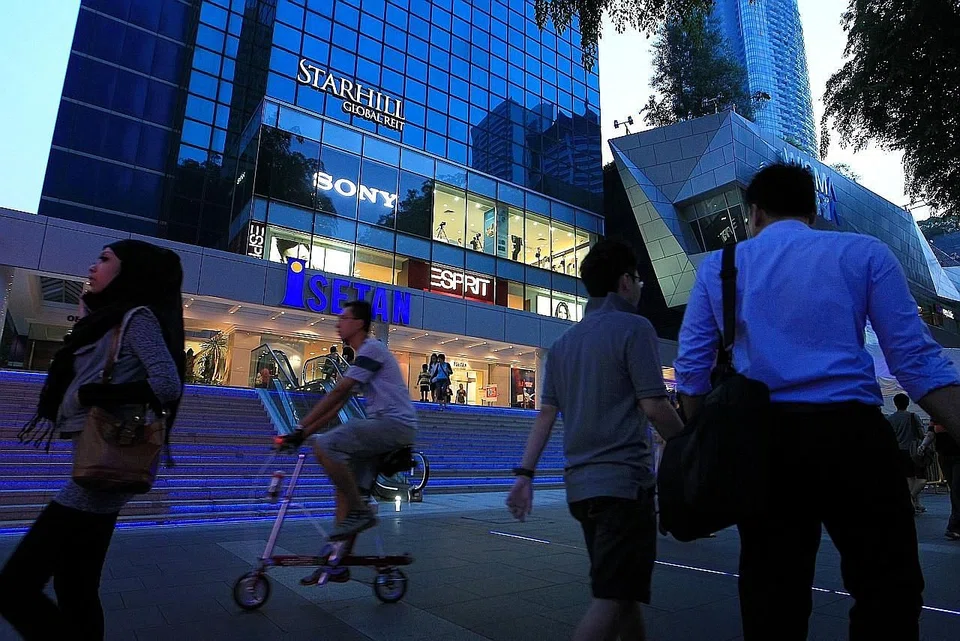
Starhill Global Reit, which has S$124 million of notes that mature in July, reported S$129.1 million of short-term borrowings as at June 30, more than double the amount it had in December 2013. Retail occupancy rates at the trust's flagship Wisma Atria mall along Orchard Road slipped to 98.5 per cent in June from 99.5 per cent at the end of 2012, company data show. Office occupancy rates are 100 per cent.
Jonathan Kuah, a Singapore-based spokesman for Starhill, said that the company has refinanced its debt due within the coming 12 months. The "leverage situation hasn't worsened", he said on Oct 7.
Retail sales, which affect revenue at some Reits, decreased for four of the past five months, the worst performance in two years, data from the Department of Statistics show. Excluding motor vehicles, sales dropped 0.4 per cent in July versus the previous corresponding period.
"Singaporeans don't shop here anymore," said Savills's Mr Cheong. "Travelling has become so cheap and they buy more stuff on the Internet. The Chinese have also been avoiding Singapore, Malaysia and Thailand since the MH370 tragedy," he said, referring to the Malaysia Airlines flight that has been missing since March.
Arrivals of tourists from North Asia, which typically make up more than a quarter of visitors, slumped almost 13 per cent in the first seven months of 2014 from a year earlier, Singapore Tourism Board data shows.
"In 2008, when the refinancing situation was quite bad, the Reits still managed to pull through," said Danny Tan, a Singapore-based fund manager at Eastspring Investments Ltd, which managed US$115 billion of assets as at June 30. "There's a high probability these Reits will be able to refinance especially because the loan market is also open to them."
While the Singapore dollar has weakened 1.9 per cent against the US dollar this half, that's not as much as the Philippine peso, which is down 2.5 per cent and Indonesia's rupiah, down 2.7 per cent.
Hiap Hoe Ltd, which recently started selling apartments in its prestigious Skyline 360 building, reported short-term borrowings of S$287.6 million for the quarter ended June 30, 94 per cent more than the S$147.9 million for the three months ended December. It raised S$115 million, selling three-year 4.75 per cent notes at par in September 2013, which now trade at 100.317. A spokesman for Hiap Hoe declined to comment.
Developers on the island are changing their business models and reducing exposure to the local market, according to Singapore-based Tim Gibson, who helps run Henderson Global Investors Ltd's global property equities fund.
"By buying Singapore developers now, you're really buying exposure outside of Singapore and into markets like China," he said on Oct 8. It "doesn't give you a huge amount of confidence that a turnaround in the residential market is coming anytime soon". Bloomberg