

Round-the-clock counselling: national mindline 1771 offers 24/7 support when life gets overwhelming
Whether it is work stress, a personal crisis or a major life change, trained counsellors are available, offering a confidential space to talk things through
 Add BT as a preferred source
DeeperDive is a beta AI feature. Refer to full articles for the facts.
When counsellor Idris Othman* answers the phone, he never knows what the conversation might bring.
On one call, a young man reached out as he was struggling to decide whether to walk away from a long-term relationship. His partner had cheated on him, yet he still valued the relationship and could not bring himself to end it.
“He just needed to talk it through,” says Idris. He is a full-time counsellor at national mindline 1771, Singapore’s 24-hour national mental health helpline and textline service launched by the Ministry of Health (MOH) in June 2025 and operated by the Institute of Mental Health (IMH).
Developed as part of Singapore’s National Mental Health and Well-being Strategy, national mindline 1771 provides a confidential first point of contact for people experiencing emotional or psychological distress. Help-seekers do not have to reveal identification details such as their name or age if they do not wish to.
For some help-seekers, the conversation is the first time they have spoken openly about what they are going through – without fear of stigma.
“Individuals, especially men, may not always feel comfortable opening up to friends,” says Idris. “Some tell me I’m the first person they’ve spoken to about their emotional and mental health challenges.”
Those who reach out – whether via call or text – range from children coping with school pressures to adults facing workplace stress or caregiving responsibilities, to seniors facing loneliness.
About 44 per cent of help-seekers who have contacted national mindline 1771 and chose to reveal their age are aged between 20 and 35.
“The transition into young adulthood can be challenging,” Idris notes. “Many who reach out are adjusting to new work environments while dealing with changes in their relationships with family, friends and partners.”
A safe, private space for all
Dr Christopher Cheok, programme director of national mindline 1771 and senior consultant at IMH, says young adults today face a complex mix of pressures. Besides long working hours and high workloads, many also worry about job security in an era of artificial intelligence.
“If this stress remains unaddressed, it could affect sleep and work performance, and may escalate to depression or anxiety disorders,” he says.
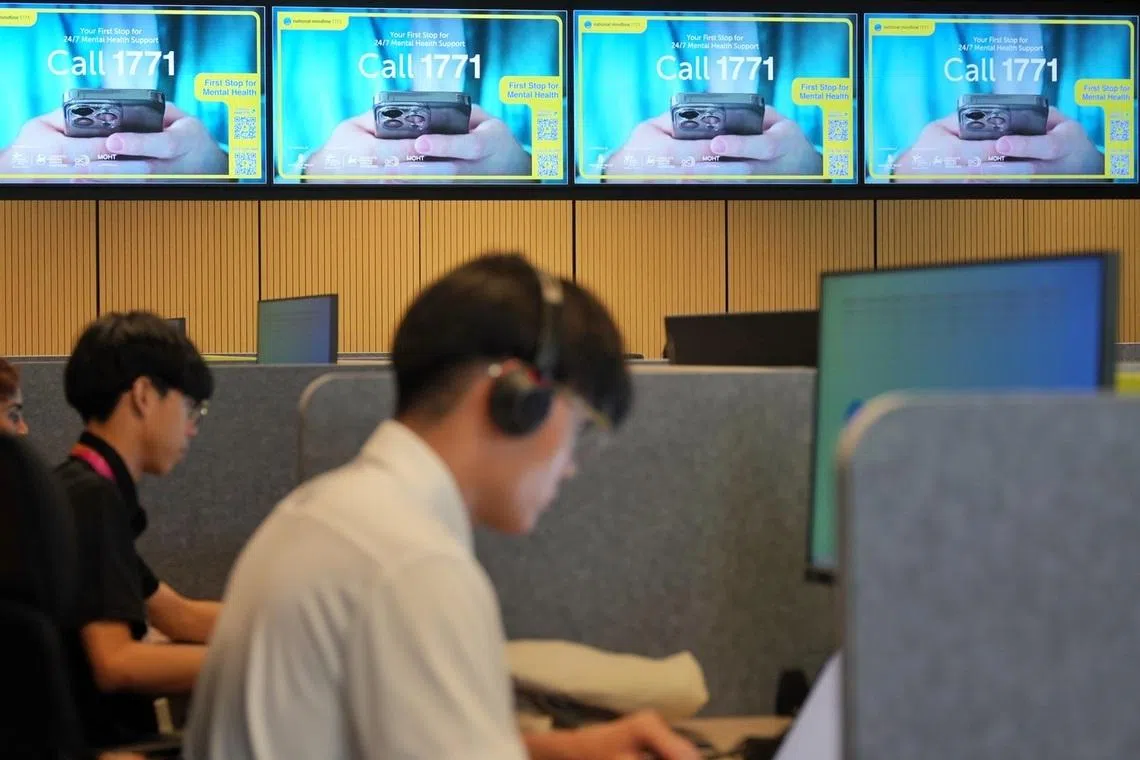
The 2024 National Youth Mental Health Study by IMH found that about one in three young people aged 15 to 35 experienced severe or extremely severe symptoms of depression, stress or anxiety, with anxiety being the most commonly reported issue.
“At their life stage, they may not feel comfortable disclosing personal information to others. Friends may not react in a supportive way, and sometimes the issue may be difficult to discuss, like a young adult whose parents have gambling or debt problems,” says Dr Cheok.
Calvin Lin*, another full-time counsellor with the service, says that young adults may hesitate to approach mental health services as they are wary about how it may affect their job prospects and reputation. Cost and reluctance to take time off work can also deter them from seeking treatment.
The national mindline 1771 offers an alternative to in-person support channels for those who wish to maintain anonymity.
“Those who are feeling vulnerable may not know how to express themselves,” says Calvin. “Calling 1771 lets them test the waters, explore what options are available and feel more confident about accessing face-to-face support if they need it.”
Dr Cheok adds that a single conversation with a mental health professional can make a difference. “It can help them to reframe their problem or look at the situation in an alternate and less stressful way. The social support received can also help alleviate some distress.”
Not just a listening ear
One individual reached out after returning to work following an extended period away. He found himself overthinking even routine workplace messages, worried that colleagues might judge him negatively. The anxiety became so overwhelming that he began avoiding interactions with co-workers altogether.
Besides providing a listening ear, the national mindline 1771 counsellor helped him regulate his emotions through grounding techniques and manage the anxiety that had been building up.
“When someone calls, we always start with ‘It’s 1771, how can we help you?’” says Calvin. “If they’re not sure where to start, we ask open questions to better understand what they’re going through.”
Idris adds: “Sometimes callers are in the midst of a panic attack when they call in. You hear them hyperventilating, sobbing, expressing distress. I guide them through breathing exercises and by the end of the call, they are calm, sometimes even laughing in relief.”
The service also becomes a first stop where help-seekers can be guided towards support that fits their situation.
For instance, when a help-seeker is feeling stressed about job uncertainties or unemployment, the counsellor may point them towards resources such as Workforce Singapore (WSG), where they can access career coaching and guidance.
“Sometimes people haven’t thought about options like career coaching,” says Calvin. “We help them see what resources are available.”
Idris believes that conversations like these help people realise that emotional distress is a normal part of life and that seeking support early can prevent problems from escalating.
“When they are in a state of distress, people may not see the solutions and resources but everyone is more capable than they realise. It’s not the end of the road and you can do things to make it better.”
*Counsellors are identified by the pen names they use during conversations.
What is national mindline 1771?
Launched by the Ministry of Health as part of the National Mental Health and Well-being Strategy, national mindline 1771 is Singapore’s first national mental health helpline and textline service.
The service, operated by trained counsellors from the Institute of Mental Health, acts as a first point of contact for anyone who needs someone to talk to for mental health concerns – whether for everyday stress or worries that are hard to handle alone.
Here’s what to know:
- The service is accessible round the clock.
- Access through phone call and WhatsApp.
- The sessions are anonymous and your information is kept confidential.
- Calls and messages are handled by trained counsellors who provide a listening ear and practical support.
- Counsellors may guide help-seekers to other appropriate support services in the community based on their needs.
Visit www.mindline.sg/1771 for more information.
Share with us your feedback on BT's products and services
TRENDING NOW

Middle East-linked energy supply shocks put Asean Power Grid back in focus

From intern to C-suite: JPMorgan’s Teresa Heitsenrether on building a fully AI-powered ‘megabank’

Richard Eu on how core values, customers keep Singapore’s TCM chain Eu Yan Sang relevant

Prime Orchard condo High Point takes fifth stab at en bloc sale with S$580 million asking price

