


Taking the silk route into electronics
Third-generation Primalanis have parlayed their grandfather's 1950s silk store, Parisilk, into a genial electronics store where customers are treated more like friends.
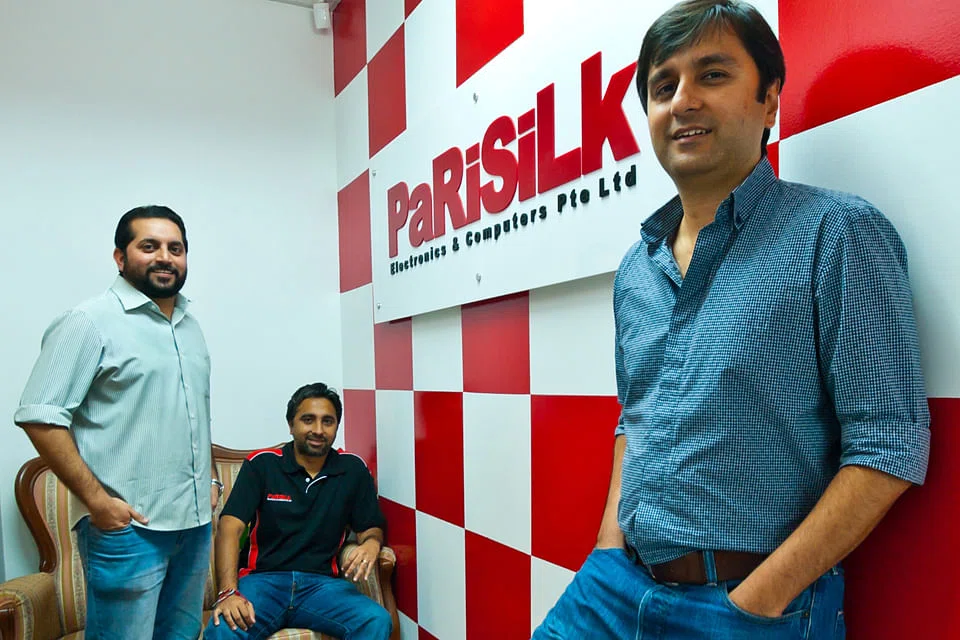
PARIS. Silk. Put those two words together and you have... an electronics store? Yes, says Michael Primalani. With a smile that belies a bemused man who's heard that joke countless times, he proceeded to explain how he headed a rebranding exercise to take the six-decade old Parisilk brand into the 21st century.
"I wanted to do something that was a little bit more relevant. I wanted to create a brand. And Paris Silk Store (what the shop was originally called) was a name, not really a brand," Parisilk's head of corporate sales and business development said.
"Even until the late 1980s and early '90s, we still had people calling and asking us for textiles, because of the word 'silk' in the name. They would flip through the yellow pages back then and jump on that word."
"People now seem less confused by the brand, and at the same time keeping the identity that people have known since the '50s," he said wryly.
If you grew up in the past two decades or so, chances are you might not be too familiar with the brand Parisilk. Even if you have come across it, you might have assumed it was a shop which sold textiles.
In some ways, you'd be correct. In 1952, Gulabrai Primalani, a newly wed Sindhi entrepreneur came to Singapore from India and began selling textiles at No 22 Transit Road, next to where Nee Soon army camp stands today. People with longer memories will recall it was named Paris Silk Store then, and as the travelling salesman he was, the elder Primalani sold crowdpleasers such as sheets of cloth and coats straight out of his suitcase. He went on to have four sons and two daughters, who would play a key role in perpetuating his business.
"He was the first Primalani to set foot in Singapore. He did a bit of homework and discovered that a particular neighbourhood was the best place to set up a retail shop," said Michael.
Why Paris? "His favourite city was Paris," laughed Michael. Back in the '50s and '60s, British soldiers were still based in Singapore, and ships used to call at Sembawang shipyards, as they do today. The elder Primalani saw an opportunity and set up shop where he could capture the large numbers of sailors and soldiers.
"A lot of ships used to make port of call at Sembawang shipyard, and you used to have the same ships calling two or three times a year. So a lot of these sailors we saw became familiar faces," said Michael.
"They used to come to our shop and say: 'Hey, I want buy a radio.' We didn't sell electronics back then. My dad (Andrew Primalani, Gulabrai's eldest son) would run across the street to a neighbouring shop, pick up a radio and bring it back and sell it to him. That's how the exposure to electronics grew," he recalled.
In 1973, some two decades after setting up shop in Singapore, the founding patriarch Primalani handed over the business to three of his sons. Looking at the declining appeal of textiles and wanting to freshen the brand up, they decided to make the switch from textiles to selling electronics a year later.
They decided to keep the name as it had gained an established foothold in Singapore and customers had become familiar with it.
In 1999, the brothers incorporated the business and converted it from a partnership to a Private Limited company. Today, the business employs around 50 people, and is run by three of Gulabrai Primalani's sons and their wives, his daughter and four grandsons from Michael's generation, for a total of 11 people.
The company operates five outlets across the island. Two are in Holland Village, with the rest in Bedok, East Coast and Sembawang.
As the head of corporate sales and business development, Michael Primalani is very much at the core of the business. He joined the company in 2004 after graduating from SMU's School of Business, becoming a fulltime staff member a year later. Despite having worked for the company for only 10 years, he was always intimately involved from the very beginning, and knew that he was destined to join it even though there was no pressure to do so.
"I was always exposed to the business. During school holidays, I would pop down to the shop and play Donkey Kong and Nintendo games," he recalled.
"My dad said: 'If you help out during the holidays, you get to take home one toy at the end of it.' That was my incentive. At the back of my mind I always knew I wanted to end up in the business. We have very close relationships with all our staff, customers and suppliers. So even back then in the store, I would see our customers as friends," he said.
Despite having a smaller footprint than other electronics retailers, the company prides itself on being customer-focused and product-centric, citing the years they have been in business and the number of repeat customers that walk into their stores.
"We are fortunate because we sell fun products, and there's always something new. We are selling things everyone uses," he said, gesturing to the stacks of iPad and iPhone boxes liberally strewn around his office.
Michael said the focus on customers is to make sure they feel welcome in the store, and not be simply part of a transaction. He wanted to make sure they could put a face to the company and present a more "human organisation".
Anyone can sell cheap products, but people need to go to someone they can trust, said Michael.
"Whenever you go into our stores it's always a conversation. When a customer walks in, the first thing we say is: 'Hi, how are you?', because that leads to a conversation. It's about what the customer needs and how you can help the customer. 'May I help you?' is transactional and impersonal," he said.
"At the end of the day, you're going to get an honest product, you're going to get an honest opinion, and you're going to get an honest price. And that's what's important to us."
"It's about profiling the customer and selling the customer what he or she needs, and not what makes you the most amount of money," he said.
Underscoring the company's attention to customer service, Michael recalled a recent incident where a delivery driver, on his way to a company's D&D, had rung him to say an item scheduled for delivery was not in his truck. The item turned out to still be at their headquarters in Changi South.
"I was at Holland Village in one of my stores. And the delivery location was in the city. I rushed down here, picked up the item and sent it down myself, all before the customer had a chance to complain," said he said. "Mistakes are made, but we must rectify them."
It is this attention to detail which has earned the company a steady stream of repeat customers. Parisilk does not engage in a blitz of marketing materials, preferring instead to keep advertising costs down by leveraging word of mouth recommendations, and passing on the savings to their customers.
"By keeping our overheads down, we don't need to raise our prices for the consumer," said Mr Primalani.
The company also employs other methods of cost-cutting. Instead of opening their outlets within shopping malls, they have taken up positions in neighbourhoods outside the city, in order to keep rental rates down and maintain flexible opening hours.
The company has also embarked on e-commerce, selling their products through their own website and online e-commerce platform Qoo10. Navin Primalani, Michael's cousin, heads the online sales team.
According to Michael, Parisilk was one of the first companies to showcase their products 20 years ago through a static website, where people could find out what products they stocked.
"The bulk of sales is still through our brick-and-mortar shops," said Michael. "I would say online accounts for around 15 per cent of our sales. So there is still a lot of room to grow. People still like coming to our stores for the experience and to have a chat with our guys," he said.
Michael reckons despite Parisilk's small size, they make up for it with the company's big heart. He says the company is not fazed by the marketing budgets of the bigger players, preferring instead to put their efforts in keeping their existing customer base content with their product offerings. Many of their customers are either regulars or who have been recommended by regulars.
However, he admitted that competition is fierce in the consumer electronics arena in Singapore. "There's no doubt the market is very competitive. You have the big boys who put in splashes of advertisement in the papers every weekend."
"Obviously there will be a bit of impact, but it's not something that overly frightens us," he said.
The company continues to do roadshows for large multinational corporations (MNCs) and reach out to consumers by other means. Despite the cutthroat market conditions, uncertain consumer sentiment and the company's small footprint, Michael is confident the company will soldier on in the face of adversity.
"At the end of the day, we are a stable ship and our roots are deep."
TRENDING NOW

AEM tumbles 11% along with Singapore and regional chip peers following Alphabet’s record plunge

If Europe goes to war, the fallout will be felt in East Asia

Singapore Q3 retrenchments rise to 4,800; resident unemployment edges up to 3%: flash data
FTI Consulting, WongPartnership among seven members on specialist panel for haze probes

