

Seoul: Shares lose ground on ex-dividend trades; won weaker
 Add BT as a preferred source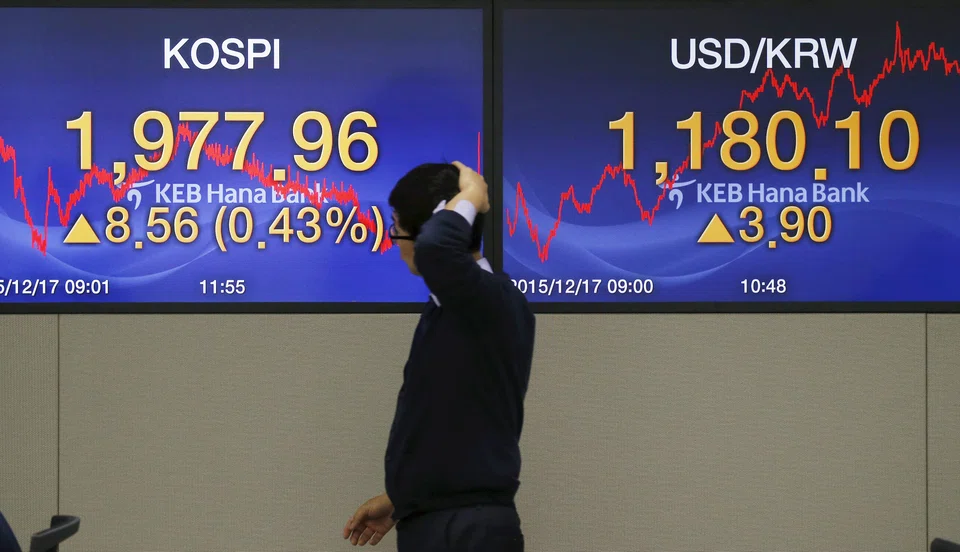
DeeperDive is a beta AI feature. Refer to full articles for the facts.
[SEOUL] South Korean shares slipped on Tuesday as many stocks went ex-dividend, and a risk-off mood dominated investor sentiment as oil prices resumed their decline.
The Korea Composite Stock Price Index (Kospi) was down 0.2 per cent at 1,960.30 points as of 0229 GMT, after falling as much as 0.9 per cent to 1,946.21 points earlier in the session.
"As market participants are wrapping up the year, they are looking to small- and medium-sized stocks," said Kim Ye-eun, a stock analyst at LIG Investment & Securities.
South Korean brokerages stocks and banking groups slid, with Daishin Securities Co Ltd falling 4.4 per cent, KB Financial Group losing 1.3 per cent and Hana Financial Group shedding 1 per cent.
In contrast, the sub-index for medical supplies companies jumped 5.9 per cent as of 0229 GMT on bargain hunting after declines in recent trading sessions.
Hanmi Pharm Co rose 12.1 per cent, Chong Kun Dang Pharmaceutical Corp advanced 4.5 per cent, and Ilyang Pharmaceutical Co Ltd gained 5.9 per cent.
Navigate Asia in
a new global order
Get the insights delivered to your inbox.
Samsung Engineering shares rose 27.1 per cent on expectations that its capital increase plan would be successful, helping boost its financial conditions.
Foreign investors are poised to become net sellers for a 19th consecutive session, offloading a net 62 billion Korean won (S$74.90 million) worth of Kospi shares near mid-session.
The South Korean won stood at 1,167.7 per dollar, down 0.2 per cent from its previous close of 1,165.4. It was set to snap a five-day winning streak.
March future prices on three-year government bonds gained 0.06 points to 109.64.
REUTERS
Share with us your feedback on BT's products and services
TRENDING NOW

Autobahn Rent A Car directors declared bankrupt over S$50 million each owed to DBS

Amazon’s MGM Studios gains creative control over ‘James Bond’ franchise
UOB’s Wee Ee Cheong says S$4.9 billion Citi deal ‘paying off’ as Asean push accelerates
In taxing wealth, how far can Singapore push property owners?

