

Forty years on, Voyager is still hurtling through space, sending back new data
Miami
ARE we alone?
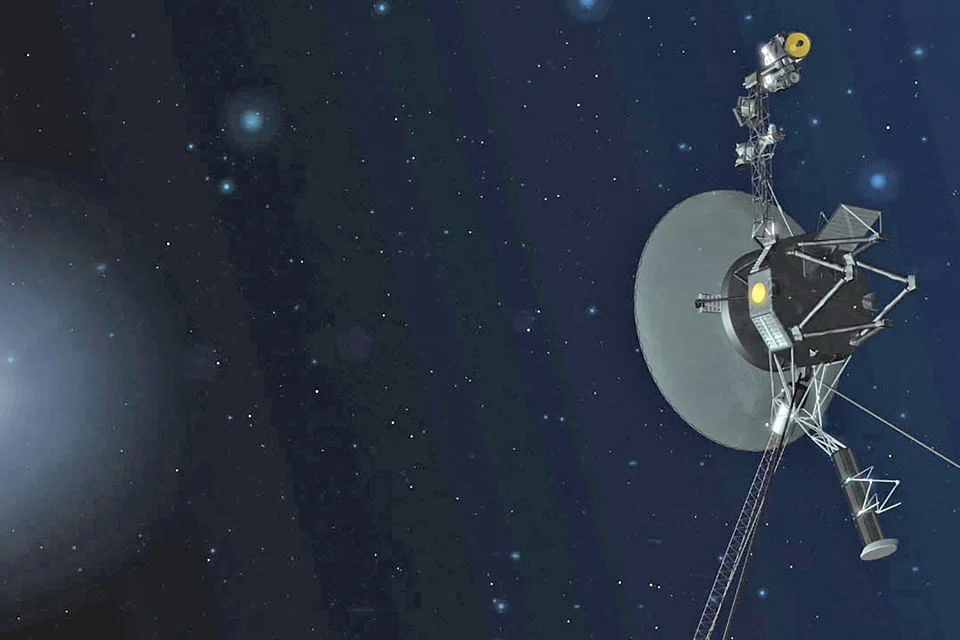
Forty years ago, Nasa rocket scientists sought to answer this question by launching the Voyager spacecraft, twin unmanned spaceships that would travel further than any human- made object in history.
They are still travelling.
When Voyager 1 and 2 launched in 1977 from Cape Canaveral, Florida, scientists knew little about the outer planets in our solar system, and could hardly imagine the scope of their upcoming space odyssey.
"None of us knew, when we launched 40 years ago, that anything would still be working and continuing on this pioneering journey," said Voyager project scientist Ed Stone.
The spaceships' main mission was to explore other planets including Jupiter, Uranus and Neptune, but they also carried the story of humanity into deep space.
On board each spaceship is a golden record - and record player - that is built to last one billion years or more and contains key information about humanity and life on planet Earth, in case of an alien encounter.
The sounds include the calls of humpback whales, the Chuck Berry song Johnny B Goode, Beethoven's Fifth Symphony, a Japanese shakuhachi (a type of flute), a Pygmy girls' initiation song and greetings in 55 languages.
Late American astronomer Carl Sagan, one of the lead scientists involved with the project, also asked his son, Nick, who is now 46 years old, to record his voice on it. "Hello, from the children of planet Earth," says the young boy.
A total of 115 images are encoded in analogue form, including the Great Wall of China, sunsets, elephants, Jane Goodall with chimps, a train, a breastfeeding mother, dolphins and images of the human sex organs.
Voyager 2 launched first, on Aug 20, 1977, followed by Voyager 1 on Sept 5 on a faster, shorter trajectory that would eventually take it into the lead.
The project had faced many challenges from the start, from tight budgets to the limits of modern technology in the 1970s.
One scientist famously recalled wrapping Voyager's cables in aluminium foil - the store-bought kind for kitchen use - to protect the spacecraft from frying in heavy radiation.
Then-US president Richard Nixon wanted to contain the mission to a two-planet flyby and a five-year life but scientists building the spaceships planned for a longer mission just in case.
The cosmic duo went on to unveil planetary features unlike anything ever seen, including details of the surface of Jupiter with its raging storm.
"These were, at that point, better pictures than any ground-based telescopes could provide," said Alan Cummings, a senior research scientist at Caltech who worked on the project beginning in 1973.
The mission also discovered the first active volcanoes beyond Earth on Jupiter's moon Io, and signs of a sub-surface ocean on Jupiter's moon Europa. Saturn's moon, Titan, turned out to have the most Earth-like atmosphere in the solar system, while Neptune's moon Triton was revealed to be spewing icy geysers.
Astronomy textbooks were rewritten on a wide scale, thanks to Voyager, which "revolutionised the science of planetary astronomy", Nasa said in an online remembrance of the famed mission.
When Voyager had no more planets to be encountered on its trajectory, Mr Sagan pressed to have its cameras turn back towards Earth for a final snap of the planet that sent it. From 6.4 billion km away, the images were taken on Valentine's Day, 1990. The Earth appeared as tiny as a speck of dust in a sunbeam, less than a single pixel in the vastness of space.
The plutonium-powered spaceships will continue until they run out of fuel, and will then orbit in the centre of the Milky Way galaxy. Scientists still hear from the Voyager spacecraft daily, and expect to get data for about another decade. AFP
TRENDING NOW

He built the Vingroup empire. Now South-east Asia’s richest man is handing some key roles to his sons
Seatrium allocates S$200 million for new share buyback programme

32 companies, 6 individuals bag accolades at Singapore Corporate Awards 2026
Stocks to watch: Mapletree Logistics Trust, Seatrium, Keppel DC Reit, Food Empire

