

Need a product or service? Get it online - on demand
Singapore
THE "Uber-ification" of services has arrived in Singapore with the proliferation of platforms offering on-demand services that users can access and book from their smartphones - and within seconds too.
If you need a ride, Uber will get you a taxi; delivery van, GoGoVan; groceries, Redmart; food, Foodpanda; takeaway meals, SkipQue; sanitary napkins (yes, even these), PSLove.
The list goes on.
Vinnie Lauria, founding partner of Golden Gate Ventures, a venture capital firm with offices in Singapore and Silicon Valley, said: "We are seeing a lot more TaskRabbit-esque services this year compared to years prior. I think it's due to the fact that people are turning online for more commerce in Singapore than ever before."
TaskRabbit, founded in Boston in 2008, lets users use a mobile app to outsource small chores to others by stating the task they need done and the price they are prepared to pay; pre-approved contractors then bid to do the job.
Mr Lauria said that although the on-demand scene has only just popped up in Singapore, it will soon become a way of life. "Just look at the US, with the TaskRabbits and InstaCarts. It's only possible now, thanks to the cheap technology that can quickly connect two parties in an instant, real-life, local marketplace, complete with a rating system for service quality," he said. "The systems never existed before to make connecting multiple parties so cost-efficient."
In the first week of this month alone, at least three online platforms offering contemporary, on-demand services burst onto the scene in Singapore:
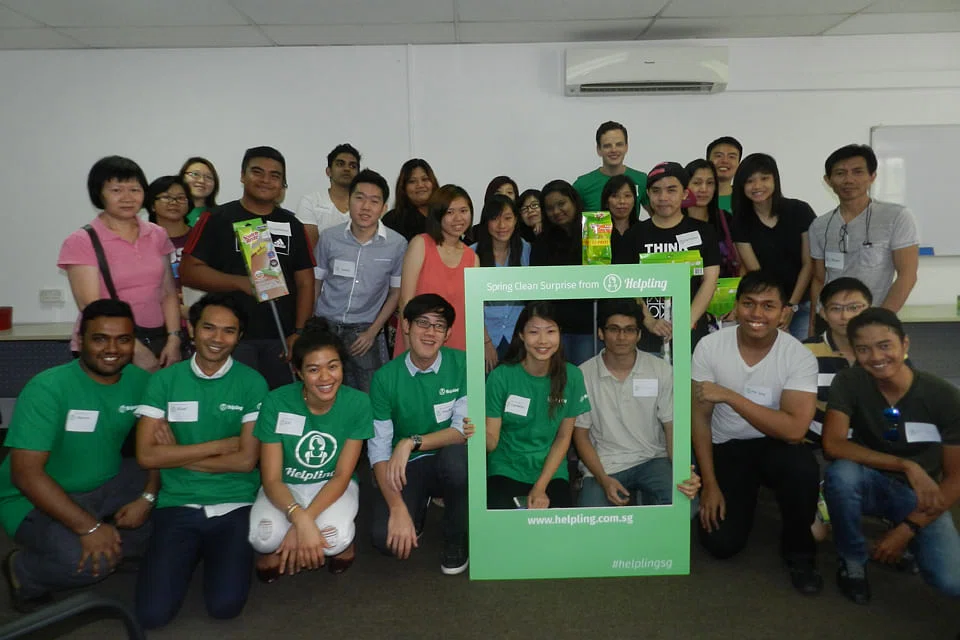
Lynette Chong, business development manager at Helpling Singapore, said: "Singaporeans are busy people. There is a large middle class of people who'd rather hire a cleaner for a few hours while they go out for dinner than spend all night cleaning after a long day of work."
Until now, finding a cleaner would usually entail a series of phone calls or paperwork, but Helpling said it can help users book a cleaner within 36 hours. The fee is a flat S$20 an hour, with no additional third-party or registration fee. Users make payment online using their credit cards.
Helpling Singapore is the Berlin- based startup's first foray into Asia. Founded last April, it has so far set up shop in some 150 cities across 11 countries, among them France, Sweden and Australia.
It is looking to diversify into babysitting and dry-cleaning services, and to expand into the rest of Asia, The Business Times has learnt.
Last December, Helpling raised US$17 million in Series A funding from investors such as Phenomen Ventures and Mangrove Capital Partners. It is backed by German incubator Rocket Internet.
Meanwhile, Singapore-based CGA aims to motivate, empower and mobilise communities to care about people around them.
Its chief executive Yeo Wan Ling said: "A time will come for all of us when we will face the need to look for care solutions for ourselves or our loved ones. Typically, this need will come unexpectedly and require almost immediate attention."
Almost always, she added, the failure to get trusted, on-time care for a loved one will lead to heartache and stress for the family. CGA thus seeks to offer easy, transparent access to accredited, reasonably-priced and quality care services, she said.
The portal also encourages its pool of caregivers to become independent healthcare practitioners, granting them total control over their schedules and pricing, and how they advertise their care specialty areas.
While the portal is now free for use for all care-seekers and caregivers, art therapists will enjoy a free lifetime subscription under a drive to boost this "up-and-coming" and "transformative" form of caregiving, said Ms Yeo.
CGA and Helpling will launch mobile apps soon.
In a feature article for NYMag, Kevin Roose observed that the "sharing economy" - referring to the startups in the business of renting out services or possessions to strangers, usually aided by technology to connect the parties - may be a sign of a struggling real economy. A depressed labour market could lead to people trying to fill holes in their income by monetising their belongings and their labour - but in creative and tech-enabled ways, he said.
TRENDING NOW

Singapore’s central gas buyer affirms Indonesia’s role as ‘important partner’ amid export review warning

Why the biggest business decision about AI isn’t which model to choose

Is Manila Asia’s new dining hot spot?

KKR founders among investors buying 42% of Peter Lim’s Valencia; club valued at US$1.4 billion

