Punggol Digital District: Singapore's first tech-driven enterprise district
50-ha development features 'exchange of spaces' between business park and campus
Singapore
THE Punggol Digital District (PDD), a new 50-hectare development in Punggol North, is set to become Singapore's first Enterprise District driven by technology and innovation.
It will comprise a JTC business park for digital economy-type companies, the Singapore Institute of Technology (SIT), and community facilities including a hawker centre, community club and heritage trail.
PDD's Masterplan was unveiled on Sunday by Deputy Prime Minister Teo Chee Hean, who noted Punggol's evolution from a fishing village to a Waterfront Town that is home to about 200,000 residents today.
He said: "Now, we are ready to embark on a new phase - to develop PDD. Such efforts also support the work at the national level to build a Smart Nation. We want to deploy more smart technologies, and prepare our workers for the digital economy."
As an Enterprise District, PDD will feature different land uses that can be co-located within a single development.
For instance, SIT's research labs and learning facilities could reside within JTC's business park buildings, while JTC could host industry research and even create startup spaces within SIT's campus.
This "exchange of spaces" between enterprise and education is said to be a first in Singapore.
Chan Ee Mun, a director at architecture firm Woha, told The Business Times: "While it's not uncommon to have industry or enterprise take up space in universities or sponsor research and collaborative endeavours in institutes of higher learning, PDD is unique and a first-of-its-kind in that it is conceived as a fully-integrated district that merges learning spaces within enterprise and vice versa."
He added that the "mixing of entrepreneurial instincts with the enthusiasm of young students" within a digitally-enhanced district that supports startups, test-bedding and early implementation strategies will allow good ideas to flourish and quickly take root.
"Businesses have a ready pool of future thought leaders and innovators while students have access to expertise and opportunities. The population of Punggol are also a ready pool of early adopters that can signal the potential of innovative products that arise from this enterprise-education partnership."
When asked if PDD could offer the enterprise-education relationship and rounded entrepreneurial ecosystem most commonly associated with Silicon Valley and Stanford, Mr Chan said: "PDD takes this a step further by developing a business park with a full-fledged university that is fully entwined."
Woha, which was engaged both by SIT and JTC for the PDD masterplan, is also the architect for three JTC parcels within PDD and Plot 1 of SIT.
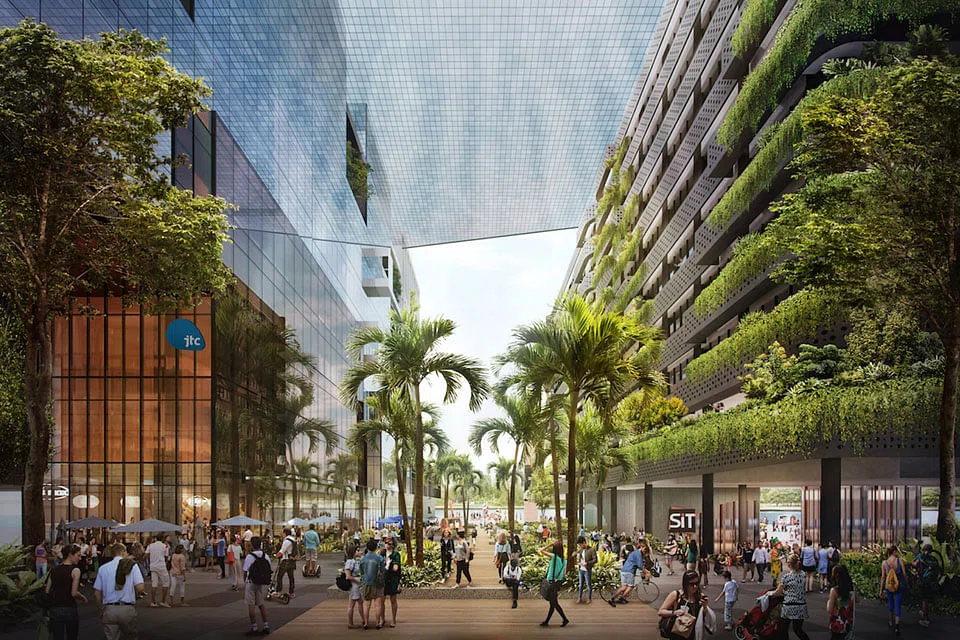
Campus Boulevard, an 800-metre pedestrianised street between the SIT campus and JTC's business park buildings, will become a key gathering space and route that connects the various developments within PDD.
JTC chief Ng Lang said: "To be developed progressively, PDD will be the first district to adopt a 'one integrated masterplan' approach that brings together a business park, a university and community facilities."
The JTC business park, scheduled to commence development this year, will house companies that are in the key growth sectors of the digital economy, such as cybersecurity, artificial intelligence and the Internet of Things.
Locating these sectors in PDD is believed to bring roughly 28,000 jobs closer to residents in Punggol and the north-east region.
District-level infrastructure aimed at optimising the use of land and energy resources, including a District Cooling System, an Integrated Facilities Management System and Centralised Logistics Hub, will be set up.
The four agencies behind PDD are SIT, JTC, the Urban Redevelopment Authority and the Infocomm Media Development Authority.
PDD's first building will be ready in about five years' time.