

All in the blood
Medical scientist David Zahniser pioneered a technology that changes fundamentally the way labs run blood tests.

Vivien Ang
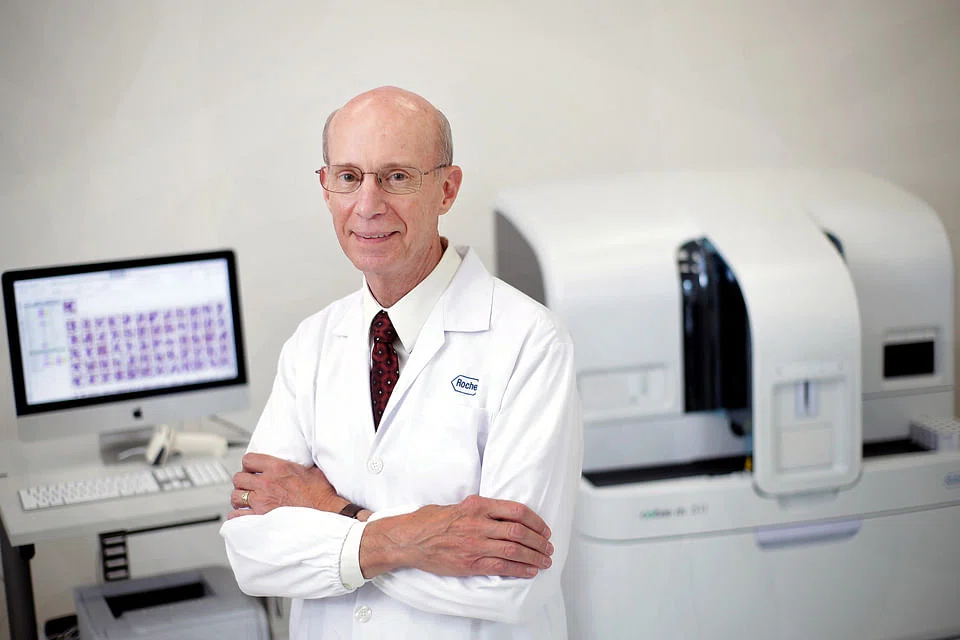
IMAGINE being able to assess the state of one's health with just one microlitre of blood. That's now a reality with Bloodhound technology, which performs a complete blood cell count with, yes, just that volume - one-millionth of a litre, or a few drops. With a complete blood cell count, a doctor can evaluate a patient's overall health and detect a wide range of disorders including anaemia and leukaemia. While conventional blood tests require drawing about 110 microlitres of blood (one vial), Bloodhound uses only 30 microlitres - of which one microlitre is used for the test.
The man behind the invention, medical scientist David Zahniser, tells The Business Times that the technology was created in the most unlikely of places - his home basement - and how the invention was in fact a family affair. A scientist-entrepreneur, Dr Zahniser, 66, has been labelled "a Steve Jobs in the world of diagnostics". In 2004, two doctors from Brigham and Women's Hospital in Boston had approached him for help with analysing blood cells on a computer image.
Dr Zahniser was then an independent consultant to Cytyc Corporation, a company he co-founded and which had developed an automated method for preparing microscope slides of cervical cell specimens.The two doctors had known about his work in cell digital imaging and analysis of Pap smear slides.
Dr Zahniser's interest was piqued and he set up a laboratory of sorts in his basement and buckled down to it. But he would hit some stumbling blocks before long.
Trick of the light
Try as he did, he didn't seem to be able to replicate the images of blood cells shown to him by the doctors. "I used to get an extra tube of blood when I visited my doctor. I would also prick my finger. I pricked my finger dozens and dozens of times, but I just could not reproduce the image the doctors had shown me."
But one day, as he was working in the basement-lab, he noticed the sunlight streaming through the window and suddenly, he realised he was looking at the same images that the two doctors had seen.
Apparently, the crux of the issue was in the angle of the light.
"Luck definitely had a part to play in it," Dr Zahniser says with a laugh.
After that serendipitous moment, coming up with the Bloodhound technology involved the family.
"I have twin boys and one of them developed the algorithm for 'teaching' the computer how to measure the cells. The other developed the system for visualising and sorting the various types of red blood cells and white blood cells. My daughter joined us two years later. She majored in computer graphics so she did the graphics for the interface and helped us with the manuals for the users and servers." Hence - a pioneering technology that would fundamentally change the way laboratories run blood tests - and which has since been acquired by Roche Diagnostics.
One problem that Dr Zahniser had to overcome was how to present "picture perfect" cells to medical technologists as diseases such as leukaemia may affect the blood's viscosity and the fragility of the cells.
"We probably spent a couple of years on that (problem). We tried to make the drop bigger or smaller. We used different chemicals to colour the cells but it all didn't work. The white blood cells would remain as a sphere, and it is hard to differentiate the cells when they all look like ping-pong balls."
In tackling this, Dr Zahniser had his second Eureka moment in the invention (the first being the discovery of the angle of the light). And that's in "realising that when you make a thin enough layer of printing the blood on the slide with automated technology, suddenly those cells would look like the perfect cells you see in the textbook".
The key is standardisation, he says. From the preparation - the technology accurately prints one microlitre of blood onto the slide - to viewing and analysing the blood test results on any computer, everything is done in the same way for every patient.
The amiable scientist tells BT why he believes the technology will revolutionise the healthcare industry. Firstly, it allows medical technologists and doctors to detect rare, pre-cancerous cells faster and more accurately as it is more "sensitive" in detecting any abnormalities in the blood cells.
Only six minutes
Peering down a microscope looking for a bad cell among a multitude of normal cells is akin to looking for a needle in a haystack. It's a different scenario when the computer is tasked with the job.
"The computer is good at counting. So, by letting the machine handle that task, and later presenting it on the Apple iMac, you get more reliable results."
Looking very much the scientist in his white lab coat, Dr Zahniser patiently explains the mechanics of the invention. He says that after the blood sample is run through the machine, the result will be sent to the computer which is able to flag cell abnormalities much faster and has an "amazing capability of manipulating the images such as sorting the cells according to size and shape".
This function is why the technology is named Bloodhound. "It tracks down the abnormal blood cells and presents it to us," Dr Zahniser says.
And instead of the half hour or so needed to produce and analyse a slide, it takes only six minutes to obtain a detailed presentation of the patient's full blood cell count.
Moreover, location is not an issue with Bloodhound as the system is connected to the Internet.
"You can have diagnostic experts in another area looking at images sent over by a team in a remote location. So, instead of having to literally take the slides and run down to the doctor's office with them, maybe in a different part of the city, you can sit in front of your iMac and see the images, and a diagnosis can be reached sooner."
At the same time, both the margin of error and the need to do retests are drastically reduced.
"Think about it, more tests sometimes need to be run after the count is done and an anomaly is spotted. You need to handle that tube of blood again, make another slide and look under the microscope again before pulling up the patient's data and keying in the details into the computer. What is the chance of making a mistake? Bloodhound allows these touch points to be eliminated as everything is self-contained in our system, which reduces the probability of an error."
Patients with blood diseases and infants will benefit most from Bloodhound, which requires less blood to be drawn compared to conventional tests.
"Sometimes, the baby has to have his/her blood drawn one to two times daily, which can lead to the infant needing a blood transfusion as the newborn just does not have that much blood. It is pretty dramatic stuff and I would like to see us evolve the device so we can further reduce the amount of blood that needs to be drawn."
Roche acquired the Bloodhound technology in July 2013 when it bought over Constitution Medical Inc (CMI), which developed the technology and where Dr Zahniser was chief scientific officer. Roche paid CMI US$220 million upfront, with further contingent payments on the achievement of certain milestones. Asked about the transaction, Dr Zahniser laughs and says he does not remember the details as it is "not all about the dollars and cents, but rather, the science", he quips.
"Roche has a high standard of quality for their instruments and the firm has service people worldwide. But as Roche at that time did not have a technology such as Bloodhound, we knew we wouldn't be just another haemotology instrument in their portfolio. We were going to be the haematology instrumentation."
Morever, Dr Zahniser was on the lookout for a partner as he wanted to make the leap from just doing R&D of the technology to making the instruments to sell.
The technology has since obtained the CE mark in Europe in December last year and is projected to hit Asia in 2018.
How did Dr Zahniser - who started out as a physicist, with degrees from MIT - venture into the world of biophysics? He got excited, he says, about getting involved in the medical arena during a stint at a laboratory in Geneva and became interested in melding the worlds of physics and biology.
"I was at a centre for European nuclear research and I overheard a man talking about using a device we used in particle physics to measure cells. I went back to MIT and pitched the idea that we do something similar to help people be diagnosed more accurately within a shorter span of time."
But as MIT did not have any course in biophysics at that time, Dr Zahniser went ahead and created his own research area in the field.
He's now working to further refine the Bloodhound technology.
Firstly, the technology should be able to become "more sensitive" to rare abnormal cells, such as in cancer of the blood or any blood disorder, he says.
Cancer: earlier detection
"That will greatly help patients because you can get an earlier detection of a recurring cancer. We currently are also looking for parasites in the red blood cell. Because we have these measurements that are being done on the size and shape of the cells, we can give more info to the labs than you could with any other system. That is going to be a big advantage especially in the Asia-Pacific."
Another area of haematology is the analysis of body fluids and the technology can be used to analyse blood cells in areas of the body where they shouldn't be present, for example, in the lungs and spinal fluid.
"The moment you have something that shows the presence of blood, we have the pictures that show the types and number of cells. It can also help look for changes in the cells in a way you can't do if you just have a count. So the picture, the digital images, are really the heart of the system."
A hematopathologist, or broadly, blood specialist, makes all the diagnostic decisions with his eyes, Dr Zahniser says. And he's on a quest to "make that occur more easily, more rapidly, and (so) help make their job easier and more efficient".
vivang@sph.com.sg
DAVID J ZAHNISER Chief Scientific Officer Roche Diagnostics Hematology
BS and MS Physics, Massachusetts Institute of Technology
PhD BioPhysics, University of Nijmegen, The Netherlands
1980 - 1989 Assistant Professor at Tufts Medical School
1989 - 2004 Vice-President of Scientific Affairs, Cytyc Corporation
2004 - 2009 President, Diagnostic Vision Corporation
2009 - 2013 Chief Scientific Officer, Constitution Medical Inc
Since 2013 Chief Scientific Officer, Roche Diagnostics Hematology
TRENDING NOW

‘We don’t want to stay as we are’: CEO Patrick Ng builds a more resilient Huationg

URA to review guidelines on floor space to give developers more design flexibility: Chee Hong Tat

He built the Vingroup empire. Now South-east Asia’s richest man is handing some key roles to his sons

32 companies, 6 individuals bag accolades at Singapore Corporate Awards 2026

