

Breaking Taboos
Douglas Young wants to take his Hong Kong cult lifestyle brand Goods of Desire (G.O.D.) international.
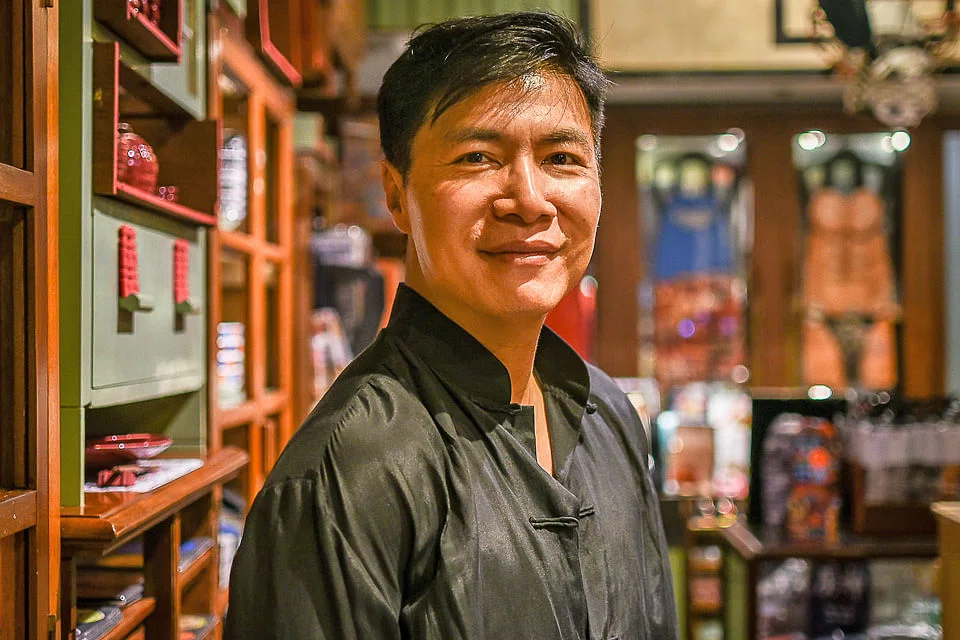
FOR two decades now, trained architect-turned-designer Douglas Young has been the face of Hong Kong cult lifestyle brand G.O.D. (Goods of Desire).
As co-founder and CEO, he has brought the brand from its nascent days in a warehouse selling mainly furniture to its current status as a household name in the city producing a range of goods melding Hong Kong tradition and culture - including Cantonese profanity - with modern practicality.
But his years at the helm could soon come to an end if Mr Young were to have his way - he feels it could be time to "shift gears" and sell a stake in the company to a bigger name that can then help bring it online and international.
There have been investment offers from interested parties and "being acquired" is also an option Mr Young is considering. "That could happen if we can find sympathetic partners because what I really do enjoy is the creative process and it's really very difficult for me to be creative and run the operations at the same time. I would love to be able to just concentrate and allow the business to grow through other people," says the 52-year-old.
Creative designing, after all, is his first love.
Born in Hong Kong in 1965 as the only child of a housewife and her engineer husband, Mr Young was encouraged from an early age to pursue his interest in the arts.
"From a young age, I've always been into creating things, drawing or building things with Lego. And my parents always indulged me, or encouraged me to do whatever I liked," he says.
"I think lots of kids growing up in Hong Kong, the kid may be talented in, say, music, but the parents may not be willing to nurture or groom the kid to become a musician because they feel you don't make money as a musician. So I'm lucky in that I've very supportive parents, both psychologically and financially."
"Mess around"
At age 14, he was sent by his parents to boarding school in a sleepy village about 240 kilometres north of London, a move that was "both scary and emancipating", says Mr Young.
"In Hong Kong, it's all about homework and exams and it's high pressure, whereas I'm really interested in the arts and painting... and there just isn't time in Hong Kong for all of that," he says.
Hong Kong also seemed to lack the space for creativity or for children to "mess around", he adds.
"It may sound trivial, but I think space really does matter. Whenever I wanted to paint at home, the only big enough table was the dining table, and I had to lay out all my paints and canvas on the table, but always had to pack up when they needed to use the table for dinner," he recalls.
"In the West, a lot of kids have the space, be it the backyard or the garage, to just lay everything out. When they feel like painting, they can just go and paint and be creative... When I arrived in the UK, I found that space, and so I could develop unrestrainedly."
He went on to study architecture at the University of Sheffield, then worked as an architect for several years in London, with little thought of returning to his birth city.
But he now believes "destiny" brought him back to Hong Kong. "It was early in the 1990s and London was going through a very bad economic period, whereas in contrast there was a lot of work in Hong Kong. So I found myself with a project in Hong Kong and... one project led to other projects. I thought there were more opportunities back here, so I decided to stay," he says.
It was during his stint as a practising interior designer and architect in Hong Kong that he discovered a newfound appreciation for the city, and a yearning to translate that into his designs. "I was almost like half a tourist because I had been away for such a long time... Things I had taken for granted suddenly appeared foreign to me," he says.
"I've always wanted to express this from an artistic point-of-view... always tried to push this agenda with my design clients. I guess it was something that was very difficult to happen when it came to architecture because back then in the 1990s nobody would have thought that this kind of Hong Kong aesthetic would be a good idea.
"I guess I was frustrated that I couldn't convince other people to give it a try, so I decided to use my own money and make an example of it."
He teamed up with business partner Benjamin Lau who shared similar views and interpretations of Hong Kong culture, and they founded G.O.D. in 1996 in a bid to lead a "revolution" in local retail. The goal was to "rejuvenate Hong Kong culture and heritage", which Mr Young - who counts Shanghai Tang and Vivienne Tam as other brands that inspire him - feels the city's people may not properly value.
The two partners pooled together HK$1 million of their own money and procured their first shop space in a warehouse district industrial building, selling mostly furniture they had designed. Things seemed to be progressing well and they expanded to three shops within a year, but then the 1997-1998 financial crisis hit, followed by several other bumps such as the 2003 Hong Kong SARS epidemic.
Mr Young is coy about his company's financials, saying only that it has been "a rollercoaster ride" over the last 20 years.
In 2015, G.O.D. closed its store in Singapore - its first overseas outlet - after three years in Central Mall on Clarke Quay, citing sluggish retail sales and a shift to online shopping.
Quirky products
"It's never been easy, it's always been a struggle," says Mr Young. "It has been up and down, it hasn't always been profitable. Luckily we're a small business; even when we're losing money, I can just about afford to compensate."
Despite the challenges and climbing rentals in Hong Kong, G.O.D. has prevailed, thanks in part to loyal customers drawn to the brand's quirky products, who are unafraid to brandish outlandish humour or embrace "taboo" subjects - a hallmark, almost, of Mr Young's design work.
His bold stance has earned admirers but also invited trouble from authorities.
He was arrested by Hong Kong police in 2007 for printing a set of T-shirts with the logo 14K, also the name of a Hong Kong triad. No charges were ultimately filed after he insisted that 14K referred to 14-karat gold, and it only made Mr Young more determined to keep pushing the envelope with his designs. "Some of our T-shirts have profanity in them, or at least things that allude to profanity, and people may be offended by those, but I do feel that to be creative is to challenge taboos and to challenge conventional thinking. The artists that I admire the most are the ones who are not afraid to push the limits. Because by pushing the limits, you help society progress," he says.
"I think Hong Kong is a very conservative society and people often say that they are glad that we're conservative, but... I think it's not possible to be conservative and innovative at the same time. To progress, you've got to think outside the box, you've got to break convention, and you've got to challenge the status quo."
Puns and double entendres pepper the custom-designed houseware, apparel and fashion accessories on offer at the six G.O.D. stores in Hong Kong today.
And Mr Young believes the brand's appeal can be extended further internationally, if given the right platform.
"I feel that there is definitely scope for G.O.D. to be introduced to places outside of Hong Kong, I don't know whether that would be through physical shops or through the Internet. We would love to work with more people who could help us expand, because up till now, we've just been a private company... and we don't really have that experience both on the Internet or in running shops outside of Hong Kong," he says.
Mr Young also believes the brand's East-meets-West, old-meets-new concept can be applied to a wide range of traditional Chinese or Hong Kong products.
"What I try to do is to change the shape so it becomes more modern, and the material so it feels more updated. I feel like there are so many things from food to graphics to clothing to homeware that can be updated, and it's the responsibility of us designers to do that job," he says.
One of the challenges ahead for G.O.D. would be to find a balance between growth and agility, he adds.
"If I open all over the place, the whole thing will become a monster, it would just be a numbers game... Right now the business is not big, we can afford to experiment, take risks," he says.
Shift gears
"There's a part of me that wants to stay where I am, but there's also a part of me that wants to shift gears, because I want to try the next level. I would love to be more creative in my advancing years, but in order to be more creative, I need to let go of the things I'm not so good at, such as maybe operations.
"So it would be great if somebody could take over the operations side, take a stake in the company, and allow me to be in my studio and work with my design team."
One thing that has not changed for Mr Young is his vision for G.O.D. as a "figurehead for Hong Kong people and Hong Kong culture".
"This is something I feel really strongly about, and that's why we've lasted 20 years. And I still have so many ideas I haven't realised yet," he says.
"People keep asking me, 'Hong Kong is a small place, when are you going to run out of ideas?' I was actually worried, too, when I first started out, that I might run out of ideas or might get bored, but the more I'm involved, the more ideas I have, the more energy I have; it's like a momentum I'm gaining."
DOUGLAS YOUNG
CEO and co-founder G.O.D. (Goods of Desire)
Born in Hong Kong in 1965
EDUCATION
1986: Graduated from University of Sheffield with degree in Architecture
1990: Architectural Association, London, graduate
2017: Awarded Honorary Doctorate of Humane Letters by Savannah College
CAREER
1990-1996: Founder of architectural and interior design firm Young Associates Limited
Since 1996: CEO and Co-founder of G.O.D.
SELECTED AWARDS
2017: "Top 50 Innovative Retail Leaders in Hong Kong" by Inside Retail Asia
2015: 'The 100 Most Influential People in Hong Kong' by Debrett's
2015: "Top 10 Hong Kong Product Designers" by The Culture Trip
2014: "The Best Chairman" by Milk X magazine
2011: "Gold Award" & "HK Best Award" by Hong Kong Design Association Global Design Award
2009: "Man of the Year" by Hong Kong Business magazine
TRENDING NOW
IOI Properties and CapitaLand Investment closer to acquiring One Raffles Place in joint bid

OCBC sheds S$8 billion in value as shares close nearly 6% down; analysts cautious on banks

Grab CEO’s wife Chloe Tong on life with Anthony Tan and finding her purpose
Crystal Jade closes four more outlets, cuts 120 jobs ahead of proposed sale

