

Cloud with clout
Google's cloud chief Diane Greene says the cloud is a utility everyone can and should use.
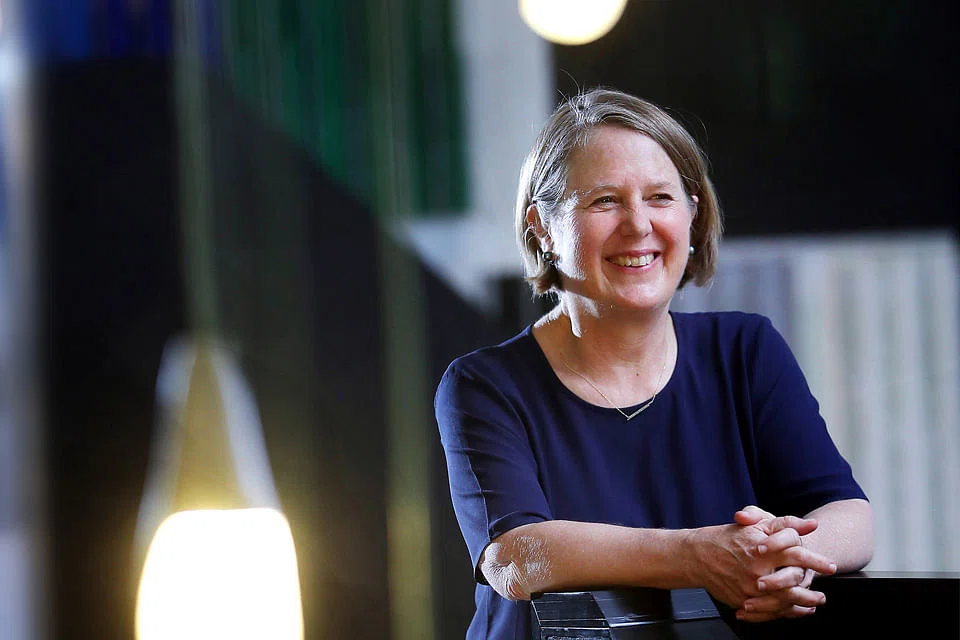
ENTERPRISE sales, to Diane Greene, isn't a matter of sweet talking and expense accounts. Rather, it's "really a science", says the chief of Google's massive cloud computing business, which has set its sights on becoming the top cloud provider in the world.
"It's a numbers thing. You've got to have great data and really analyse it, and structure the organisation to make it all work. You engineer a sales operation. I think it's a matter of seeing how everything influences each other. Everything is much more connected than I think people realise," she says, adding that it resembles building a "finely tuned machine".
"You can't go out into the enterprise without everybody reinforcing the work of each other, because we're all collaborating... There's got to be a lot of communication and everybody has to understand the cause and effect of what they're doing so that it can all work together. You don't want one gear turning a lot faster than the other."
That formula for success has worked, and many times over. A Silicon Valley legend who rose to prominence after co-founding and taking public a virtualisation software company called VMWare - which was at one point the third most highly valued software maker in the US - Ms Greene is a serial entrepreneur with a sharp business acumen.
She joined Google's cloud unit in 2015 after the tech giant bought her cloud platform startup Bebop for US$380.2 million. In a testament to her reputation, the purchase was widely seen as a big win for Google. And although she made about US$149 million from Google's acquisition of Bebop, she said she would donate it to charity.
An engineer's engineer
Speaking to The Business Times at the launch of the tech giant's Singapore cloud platform earlier in June, at Google Asia Pacific's Mapletree Business City II premises in Pasir Panjang, Ms Greene is no-nonsense, direct and the very opposite of flashy. Her speech is peppered with occasional science-related metaphors, and she visibly lights up when talking about technology.
"I like building new things," she says simply. "What excites me, is really - it's everybody inventing the future in such a positive way. And being part of it and being the technology enabler for all this is pretty exciting."
In a fashion that an engineer would approve of, her ascent to the top was built on a deep foundation. She studied mechanical engineering in college, went on to get a master's degree in naval architecture from the Massachusetts Institute of Technology (MIT), and worked on designing oil rigs as her first job. She later went back to school to get a master's degree in computer science at University of California Berkeley before co-founding VMWare.
"It was incredibly helpful to be very technical... I also enjoy working with technical people quite a bit," she says. "In doing the business and working with executives at other companies the fact that I understood the technology gave me a huge advantage, because of how we would structure deals and how we would collaborate on creating something for the future together. I was able to brainstorm in a really concrete way. I never felt like there was much awareness of gender; we were just building."
Born in Rochester, New York, Ms Greene grew up by the water in Annapolis, Maryland. As the third eldest, with three brothers, she was "quite used to" being in an all-male environment, she quips. Even her early interests were arguably related to engineering. Her father had a boat, and "I was going out on a boat before I could walk", she says.
"I grew up racing sailboats on the Chesapeake Bay, and racing a sailboat is kind of an engineering endeavour... It's a project. You're building something, you're being prepared for something, and the engineering involved in making a boat go fast is fairly considerable."
How she ended up doing mechanical engineering, though, is something of a "funny story", she says, partly to do with a special project in high school.
The project involved bridge design, "where I built this little bridge with these little aluminium trusses". "I got a spring gauge and glued it up to one of the trusses and hooked it up to the electronics," she notes, with relish. "And then I kind of moved it around and hung loads and measured the flexion. It was a really fun, cool project."
After graduating high school and going to college, she chanced upon a course called Statics "that was all about what I had done", and decided she would sign up.
When she turned up for class - "of course I'm the only girl in it" - the professor asked the roughly 80 students in the room to say what kind of engineering they were majoring in.
Her immediate thought then was: "Well I'm majoring in psychology but there is no way I'm gonna say that!" she recounts, laughing. "And the guy next to me goes, 'mechanical engineering' - and I'm like, 'Yeah, mechanical engineering'." The professor then said, "Young lady, would you talk to me after class?". And when she went up to him, he told her: "I'm so glad you're going to be majoring in mechanical engineering. I'm going to be your adviser!"
Another reason she stuck to mechanical engineering was that she was busy racing sailboats in her college days and was therefore moving from school to school, "to be where the sailboat racing was that I wanted to be part of", she says.
"What I found out pretty quickly was the psychology and literature classes didn't transfer and the engineering classes always transferred, and so I could get out in four years if I majored in engineering. That worked pretty well."
She attended three different colleges as an undergraduate and graduated from the University of Vermont. But when she "looked around at all the jobs, they didn't look all that exciting to me so I thought maybe I would go race sailboats", she adds.
She changed her mind after the chair of her department, who had gone to MIT, suggested she could study naval architecture there. After her master's degree, she went to work in the oil industry designing rigs, including working on mooring systems for a "firefighting semi-submersible".
"Back then they had no quarters for women on oil rigs, so I couldn't go out in the field which was really frustrating to me... And that's how I got really into computer science."
One thing led to another. She ended up spending six months in Hawaii and worked for windsurfing-related companies, and then decided to go back to school to study computer science at Berkeley.
Cloud clout
The rest is tech history. Ms Greene worked at a couple of startups, including co-founding a low-bandwidth video streaming company called VXtreme when she was 42. VXtreme got sold to Microsoft in 1997 for about US$75 million and became the basis for its Windows media player.
A while later, she decided to set up a company based on her husband's research in virtualisation, and VMWare was born in 1998. It was snapped up by data storage giant EMC for a cool US$635 million in 2003 and Ms Greene stayed on till 2008, including taking VMWare public on the New York Stock Exchange in 2007.
Her entrepreneurial winning streak continued, eventually leading to Google's acquisition of Bebop two years ago - which was largely viewed as an acqui-hire. She was already on the group's radar, having been on its board of directors since 2012, and when she came in to helm its cloud business she embarked on a careful reorganisation aimed at ramping up its enterprise sales push.
"We brought together sales, marketing, Google Cloud Platform and GSuite," she says, referring to the group's cloud services and its business productivity platforms. "We put that all in one group and then we started focusing on the enterprise very seriously, and ramped up our investment on every front." Globally, the company has spent US$29.4 billion in capital expenditure over the past three years on its cloud services.
Its efforts have paid off so far, she says. "When we go head to head with our competitors we're winning about 60 per cent of the time."
Intelligence at scale
Her enthusiasm about cloud computing is evident. The technology has catalysed a transformation in the corporate world, Ms Greene says.
"This is a time when the technology is accelerating faster than anything we've ever seen, the enterprise is now reinventing itself at a faster pace. It's really going through this - sort of a buzzword, but it's digital transformation. They're kind of building a digital version of themselves in the cloud so they can analyse what's going on with their company."
That has helped businesses make decisions more quickly and do new things with more flexibility, she says.
Cloud computing "does a few things for people: It makes it so that you don't have to buy your own computers, you don't have to manage your own computers, storage and networking", she notes.
"You don't have to provision it, the services are there for you to use, and by the way it's reliable - more reliable than probably it would be if you tried to run your own. It's more secure than if you tried to run your own, and probably more performant because it's always state-of-the-art.
"It's also quite a bit less expensive because of the scale a public cloud can run at," Ms Greene says, adding that on top of cost savings from using cloud computing services, businesses can also save at least 25 per cent by using Google's cloud over its competitors' "because of how we bill". The company has made it a point to give users "tremendous flexibility" and has decided to bill "by the minute" rather than by the hour, she says.
When asked about businesses that may choose to run their own "private clouds" instead of using an external public cloud, Ms Greene says running a private cloud is "still a lot harder than just letting someone else manage it and update it and have the latest technology". "I'm convinced that no matter how you look at it, our cloud is ahead of what anybody could do in their private data centre."
One obvious customer for a public cloud would be startups. "If you're building something... you don't know whether you're going to be successful," she notes, adding that using cloud services lets businesses scale up more quickly.
"As you need more it just happens. When Pokemon Go launched they ended up using 50 times what they predicted they were going to need. But because they hadn't had to buy all that hardware and provision it and be ready, they could just have Google keep giving them more resources - and so it takes the risk out of success, if you will."
Startups are not the only businesses that stand to benefit. "If you're a little tiny shop, you're going to use the cloud through a service offered in the cloud. But as you get bigger you develop your own applications and you're going to use the cloud to do your development and build your services," she says.
"Everybody today is getting tonnes of data about their customers and one of the giant advantages of cloud is, all of a sudden you have a place to put all that data."
Storing data in the cloud lets a business "join that data" with other interesting data such as Google Maps, she adds, noting that the company's cloud platform also includes tools for analytics and machine learning, such as image recognition, language translation and natural language processing.
"All these things are available in the cloud. You can simply have an idea and assemble it very, very quickly. You don't have to know anything about how to run a system, how to make it secure, how to make it available, and you don't necessarily have to have machine learning expertise yourself," she says.
"Basically the cloud gives you a way to easily develop a lot of intelligence about your business, be it manufacturing, be it customers... you can customise your decisions."
Brighter horizons
In the future, Ms Greene sees for cloud computing, people will all use the cloud to aggregate, analyse and act on data.
"You will have devices on the edge of the network; you will have sensors, Internet of Things; you will have tiny computers for real-time applications in a factory doing some of the processing. But the cloud - one of the huge strengths of the cloud is it brings all the data together, so the data is no longer siloed, and it's such an enabler in getting insight into things," she says.
Google itself has benefited from using the cloud platform, she adds. "As an example, we just took all the inputs from our data centres' cooling systems, maybe 200 and some inputs, and fed them into a machine learning model we had... a lot of data from all our data centres."
The findings "told us what settings to use for pumps and whatnot, and we were able to save up to 40 per cent in our cooling costs, in our cooling power for the data centres, by doing that".
Cloud computing can be used for medical diagnosis too, she says, pointing to another recent project by Google researchers working on diabetic retinopathy, an eye disease where blood vessels in the retina of the eye may bleed or leak fluid. "We took all these retinal images and then what doctors had diagnosed, and put it all in the cloud."
The researchers used machine learning on that data to come up with a way to spot signs of the disease, which turned out to be as good as or even slightly better than a group of ophthalmologists.
"The cloud is really what enabled machine learning to take off, and these neural nets, because all of a sudden you could have these huge amounts of shared data to train on... where it can diagnose with more accuracy than a doctor. So it's an incredible aid for doctors as they're treating patients." And that applies to every industry - "fraud detection in financial services, an endless number of things", she says. "It's one of those utilities where being able to share and aggregate everything in one scaled place just gives you enormous advantage."
DIANE GREENE
Chief of Google Cloud
1955 Born in Rochester, New York, US
Education
1976 BSc (Mechanical Engineering), University of Vermont
1978 MSc (Naval Architecture), Massachusetts Institute of Technology
1988 MSc (Computer Science), University of California Berkeley
Career
1978 Designing offshore oil rigs for Earl & Wright Consulting Engineers in Houston, Texas
1995 Founder and CEO, streaming media company VXtreme
1998 Co-founder and CEO, virtualisation company VMware
2012 Co-founder and CEO, cloud platform startup Bebop
2012 Board member, Google
2015 Senior vice president, Google Cloud
1976 US national women's sailing dinghy champion
TRENDING NOW

What shattered Crystal Jade? How the culinary empire shrank from 120 to just 9 outlets

‘We’ll wait and see’: Investors wary after STI sinks below 5,000 amid global AI selldown

Indonesia revokes APRIL Group unit’s Riau forestry permits over alleged peatland fires, violations

Vietnam’s Long Thanh airport hits new snag as airlines seek to delay moving operations

