

How to do well by doing good
As president of the Massachusetts Institute of Technology, Rafael Reif upholds a firm belief in using one's huge talents for a larger purpose.
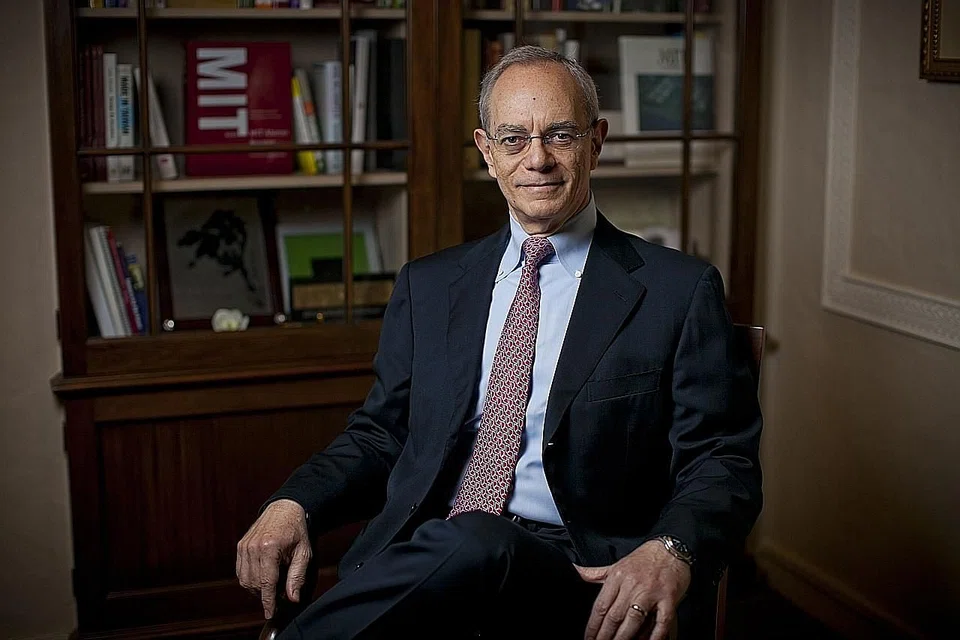
WHAT is better? When you have the power to influence one of the world's most concentrated populations of geniuses, that philosophical question takes on some very real consequences. Professor Rafael Reif is the president of the Massachusetts Institute of Technology (MIT), where some of the most intelligent students in the world mingle with astronauts and Nobel Prize winners along infinite corridors. That wealth of talent compels Prof Reif to direct his charges toward doing better. And so, back to the original question: What is better?
For Prof Reif, doing better means fearlessly embracing oversized ambitions and attacking some of the most daunting, pressing and challenging problems of our times. But above all, better is knowing the difference between doing well and doing good.
"Personally, I always felt that it's better to try to do good with whatever talents you have," Prof Reif says. "If you do something good, it's almost permanent. When you accomplish something good and society benefits, it's not going to go back, or typically doesn't go back. If you try to do well for yourself, maybe I'll be more comfortable, instead of having two cars I'll have three or four cars or maybe a yacht or something. But it doesn't bring any irreversible benefit to society. So I prefer the doing good part."
Born in 1950 to Jewish refugees in Venezuela, Prof Reif was the youngest of four brothers. The family was not well off - Prof Reif's father made ends meet by taking on a variety of menial jobs. But Prof Reif, following in the footsteps of his elder brothers, bucked the neighbourhood norm and enrolled in high school and eventually college in Venezuela. Electrical engineering was his degree of choice.
"Like anybody who comes from a poor family, I need to get a job. So I got a degree in engineering, which I chose as a career because I thought it was something practical. You could get a job as an engineer at the time," says Prof Reif.
But after experiencing the actual work of an engineer during his practical training stint, Prof Reif decided that while the work was interesting, it was not quite his cup of tea. So he tried teaching at a local university in Venezuela.
"I enjoyed that, I enjoyed being with students, I enjoyed teaching, I enjoyed doing projects with them. So I thought very quickly, if I wanted that as a career, I'd better get a graduate degree. And I thought that the way to secure that was to get a PhD. A master's probably would not be enough to get me a very good, steady job in Venezuela."
Prof Reif found himself at Stanford University in California on the West Coast of the United States. He completed his master's degree and received his doctorate, and was all set to head back to Venezuela to resume his teaching career there when a chance reunion with a former colleague who had moved to MIT set off a recruitment campaign by the East Coast institution.
"At the end of the day it was a very intense recruitment period," he recalls. "I was initially uninterested. But I went to visit MIT and I just saw a place that I didn't know existed. I didn't think that such a place, really, could be on this Earth. And when I saw that I said, I got to try being here for two or three years. I didn't go back to Venezuela and I never went back."
The MIT DNA
MIT is a most peculiar place. In just over 150 years of history, the university has produced or hired 80 Nobel Laureates, or one every two years; 56 National Medal of Science winners; 43 MacArthur "Genius" Fellows; and 28 National Medal of Technology and Innovation winners. The school received almost 19,000 undergraduate freshman applications in 2013 and accepted only 1,548, or less than a twelfth.
But those numbers are just the symptoms, the signs that something special is happening. How those numbers came to be, and what won Prof Reif over, is the culture that drives life at MIT.
Ingenuity and smarts are celebrated. University lore is not filled with outstanding athletes or graduates who struck it rich, but with "hacks" - anonymous, complex pranks, the more complicated the better. And as long as you had the goods, it did not matter where you came from.
"I knew quite a few universities, where I got my PhD and a few others in the area, so I knew them very well," Prof Reif says. "It was relatively homogenous in terms of the kind of people you would see, the kind of professors you would see. It almost gave you the idea that if a professor behaves this way or looks this way, that's what's being smart. And then I go to MIT, which I'd only heard of - I was scared of MIT, MIT had this reputation of unachievable smartness - so I go there and I just meet these professors who'd interviewed me. I meet everybody, everything. People from Turkey, from India, from Pakistan, from Greece, from - you name it - from China.
"When I saw all these people, then I realised, this is it. This is meritocracy. Because they don't look alike, they don't behave alike, they had completely different cultures, and they're working with each other, and all of them very humble. They're all people with reputations. I studied from their books, I studied from their papers, I thought they lived on pedestals. I meet them and they're just regular people, and they're all culturally different. I could not believe that there was a place like that in the world.
"And I said, this is where I want to be."
But beyond the intelligence and the diversity, there is also a strong sense of civic duty that permeates the walls of MIT, a sense that one has a responsibility to put one's skills to use for a larger purpose.
It is in explaining that culture that Prof Reif raises the distinction between doing well for oneself versus doing good for all.
"In many institutions, in a subtle way or more obvious way they teach students to figure out how to do well in society," he says. "The MIT kids, by and large, what they want is to do good. They want to do something impactful. They realise their talent and they want to work with others to do something good.
"If by doing something good they do well, so much the better, but the driving force is to do something good. That's also a big, big, big difference. And I don't know if that's an aspiration of other colleges, but that is unavoidable. That's the DNA of the place."
When people serve a greater purpose, they appreciate others based on their ability and willingness to contribute to that goal, and so they learn to move past the old way of judging people.
"There are so strong ethnic biases, and people in one society from one country may not like that other society because of something that happened a thousand years ago," Prof Reif says.
"We have lots of that problem in the world, which is really unfortunate. You throw these people at MIT, you put to them a problem that is much bigger than themselves, that is important for the world, and they work together. And they learn to recognise each other as human beings, and they learn to overcome the silly biases they have that they grew up with."
Ahead of the game
Of course, Prof Reif's challenge is not simply finding feel-good projects of scale. Strategically, the projects also need to be relevant, and must help MIT to retain its reputation as an institution at the cutting edge of innovation and technology.
"You have to imagine where we're going, where the future is going to be in 10 years and 20 years and be prepared to get us there. And that is a good chunk of my job, to get us there," he says.
Prof Reif believes that MIT rests on three pillars: Education, innovation and research. The school needs to teach its students well, it needs to be creative, and it needs to seek answers to big problems.
Online education has become Prof Reif's way of uniting those three aspects of the school. He led the development of MITx and edX, initiatives that offer full courses from MIT and other universities for free on the Internet, and in the process challenged the traditional residential model of universities where students have to live and take classes around a campus.
The basic idea behind online courses was to improve access to the knowledge at MIT. The school's limited capacity on campus means that many worthy candidates do not get to become MIT students.
"If you're in a high school in a little town in the middle of nowhere, and another 40 or 50 kids in your class, you may be one of the smartest kids in the class in the way you learn material, but you don't know how smart you are," Prof Reif says.
"You have no idea. But if you take a course that is global, one of these MITx courses that are very high quality, and you do well, all of a sudden you realise you get a whole lot of self-confidence. You are as good as the best, and the sky is the limit for you. You don't think that way if you are in a small little town without access to much. Those are the kind of things that I want to empower."
Offering good-as-being-there courses online for free would seem to be self-defeating from a business perspective, but it is in fact a rather shrewd strategic move, whether by coincidence or design.
By providing universal access to lessons from the top universities, MITx and edX have made it tougher for lesser colleges to attract students with lessons that are of lower quality.
Universities will now have to compete on their intangibles, the stuff that they offer to students beyond simply a lecture on calculus. And when you feel as good about your school's culture as Prof Reif, that seems like an ideal arena in which to play.
"By sharing our content and making it available, that creates a baseline," Prof Reif says.
"If you're a professor and you teach a course that is on MITx, you have two choices. Either come up with a better one, or use ours. So that's a baseline. Nothing's going to be worse than that. So that's what I wanted to do. Why not share it?
"But once you have that, what do you do with it? If you and I have the same material now, because we make it available, I can use that in a classroom in a different way. I can have a discussion with a student in a different way. That's my value added. You may use a different value added. And then we compete in the value added game, but we have the same base structure, and that's what I wanted."
Doing and seeing big
Beyond online education, Prof Reif has also picked a few major areas of focus for the university. "The easiest one to identify in my mind that I would like us to do more work on, is basically the health of the planet," he says, highlighting fresh water and food security as particular areas of interest.
"We only live in this one planet. I heard a speech by Elon Musk at MIT, the founder of SpaceX and the Tesla Motor, and he was saying that we have to start thinking about colonising Mars just in case something happens with Planet Earth, and that's a grandiose idea, but I'd rather we stay fixed on Planet Earth and not have to go and colonise Mars."
Healthcare and healthcare costs are also being looked at closely, as is using innovation to create jobs.
Looking at such big-picture issues as an administrator is a far cry from Prof Reif's days as a teacher and researcher.
"I do miss doing research in that I do enjoy very much working with students," he says.
"It's the refreshing part. Students are always asking questions and making your brain be young. So I miss that part, but at the same time I still work with students, but I work in different kinds of challenges with students, and I still am surrounded by them and they still come to my office and they still refresh me with thoughts and they're still very candid with me and I enjoy that. So I do miss the research part, but...with the position that I have now, I can just influence things in a much bigger way."
Prof Reif admits that his work leaves him with little spare time for recreation.
"I still try to work out and go jogging and on occasion I try to swim, but I haven't found a way to do it in a regimented way so that I know on Monday, Wednesday, Friday I can do this," Prof Reif says. "That has not been possible. I'm not complaining, I love what I'm doing, but that's part of my personal life that hasn't been fixed."
Is all that work worth it? Without a doubt, according to Prof Reif.
"To be leading a place that can do so much good, with the people of MIT, and to try to channel all that tremendous talent to do something good for the world is an amazing privilege," he says.
L RAFAEL REIF
President, Massachusetts Institute of Technology
1950 Born Aug 21 in Venezuela
1973 Bachelor's degree in electrical engineering, Universidad de Carabobo, Valencia, Venezuela
1979 Doctorate in electrical engineering, Stanford University
1978-1979 Visiting associate professor, electrical engineering, Stanford University
1980-1983: Assistant professor of electrical engineering, Massachusetts Institute of Technology (MIT)
1983-1988 Associate professor of electrical engineering, MIT
1985 Earned tenure at MIT
1988 to date Professor, MIT
2004 Named Fariborz Maseeh Professor of Emerging Technology
2004-2005 Head of the department of electrical engineering and computer science
2005-2012 Provost, MIT
2012 to date President, MIT
other milestones
1984 United States Presidential Young Investigator award
1993 Fellow of the Institute of Electrical and Electronics Engineers (IEEE)
2000 Aristotle Award, Semiconductor Research Corp
TRENDING NOW

Britain’s mansion tax shows the difficulty of targeting wealth

Once staunchly pro-China, Malaysian Chinese businesses are now distancing themselves from Beijing

The only common thing in S-E Asia is that we all eat rice: Cisco’s Asean president
Singapore data centre operator DayOne opts for US IPO at likely US$20 billion valuation

