The artist as leader
CEO Andrew Penn believes willingness to learn and try new things is helping him to write a new chapter at Telstra.
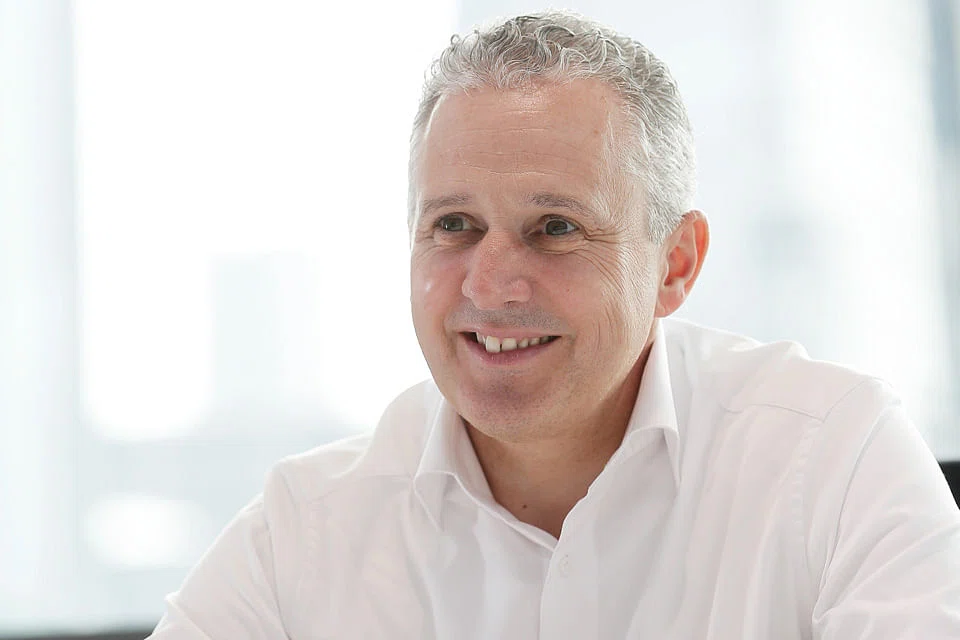
ANDREW Penn, CEO of Australia telecommunications giant, Telstra, loves to paint. When we met recently he says, half in jest, that some paint is still visible under his nails - he had been painting over the weekend. Mr Penn is a bit shy about his hobby - he thinks he is still not good enough to hold an exhibition - but is very passionate; his favourite mediums are oils and acrylic.
"I wouldn't say I'm a good artist but I do paint in my spare time... I prefer oil with palette knives. (However) I probably paint as much in acrylic as oil. Oil is harder to work with since it takes more time to dry and clean. In that respect, acrylic is easier to work with."
He likes to paint interpretive landscapes. "I'm more of a structure person and less colours. Colours are important but structure is more important." Surfaces are also important for Mr Penn. "I quite like painting on paper with oil. I like the juxtaposition of real heavy and rich oil on very delicate paper. That's kind of cool." He also paints with oil on more traditional surfaces like linen and canvas. But "oil and paper is quite hard to manage but I like that", Mr Penn says.
The Telstra CEO is a bit of a late bloomer: he took up painting just 10 years ago. Mr Penn has always had an interest in visual arts and he also collects art. "I started to paint because I wanted to better understand the art. It's so easy to be judgmental about art. You see art and go to a museum and you say, 'I can paint that work'. But it's not as easy as you may think."
Mr Penn was also influenced by a book written by Winston Churchill titled Why I paint: "Churchill was a great artist and he had this point of view that you need to have a hobby or pastime which exercises a different part of the brain to that you use every day as that helps in regeneration of the brain and looking after yourself... Latest studies on dementia suggest that you should do something that you don't usually do in order to keep your brain active."
The Telstra CEO laughs, when asked if he's a believer of Edward de Bono's lateral thinking concepts which also deal with using both sides of the brain. However, a look at Mr Penn's career to date shows that he's not afraid to look at problems from a new angle and try creative solutions to tackle them.
This unconventional and creative streak partly explains his big career move from a top position in the insurance industry to the helm of a telecoms giant. Prior to joining Telstra, first as CFO (chief financial officer) and group executive international and then becoming the CEO, Mr Penn was with insurance company AXA Asia Pacific for 20 years in various roles, the last as group chief executive for Asia.
At Telstra, Mr Penn has brought together a high-powered team of leaders who are well-known experts in their respective fields. Mr Penn's stated aim is to transform the telecoms giant into a technology power house that's in the business of telecommunications.
As a boy who dropped out of school at 15 in his native England because he was bored, Mr Penn never imagined he would become CEO of what is probably Australia's most iconic company. How did he get here?
The Telstra boss believes that one needs to be prepared to continue to learn and "push oneself" throughout life. This conviction resulted in Mr Penn eventually getting his accountancy qualifications and then an MBA from Kingston University in London.
In 1990, he joined the British arm of what was then Australia's second largest life insurance group, National Mutual, in London.
Within a couple of years he went to Australia to work at National Mutual's headquarters. Mr Penn rose up the ranks and eventually became the chief executive of Axa Asia Pacific, which had taken majority ownership of National Mutual. His tenure at Axa was cut short as a result of a protracted takeover battle which resulted in a carve-up of the Axa Asia Pacific business.
Was his unconventional career path a deliberate choice?
"I'm not sure I always thought about it and whether I took the steps consciously. But one thing that has been consistent in my life is about learning. It is consistent in the sense that I know that my learning in school was not a good one. I actually didn't apply myself and I didn't enjoy it and wasn't successful and then I dropped out of school when I was 15.
"But then when I went to work, I discovered a motivation in something that interested me. I applied myself to learning and I found that I really enjoyed the learning part of things.
"One thing in me is that I like to discover through personal application. This brings me back to art. I want to paint because then I can understand what's involved."
Mr Penn says that he's always had an interest in technology. "So (after joining Telstra), I threw myself into it as I wanted to understand how technology works."
The Telstra boss notes that he could always have gone back to the insurance industry after parting with Axa Asia Pacific - "I had many opportunities to go back to the sector.
"But there were two things that motivated me to not go back. The first was that I couldn't go back and work for a competitor after having spent 20 years in one company; I just didn't feel comfortable in doing so. And secondly I wanted an opportunity to learn something completely different."
A sense of urgency
David Thodey, Telstra's CEO from 2009 to 2015, provided Mr Penn with just that opportunity. Mr Penn joined Telstra in January 2012 as chief financial officer and head of Telstra International. He took over as CEO when Mr Thodey retired in 2015.
Discussing some of the changes he brought about in what was already a well-managed and successful company, Mr Penn says: "I think I probably made more aspects of their strategy explicit instead of implicit. I made some things more transparent and specific than they had been earlier."
Explaining, he notes that around the time he joined the company, Telstra was wrestling with a transition from being a network-focused company to one that was more technology-focused.
Mr Penn brought in a sense of urgency into this transition. "What is driving (this transition) is really the pace of technology innovation which is changing the way use connected devices today. We need to develop a new set of skills in order to be able to respond to that."
Noting that Telstra is an organisation with immense network engineering capabilities, he says: "We needed to move on to become more of a software engineering company with data science and artificial intelligence capabilities. That does not take away our networking capabilities. We need to complement that with a set of different engineering skills."
On his role in this transition, Mr Penn says all he did was "accelerate the process".
Mr Penn takes the oft-repeated example of how Uber has changed the taxi industry. "It's not that the technology used by Uber is very complex. But they have used the technology to create a completely transformational customer experience."
This change in customer experience when using Uber has far reaching consequences for other industries, Mr Penn points out.
"Unless you can match this customer experience, and even if you are not in the taxi business but in another industry, you can have your customer tell you: 'Why is it so hard to, for example, get a new mobile phone if it's so simple to get an Uber taxi?'.
"I think even if your own industry is not disrupted you have to note that the minds of customers and consumers are becoming disrupted because they are experiencing transformational customer experiences in their daily lives. Lots of things that are frustrating are being solved."
The Telstra CEO says the solution is to make sure that "whatever part of your service is frustrating customers is solved very quickly". Technology, he adds, plays a critical role in the solution. "But I don't think technology on its own is the driver, it's the focus on customer experience that is the driver. Technology is the facilitator and I would say it's the transformation of the customer experience that is being facilitated by technology.
"It's a subtle difference but an important one as otherwise you could be building technology for technology's sake."
Mr Penn notes that 10 to 15 years ago people used their telecom network differently from how they use it today.
"This (year) is the 10th anniversary of the iPhone, around one billion of them have been sold as have several billions of other smart phones, and this has changed everything. Prior to the iPhone, telecom was about SMS (short message service) and voice, that's changed totally today."
Noting the wide variety of services available to customers today, Mr Penn observes that many telcos look to that and the transformation being brought about by various OTT (over the top) players such as WhatsApp, Skype and Netflix as a threat to their traditional business model.
"I see it as a fantastic opportunity because it is driving more traffic to the network. What telcos have to do is change their pricing models away from charging for voice minutes and SMS minutes to monetising data.
"Fundamentally, the demand for data and network is growing 50-60 per cent per annum. What's driving this growth is the use of apps and services; whether it's mobile banking, messaging or watching media, however you use your device today."
What should a telco do in this situation? Mr Penn feels this is where technology comes in. "You have got to have the best network, with the highest speed, strongest reliability and lowest latency. Certainly that's critical but it's not sufficient.
"It's actually also, how does the application- say Netflix, which people want to use - perform on the network. From a customer point of view, he does not wake up in the morning thinking, 'I want a great network'. Rather he wakes up thinking, 'I want to watch the rest of House of Cards that I didn't see last night on the train on my way home from work'. And the network only becomes relevant when it isn't performing - that's actually a different type of technology problem."
So, says Mr Penn, what is strategically critical for Telstra is to shift the emphasis and capability of the organisation from just providing the best network - "which we must continue to do" - to facilitating the best experience with applications, services and media on Telstra's network. "If you want to watch Netflix it performs better on our network than any other network. It's actually the application service that customers are interested in, not network speeds."
This emphasis on customer experience fits into Mr Penn's style of management at Telstra.
"I'm interested in what the technology can do more than I'm interested in how it works," Mr Penn says. "I mean, yes, I need to understand to some degree how it works. But what really excites me and I get passionate about is what the technology can do: increase productivity and improve the quality of our lives.
"I think if you apply that thinking of what can it do and understand that, then if you have some very capable people around you who understand how you can make the technology work and what the boundaries are, then you have a winning combination."
He gives the example of drones.
Mr Penn notes that if you know how drones work and what some of the applications of drones are and how they can be used, then from there you can go to the next stage. "You can then look at what are the network constraints? What are the really important aspects?
"For example, latency is going to be important. One of the big dynamics with drones at the moment is that they are limited to line-of-sight operations. If you can get beyond line of sight for a drone then the number of use cases goes up.
"For me it's about conceptualising issues and opportunities around it and then working with some very smart people who have the technology skills to come up with the solutions,"
Becoming a tech company
The Telstra CEO adds that it's easy from a technologist point of view to get very wrapped up with the technology itself, as opposed to what problem one is trying to solve with the technology. "You need to know enough in life to ask the right questions, you don't necessarily have to have the skills to answer them all."
Smart homes, apps, healthcare, sensors and near-zero latency 5G networks are the areas Telstra is exploring under Mr Penn's watch. For this, as he notes, Telstra has to transform into a technology company rather than remain a pure networking player that builds infrastructure to allow people to connect to each other.
He envisages that by 2020, Telstra would be transformed into such a company. "Empowering people to connect is really important. I'm not saying we will become a Google or Facebook. What I'm saying is there are a new suite of technologies that we need to build capability in to actually enable these wonderful solutions to work because they do fundamentally rely on the network and customers rely on connectivity more than they have ever done before."
Mr Penn says the thing he's most proud of since he took over is he has been able to get a top-notch team together. "A really good quality team with a shared vision, I think that's one of the most important things.
"I think in a big team with very capable people, it takes quite a lot of work to get the team together. It also takes quite a lot of sophisticated nuancing to ensure that everybody is sort of working cohesively for the same objective."
Unlike many CEOs, Mr Penn doesn't believe in separating his personal life from his work life. "I have a philosophy of integrating things. What I mean is that I don't try to separate my personal life from my work life, or my painting from my work." Joking that if you want to get something done, it's best to give the work to a busy person, He says he does a lot of social work especially with special kids. "I also provide social and health support to terminally ill children."
He works with an organisation in Australia, called JDRF, that is trying to find a cure for Type 1 diabetes. "They are very research-based. I like the idea that they are trying to eradicate a problem completely. To me it's about the idea and backing someone I think that can make a big difference."
ANDREW PENN
CEO, Telstra Corp
1963 Born in the United Kingdom
1988 Fellow of Chartered Association of Certified Accountants
1991 MBA, Kingston University, London
1992 Moved to Australia
1998 Graduate, Harvard Business School's Advanced Management Programme
1990-2011 Worked in various positions in National Mutual (which later became AXA Asia Pacific), last as group executive
2012 Joined Telstra as chief financial officer and group executive international
2015 Became CEO of Telstra