Scania, Toyota come on board to test-bed truck platooning system
Singapore
IF the truck platooning trials starting from early 2017 go according to plan, multiple truckloads of cargo at Singapore's port can be transported between terminals by just one driver in the near future.
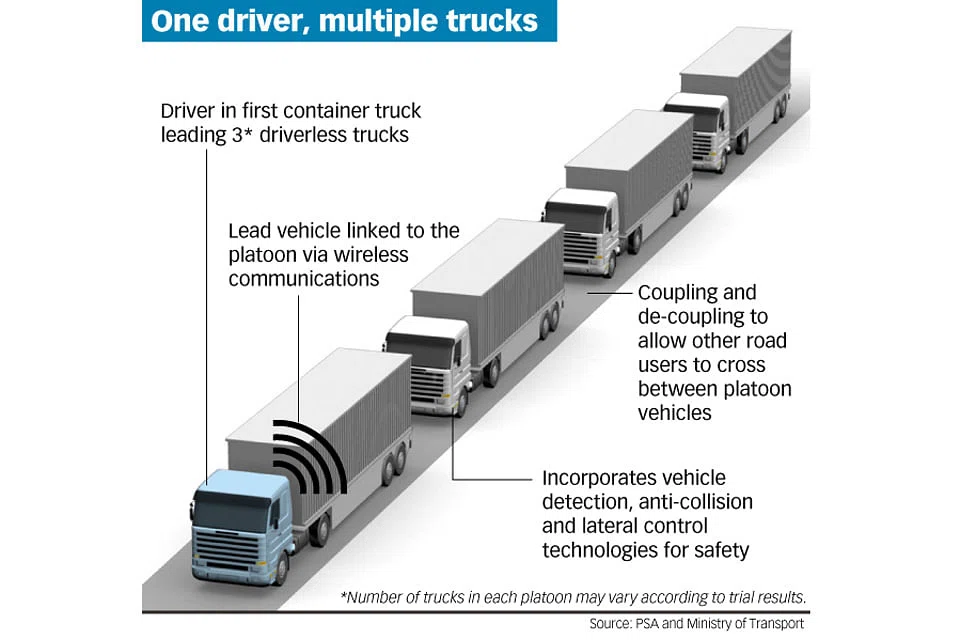
This autonomous freight technology calls for one human-driven truck to lead a convoy of one or more driverless trucks.
The Ministry of Transport and PSA penned the agreements on Monday with Scania and Toyota to test-bed the truck platooning system for use on Singapore's public roads. These agreements followed a memorandum of understanding inked by the Ministry of Transport and PSA in October 2015 to collaborate and co-fund truck platooning projects.
The truck platooning trials will take place in two phases over a three-year period from January 2017 to December 2019. Scania and Toyota will undertake the first phase of the truck platooning trials lasting about a year, in their respective research centres in Sweden and Japan. One of the two companies will be selected based on the outcomes of the phase 1 trials to proceed into phase 2 projected from 2018, during which trials and development of the technology will take place in Singapore.
The trials in Singapore will initially involve transporting containers from Pasir Panjang Terminal to Brani Terminal at the Singapore port. A 10-kilometre long test route along West Coast Highway has been designated for the phase 2 trials. The inter-terminal haulage may eventually be scaled up to include haulage within the port area and between Pasir Panjang Terminals and the Tuas Port.
Taking on truck platooning will help alleviate manpower shortage as well as allow for more freight movement at night to ease traffic congestion.
Permanent Secretary for Transport and Chairman of the Committee on Autonomous Road Transport in Singapore, Pang Kin Keong said: "Trucking as we know it today is a highly labour-intensive industry. We face a shortage of truck drivers. In this regard, truck platooning technology presents us with an opportunity to boost productivity in both the port and the trucking industry."
PSA International's regional CEO for South-east Asia, Ong Kim Pong said the progress made in truck platooning "underlines our joint commitment to being future-ready, while also helping us to continue to serve our customers better through fast and efficient inter-terminal container movement.
The Business Times understands under 2 million teus (20 foot equivalent units) of cargo annually are being transported between terminals using trucks. One industry observer estimated using truck platoons with one lead and two autonomous trucks in each platoon, PSA may save S$10 million annually or S$7 per teu moved over land by reducing the number of drivers needed.
Mr Pang said that by taking on truck platooning, truck drivers will be offered opportunities to take on higher-skilled roles as fleet operators and managers.
This falls in line with a drive in the larger maritime industry to align job profiles with the aspirations of younger, more technologically savvy Singaporeans.
Mr Ong opined that it is timely to move on to the next steps in developing autonomous truck platooning technology as PSA prepares for its future terminals in Tuas. PSA is building the next-generation port (NGP) from scratch at Tuas. Smarter, greener and automated, the NGP at Tuas will feature technology-boosting efficiency and productivity as well as improving safety and security. PSA is also test-bedding automated guided vehicles (AGVs) at the Pasir Panjang Terminal. The AGV technology is intended to be implemented at the NGP at Tuas.