

Co-work operations
Much has changed since Hackerspace, Singapore's first co-working space, opened in Singapore in 2009. Debbie Yong and Georgine Verano give updates on new collaborative working communities - with a difference
Woolf Works
176 Joo Chiat Rd, #02-01 Tel 9002 3724
AH, the power of great writers to articulate sentiments that hold true long after they're gone. When Virginia Woolf wrote her 1923 essay A Room Of One's Own, did she know that it would later become the inspiration for Singapore's first women-only co-working space?
Christened Woolf Works in tribute, the week-old space in Joo Chiat is Michaela Anchan's circa-2014 manifestation of Woolf's belief that "a woman must have money and a room of her own if she is to write fiction". The New Zealand native felt that message keenly. She juggles dual roles as a writer of short stories and fiction and as a stay-home mother with two children aged five and 12. She says: "After taking care of the kids and the family, I hardly get any free time or space at home where I can focus on my writing."
That kicked off her search for a personal office space six months ago, which was shortly called off when the options proved too costly. Then she discovered the concept of co-working. "I thought maybe other women and mothers in the same predicament could benefit from a collective space," says Ms Anchan.
Besides, as an active member of several business networking groups for women, "I enjoy the energy of women working together and very often we have to deal with the same struggles such as balancing our domestic responsibilities with our personal ambitions," she says. Open to "anyone from business professionals to writers and bloggers", Woolf Works additionally targets a group that Ms Anchan believes to be growing: the "mum-preneur", or stay-home mothers turned entrepreneurs.
Existing co-working spaces in the Central Business District tend to be too corporate for this group, while the more edgy co-working spaces are typically skewed towards technology entrepreneurs, she says.
What Ms Anchan wanted to create instead was "a calm and peaceful space for women looking for a place where they can be themselves", she says. Besides the usual office amentities such as free wireless Internet access, printing facilities, a library of magazines and business publications, and a cosy meeting room that seats up to three, the 1,400 sq ft space on the second floor of a Joo Chiat shophouse has plenty of female-oriented features.
A bouquet of fresh flowers is delivered by neighbourhood florist, Hiew, daily. Soft music plays in the background and the communal pantry is stocked with Sarnies coffee and healthy snacks such as dried fruit and nuts from local brand, Fave. Lots of wide open spaces and a white and bright yellow colour palette conceptualised by a Dutch architect-friend gives the space an airy, contemporary feel.
"I've even had someone enquire if she could sign up just to have a quiet space where she can read a book," laughs Ms Anchan.
Rates start at S$500 for the five permanent desks and part-time use for the 25 "hot desks" are charged at S$200, S$300 and S$400 monthly for weekly, twice weekly and thrice weekly visits. Or drop in on an ad-hoc basis for S$50 per day. Permanent members get 24/7 use of the space, whereas others can use the space from 9am to 6pm daily. A conference room upstairs that can hold 12 people seated and 25 standing can be booked for S$40 per hour and upwards - for everything from business meetings to group pilates classes.
Ms Anchan will engage guest speakers to conduct professional workshops on goal-setting and business incorporation in the space, along with regular business networking social events for women. Talks start from next week and are free for members (S$5 per entry for the public).
A tad too sexist? While men can't sign up as members, they can, however, accompany members as guests for these events, says Ms Anchan. On the rise in popularity of co-working spaces, she observes: "The nature of how we all work is changing. More people are choosing to work from home these days and office space is simultaneously getting more and more expensive."
If this space takes off, she would like to open further spaces in the western part of Singapore, preferably next to a childcare centre. "But let's do this one step at a time," she says.
DRAWN TO CO-WORKING
Art Social Haus
#10-08 Oxley Bizhub 2
62 Ubi Road 1
www.facebook.com/artsocialhaus
AS anyone who has dabbled in creating art can attest, it is a messy affair.
Paint splatters and stains. Solvents stink up the room. The cat might trample all over your drying masterpiece, and good luck trying to pack all of that up quickly when your children demand that your "art studio" - really the family dining table - be returned at meal times.
So weary of having to deal with such issues were graphic designers Sheau Chan and Erica Tsirtsakis that the two women came together to start art-centric co-working studio, Art Social Haus, last month.
"We initially thought of renting an art studio to share between us, but since we both have full-time jobs, we decided to find a place we could open up to others like us to fully utilise the space," says Ms Chan. Both she and Australia-raised Argentinian Ms Tsirtsakis work with foreign design agencies based here. They met two years ago when Ms Tsirtsakis attended a diploma course in visual design that Ms Chan taught.
Positioned somewhere between a professional art studio and an art-jamming space, where amateur artists rent easels, brushes and paints on an hourly basis, Art Social Haus is targeted at "people who are slightly more serious than the hobbyist painter, but who are not established enough yet to be able to afford a studio of their own" - such as fresh graduates from the various art schools, says Ms Chan. Her day-job is also based out of a co-working space in the Central Business District.
"Most artists like to work on their own, but sometimes when you run out of inspiration, it's also nice to have people to talk to or just to walk around the premises to see what others are doing," she adds.
Rates at Art Social Haus start from S$280 per person per month, which gets you a 1.5 m by 1.2 m personal workspace that includes an easel, a stool and a trolley. Members also have free use of communal facilities such as two manual inking stations for print makers, a large wooden table for meetings, a cosy sofa lounge with a pantry stocked with teas and coffee, and a bathroom with an industrial metal sink. Dry on inspiration? Dip in the outdoor pool or take a treadmill break in the shared gym on the top floor in the brand new light industrial building. Art Social Haus can fit up to 10 easels and eight work desks for a total of 15 people at full capacity. There is minimum rental period of six months for desks and three months for easels. For the non-committal artist, workstations are also open for daily rentals on weekends at S$35 per 4-hour morning or afternoon session, and S$60 for a full eight-hour stretch.
Each monthly member will be given an access key which gives them 24-hour access to the studio, "because we know a lot of creative people are most productive from midnight to sunrise," laughs Ms Chan. "We want to create a community where people can feel comfortable, learn from each other, even bake cookies to share with one another," adds Ms Tsirtsakis of the 1,000 sq ft rectangular room kitted out with hand-restored kitchenware and second-hand furniture from the Salvation Army. In the spirit of camaraderie, members who sign up for monthly rentals can opt to share the space with up to two other friends for S$350 per person for two people per month; and S$400 per person per month for a three-person sharing arrangement.
All members get to hold one free exhibition held at the space within the membership period. There are no restrictions on the types of artists and their mediums that the space can accommodate, say Ms Chan and Ms Tsirtsakis, who hope to attract everyone from painters to sculptors, and printmakers to ceramic artists to sign up.
The two women plan to gradually host creative workshops showcasing less conventional art forms such as tattoo art, talks by female artists, poetry readings and even art-themed whisky and food pairing dinners in the space. Groups of painters can also rent the easel spaces collectively for private tutelage and events.
The place will not be manned by a community manager all the time, adds Ms Tsirtsakis. "We hope to encourage people to take ownership of the space. We're not a stiff service office."
TEAM-BUILDING, LITERALLY
The Tool Room
12 Dunlop Street Tel 8233 9810
WHEN the going gets tough, the really tough keep going at it - with a hammer.
That's what cocktail bar owner Abhishek Cherian George did when he found out that the Little India shophouse he had taken over could not get a liquor licence. No, he wasn't unleashing a vengeful rampage for his dashed dreams of running a second speakeasy in the area. The hammering and sawing was part of Mr George's Plan B: to transform the three-storey shophouse into the co-working space of his dreams. "The objective was to solve all the problems I had when I was trying to find a place to work," says Mr George of The Tool Room, which opened last month.
For the sufferer of chronic back problems, this meant equipping each workstation with eye-level monitors, standing-height desks, personal orthotic Equilibras slippers and, depending on the membership package you take up, even S$800 ergonomically designed Locus Seats. Worked too late into the night and missed the last train home? Just hop on one of the four foldable bicycles that you can borrow to get home. Or take a quick nap till morning on the "napping loft" upstairs.
The three-level shophouse has 12 workstations on the ground floor, with 10 more under construction on the second floor. Membership comes in three tiers, priced from S$650 to S$850, and drawing on Mr George's F&B background - he also runs Boat Quay speakeasy The Spiffy Dapper and Dapper Coffee - some of the packages entitle members to personal bar fridges stocked with 20 bottles of cold-brew coffee every month, and complimentary cocktails when they visit the bar. The space cost $120,000 and four months to set up - half of what it would have cost if he had hired contractors instead of doing everything up himself.
Tembusu Terminal, the makers of Singapore's first Bitcoin ATM, are permanent tenants. The space will be an incubator of sorts for the private equity business that Mr George hopes to launch in the future, along with a second F&B outlet by year-end.
INCUBATOR WITH SOME JAVA JIVE
The Cub
48 Niven Road
THERE may be no such thing as a free lunch, but a free office space? Perhaps, though it comes with one catch: it is only for the very enterprising.
To get a seat at The Cub - a large oval meeting table that fits up to 12 around it - you have to first pitch your business idea to venture capitalist Joel Sng. For the table sits in the middle of the hubbub in a 2,000 sq ft shophouse along Niven Road, an office and startup incubator for the various businesses that Mr Sng invests in.
He explains the generosity: "We want to give out the space to support budding entrepeneurs, I have excess capacity. Even if I charge S$100 a month for a seat, it doesn't move the needle from a returns point of view."
Even if the pitch is not successful, startups are welcome to use the space. "I don't see it as a loss, if they are here for awhile and we've shared great ideas and learnt from each other, there's value in that too," says Mr Sng, a Harvard graduate who runs his family's investment business, and who co-founded a venture capital firm, Formation 8, which also runs out of the shophouse. Two of his other businesses, LifeOpp, a site which pairs jobseekers with employers started last March, and Asiagenomics, which owns the distribution rights for genomics testing in Singapore, occupy the rest of the space.
Startups at The Cub can get legal advice from Mr Sng's legal team and "piggy back on good rates" offered by partner accounting firms, he says. Besides free Internet connection, budding entrepeneurs can also lounge in a nook at the back of the second floor furnished with colourful bean bags and carpet grass, or hold more formal discussions in a glass-encased meeting room that seats up to eight.
Startups which have used the space range from single-person ventures to a four-man team, and include businesses such as Learnemy, an online marketplace for teachers and students, and Mr Huntly, an online global network of headhunters. There is no time limit to how long startups can use the space, says Mr Sng, but there is one rule: Everyone has to come in at 9am. "It promotes discipline and keeps you on track," he explains. Tenants are welcome to stay on to work through the night, if they prefer.
Should a caffeine kick be required, there's Whale & Cloud, a colourful office pantry stocked with coffee beans that Mr Sng has accumulated from his business trips around the world, and used by the various startups for meetings with their clients and potential investors on weekdays.
When the office is shut on weekends, the 300 sq ft space morphs into a weekend-only cafe-cum-retail store that has been gradually drawing a steady stream of largely young expatriate residents from the condominiums nearby and local cafe-hoppers. You enter the cafe through the back alley by knocking on a closed door numbered 48 and 3/4.
CO-LIVING FOR LIKE-MINDED
13
13 Lorong 24A Geylang
WORK-LIFE separation? So last generation.
According to Darius Cheung, there is a growing demand for people who want to sleep where they work. Six months ago, he founded 13, a co-working and co-living space "for people who want to live with a purpose," he says.
Named for its house number and part of the Lorong 24A Shophouse Series collective of architect-designed conservation shophouses in Geylang, 13 is a sprawling 4,000 sq ft, five-storey shophouse that comprises six reidential rooms and 15 co-working office desks that can be rented on a monthly basis.
While the co-living concept isn't new - similar projects exist in cities such as New York, Berlin, Stockholm, Kyoto and even Matera in rural Italy, where residents have individual rooms but share community-managed work spaces and facilities - 13 was particularly inspired by Mr Cheung's two weeks spent in the eight-room Sandbox House in Berkeley and the 30-room Embassy in San Francisco last year. There, he observed technology entrepreneurs living among designers and food innovators who manned the apartments' edible gardens, recalls Mr Cheung, who is also the co-founder of 99.co, an online apartment rental search platform.
The all en-suite rooms at 13 range from 300 sq ft to 800 sq ft in size and cost between S$1,300 and S$2,000 in monthly rent. Each resident has to commit to a minimum stay of six months, as required by law, and potential housemates are first invited to the house's dinners or monthly house parties that gather the local startup community to see if they would fit in with the mix.
There is no strict criteria as to who can join as residents, but Mr Cheung believes the unconventional nature of the space and its Geylang location makes it a "self-selecting process". "We did have some bankers who were keen to live here because of the space, but they didn't quite fit in with the rest of the housemates so we had to say no," says Mr Cheung.
The house is currently fully tenanted out to a French couple who work in fashion, a graphic designer from England, a fashion designer from India, a Singapore-educated Indian national who runs a startup specialising in drone technology, and the teams behind software engineering company Watt Digital and short film online platform Viddsee.
Besides the rooms, there are also 15 "hot desks" that non-residents can rent for S$350 a month, which includes 24-hour access to the shophouse and all its facilities and events. The open-counter kitchen is fitted with a projector screen so it can double as a meeting room in the day time.
While 13 is "just barely breaking even" for now, "we're not doing it for profit, but because it's interesting," says Mr Cheung, who came across the shophouse when visiting an art exhibition in a neighbouring unit last year.
"It could be profitable if we took a less costly space, but we intentionally wanted a place that is design-centric and inspiring," he adds. Other units in the Shophouse Series have a current tag of S$9,000 to S$11,000 in monthly rent.
While Mr Cheung believes there is room for more co-living projects in Singapore, particularly another one close to the local universities and the startup hub at Block 71, Ayer Rajah, in the western parts of Singapore, he has no concrete plans to launch a second venue yet.
"It was very risky at first, we didn't know if anyone would even be interested," he admits.
By Debbie Yong
ONE-STOP SHOPS FOR STARTUPS
Home-Fix XPC (Experience Centre)
19 Tai Seng Avenue, Home-Fix Building #06-01 Tel 6671 9000
Mon - Fri: 9.30am-6.30pm; Sat: 10am-6.30pm; Closed on Sundays and public holidays
STARTED by hardware store Home-Fix's founder and managing director Low Cheong Kee, Home-Fix XPC is the third in a series of "makerspaces" to have opened here this year, and possibly the largest.
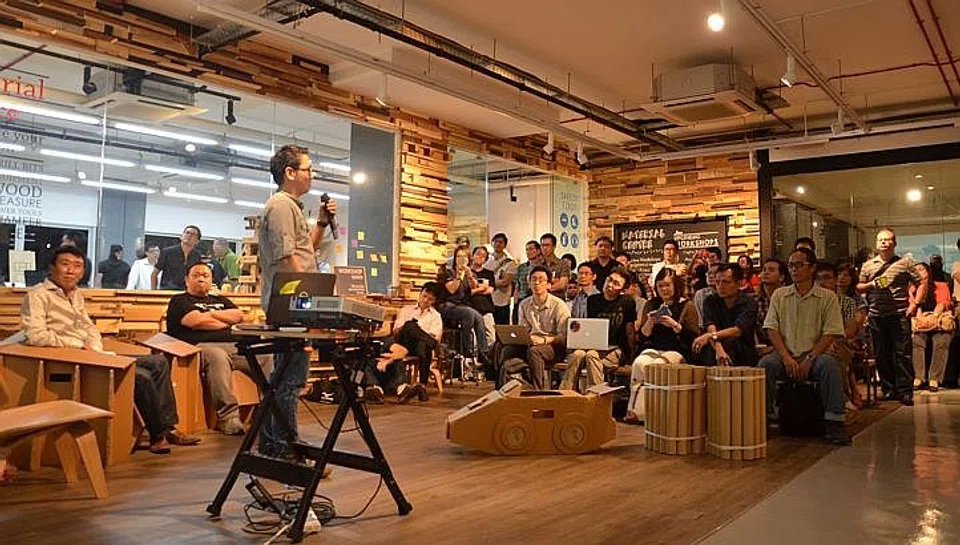
A makerspace is an area that provides not only co-working space but also tools and workshop facilities for members. The 10,000 sq ft Home-Fix XPC is really a large workshop and office that sits on the first two levels of Home-Fix's headquarters in Tai Seng Avenue.
What was originally intended to be a knowledge resource centre for hardware enthusiasts to meet and swap ideas developed into a "makerspace" late last year when Mr Low was approached by the Singapore Makers - an online community of about 1,000 enthusiasts (600 of whom are in contact with Home-Fix) - who were looking to use Home-Fix's headquarters to host Maker Meetups. XPC is fully equipped to house those whose projects range from woodworking to electronics and 3D printing. Level 2 is divided into four glass-walled rooms housing a meeting room, a prototyping lab, an electronics room with benches lined with power tools and a well-stocked workshop which provides materials such as table saws and drills.
For added convenience, they've even set up a materials store, where members can purchase wood, fabric or other materials for their projects. Ernest Hu, the creative executive who runs XPC's operations, says that they are planning to move the workshop areas to the first floor, and provide more co-working spaces for members.
Though it was only started in June, Home-Fix XPC's roster of members now includes a full-time carpenter, 3D printer developers and even a bicycle crafter. Mr Hu says that although not all the spaces have been taken up yet, reaction has been strong enough for them to further expand the co-working space. Members can utilise the space from S$20 daily to SS$400 monthly. For S$20, you get to use the workshop space and all its tools, equipment and machines for a day. You will be assigned a workbench with your personal tools. For a monthly rate of S$120, you will receive unlimited access to the same facilities for a month, and for SS$400 a month, you will receive a co-working table, free Wi-Fi as well as free use of the pantry, workshop and meeting rooms. For uncompleted projects, there is an optional storage locker for S$50 per month.
The Merry Men Collective
315 Outram Road, Tan Boon Liat Building #05-01 Tel 6223 6856
THE Merry Men Collective, owned by Shawn Heng and Eugene Fung, is a co-working space for companies to work not just side by side, but together.
The partners purchased the space in the Tan Boon Liat building two months ago while hunting for an office of their own. Although it was too big for their still-growing company, they didn't want to pass up on the sun-soaked space with its 3m-high ceilings. This, in turn, inspired sharing the space with like-minded startups, creatives, or young businesses which did not need or could not afford a proper office space.
Mr Heng and his partner engaged an interior designer friend to help them redesign the 1,600 sq ft space, with 14 tables, a meeting room at the back as well as a pantry for their clients. Being in the bar business, they incorporated a mini-bar section that fully stocks beers, champagnes and wines for clients as well.
Rentals range from S$500 to S$600 a month; S$500 gets you a standard desk with four storage shelves, while S$600 gets you a slightly larger desk with eight storage shelves. Mr Heng insists they're not in this for the money - they even have a barter system with some clients, swapping skills for rental payment. One example is photographer Joshua Sim, who owns The Beautiful Moment Photography, whom Mr Heng says takes photos for The Merry Men Collective in exchange for rental sometimes. Clients are also carefully chosen.
His ideal crowd? A mix of Web and graphic designers, photographers and brand or marketing startups, that will be able to create a more open vibe, offering one another assistance and networking.
By Georgine Verano
Share with us your feedback on BT's products and services
TRENDING NOW

Singapore expects all parties to honour commitments, says PM Wong after Indonesia cuts gas exports

Gas Supply may pursue remedies if contract breached following Indonesia’s export cuts: Tan See Leng

SoftBank’s Son plans US$50 billion Malaysia tech outlay: Anwar Ibrahim

Is Manila Asia’s new dining hot spot?

