

Future of virtual and augmented reality
Technological advances will enable the 5 human senses, and ultimately, consciousness itself, to be re-created in the virtual environment
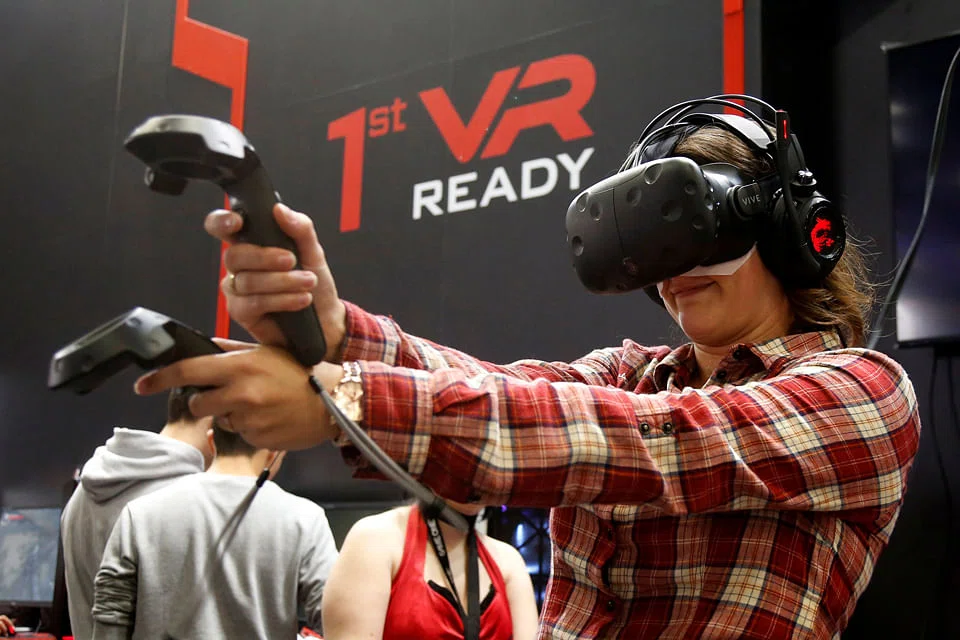
CURRENT market forecast models do not necessarily factor in changes to virtual reality (VR) and augmented reality (AR) device applications and demand for them as their performances improves.
This is understandable as there are limits to how far out a meaningful roadmap can be drawn.
Over the next 10 years or so, however, we believe both VR and AR devices will steadily evolve.
VR starts with users viewing a virtual scene in isolation and ultimately evolves into an immersive experience that allows users to feel like part of a virtual world.
AR starts by displaying part of a user's actual field of vision in a text box. Semi-transparent landmarks, figures, and other computer graphics are then introduced into the real-world scene in such a way as to appear natural.
In the final stage, objects and people that have a convincing life-like quality are introduced and users are able to interact with them.
Three stages of VR
Skype and FaceTime video call services share concepts found in VR. Halo, Metal Gear Solid, and other first-person shooter (FPS) video games are also close to VR.
But video calls or FPS video games are a far cry from immersion in a virtual world and are more accurately described as isolated experiences.
The next stage is to create a virtual setting, or ambience, around the user.
This is achieved by looking at a VR headset display rather than a laptop PC or TV screen.
In the case of a roller coaster computer graphic, the user would be engulfed by the screams of other people on the ride.
The final stage of VR evolution is the immersive experience. Users enter a virtual world in which they can roam over hills, hold business discussions with customers, or dance with their grandchildren.
This is not just the sensation of watching a virtual world but of actively engaging with it.
We expect this will involve users wearing a headset as well as clothing devices such as gloves, shoes, and pants that enable the virtual world to respond to their movements.
Three stages of AR
We expect AR to evolve in three stages.
The first stage is digital display functionality on vehicle windshields, such as displaying speed.
This allows drivers to know if they are travelling at a safe speed without having to divert their eyes to the dashboard.
However, this type of computer graphic does not follow the driver's line of sight.
The next stage is using semi-transparent images to display directions, signals, road signs, and other functions in the driver's field of vision.
A feature of the second stage of AR is that the computer graphic works in unison with the movement of vehicle.
The final stage is the introduction of life-like computer graphics.
In 10 years, we think a number of items could be orbiting the kind of globe one buys for children.
Concerts and sports
We believe VR and AR are likely to have many applications in the leisure and entertainment fields, including concerts, sports, horse racing, and amusement parks, as well as commerce and business (conferences, training, exhibitions, travel, and more).
For example, people could watch sporting events in VR.
This would not replace the thrill of watching an event "live" and should thus increase the size of the sports market in net terms.
Also, we see potential for pop concerts to be streamed using VR services.
We believe the use of VR for sports and the arts that are primarily meant to be consumed visually is not far away.
By projecting virtual objects or people in real space through the use of AR, it has become possible to intuitively convey images of objects or people that previously had to be imagined.
By superimposing 3D computer-generated imagery over real-time images, AR allows users to view and touch objects from different angles in an almost realistic fashion and to use a gyroscope to adjust views and aspects.
This not only offers greater convenience, it may also affect human sensibility.
Put another way, humanity's desire to own material things and infrastructure could wane and the importance of objects existing physically before one's eyes could also diminish.
In the world of AR, it is also possible to superimpose text, statistics, or other information forms over real-life images or background scenes.
We believe this will bring life changes similar to those triggered by the birth of the Internet.
As this technology not only allows explanations of immediate events or phenomena even where there is no prior memory or knowledge, it also makes it possible to obtain information to augment existing knowledge such as up-to-date information and statistics, such as support ratings, sales, and traffic news.
Customising such information to an individual's needs also appears feasible, especially when linked to profiles, data sets and productivity applications relevant to that user.
The use of VR can simulate environments that give the impression almost of a novel scene.
Using a headset or similar device, the VR visitor normally stands in a certain space, or in some cases, sits in a chair or lies on a bed.
VR not only includes sight and sound, but if sensors corresponding to each of the five senses are applied to the body, the overall virtual experience can deliver a level of awareness that transcends the physical body.
For the user, VR heightens the perception of being physically present in a non-physical world, a perception that is created as the user's awareness of physical self is transformed by being immersed in a virtual space.
We believe the use of VR in entertainment applications such as games and movies will deliver a relatively more realistic experience.
However, we think VR could ultimately result in human consciousness itself being recreated within the virtual environment.
The next frontier
We think VR could play a major role in humanity's future.
Specifically, we think rapid advances in hyper-capacity networks and ultra-miniature or high-performance computing could see the nascent Internet of Things (IoT) eventually absorb VR as a key tool for accessing all data on things and events uploaded to and stored on networks.
Our near-term roadmap has VR succeeding telephones, TVs, and the Internet as the next major advance in human communications.
As this occurs, we expect VR to be combined with AR to create a virtual space as precise and detailed as a photograph.
We expect further technological advances to eventually enable the five human senses, as well as, ultimately, consciousness itself, to be re-created in the virtual environment.
This outlook for the future is currently transitioning from mere futurist vision to the actual roadmap used by scientists involved in computers, IoT, and VR.
We think future technological advances will make VR and AR platforms that transform human lifestyles.
GET STARTED NOW
Be a young investor
Do you aspire to be a successful young investor? Are you keen on taking the first step towards achieving that? The BT-Citibank Young Investors' Forum is no typical page extracted from a financial textbook. This forum will present step-by-step guides on how to start investing, feature stories of peers who have made some headway with their investments, and provide answers to your burning questions on investing. First, we need you to invest - not your money, but your time - in reading The Business Times every Monday. You need not be an armchair reader either - write in to btyif@sph.com.sg now!

TRENDING NOW
Prima to move out of historic Keppel Road flour mill building in 2028

Temasek-related Azalea, SeaTown, Seviora Capital to merge in 2027

Family offices see more tailored products, leverage ‘collective firepower’ for direct deal access
Singapore room rates soar, but hotels seeing mixed demand from F1 race and events

