As new investment comes in, Thailand’s Eastern Economic Corridor shows flickers of life
OFFICIALS at Thailand’s much vaunted Eastern Economic Corridor (EEC) - located about 3 hours away from the capital Bangkok - remain hopeful that the massive project can bring in 2.2 trillion baht (S$88.5 billion) in investments over the next 5 years.
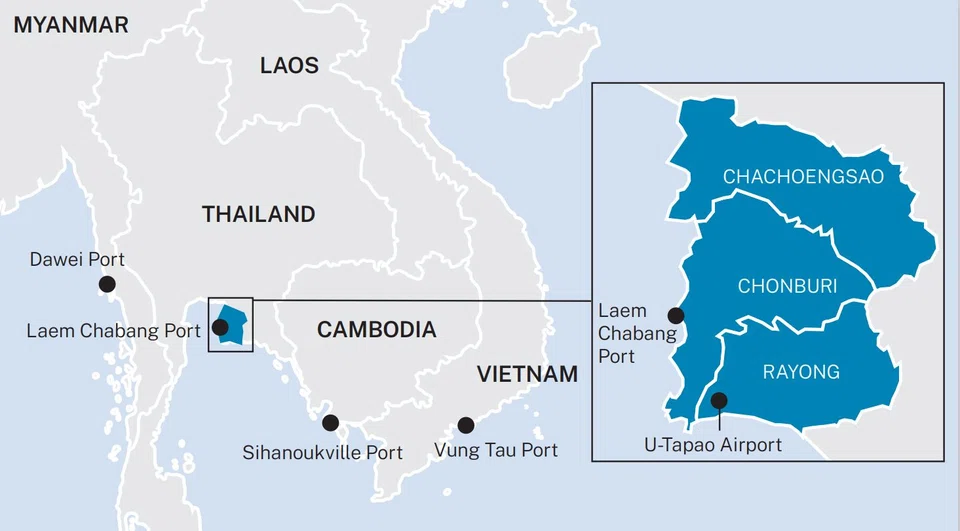
The EEC covers 3 eastern provinces in the country off the coast of the Gulf of Thailand - Chonburi, Rayong and Chachoengsao - and spans more than 13,000 sq km. The developments there are meant to be in line with Thailand’s adoption of the Bio-Circular-Green (BCG) economic model that was introduced last year as part of a big push to transform the economy into one that’s value-based and innovation-driven.
The EEC’s development plan focuses on different S-curve industries such as artificial intelligence and aerospace, and has already attracted foreign investment from countries including Singapore and China. Kanit Sangsubhan, secretary-general of the EEC Office, said his office is sticking by its investment target of 2.2 trillion baht in investments to the EEC over the next 5 years.
Last week, the EEC office announced a target to lure at least 25 billion baht worth of investments from Japan this year, in areas such as electric vehicles (EVs), semiconductors, smart farming and the BCG industry.
“BCG has been adopted as a package for our economy recovery, as well as the overarching theme of APEC 2022,” said Cherdchai Chaivaivid, director-general of international economic affairs at Thailand’s Ministry of Foreign Affairs, during a recent media visit to the EEC innovation centre in Rayong. Thailand is the host of this year’s Asia-Pacific Economic Cooperation (Apec) summit, to be held in November in Bangkok.
The EEC scheme was first launched in June 2016 under Prime Minister Prayut Chan-o-cha’s administration. In 2018, the scheme was etched into law with the passing of the EEC Act, which enacted a set of special privileges for the project and established it as a sandbox for higher-tech industries and a host of mega infrastructure projects. The government hopes to use the EEC to develop the country’s eastern provinces into a leading Asean economic zone.
At the heart of the EEC concept is the promotion of 12 new S-Curve industries designed to boost Thailand up the value-added ladder. A big challenge in promoting these new sectors has always been a lack of local technology and research and development (R&D) facilities to support these sectors.
In some sectors such as EVs, the technology will depend on foreign direct investment, which has already turned Thailand into an automobile manufacturing hub, albeit for combustion engine vehicles. Thailand recently announced a comprehensive EV tax promotion package to encourage auto manufacturers to shift their production to EVs.
Key to the government’s efforts to upgrade Thailand’s R&D capabilities is the EEC Innovation Centre, which will be partially open this November to coincide with the Apec Summit.
“(The centre) is designed to become a pilot plant for R&D that can be further developed on a commercial scale,” said Kanit from the EEC office. In November, the innovation centre’s headquarters, a sustainable manufacturing facility and a smart greenhouse will be operational.
The innovation centre has been designed to support 6 priority industries - agriculture, biofuels and biochemicals, transport, automation, aviation and aerospace, and medical devices.
One of the more promising sectors for Thailand, which remains a largely agriculture-based country, is bio-refining and the resulting products such as biofuels, biochemicals and bioplastics.
“We believe bio-refining will be one of the sunrise industries which will help driving the growth and sustainability of Thailand,” said Janekrishna Kanatharana, executive vice-president of the government’s National Science and Technology Development Agency.
Last month, the agency announced the completion of a 50/50 joint venture with Bio-Base Europe Pilot Plant - a not-for-profit Belgium-based organisation - to manage the Bio-Base Asia Pilot Plant at the EEC innovation centre.
“This is the only multi-purpose, multi-output facility in Asia,” said Janekrishna. “The joint venture company will manage the bio-refinery plant, as well as provide technical services and consultancies for industries, and assure those who wish to scale up and localise technologies in Thailand and the region,” he said.
The actual bio-refinery, to be paid for by the Thai government at a cost of US$100 million, will only be ready by 2024.