



Chance for Asia to go greener as energy markets' recovery is weak: EIU

Singapore
THE recovery of energy markets from the impact of the Covid-19 pandemic will be weak this year, presenting an opportunity for key Asian economies to pivot towards a greener economic recovery.
In its latest report titled "Asia In 2021: Trends To Watch In Three Key Economies", the Economist Intelligence Unit (EIU), the research and analysis division of the Economist Group, identified China as a key player in the deployment of renewable energy in Asia; it will account for two-thirds of the region's renewables capacity.
But other analysts warn that the Chinese economy's shift away from its heavy dependence on fossil fuels in such a short time will be expensive, and will trigger opposition from industries that rely on fossil fuels.
Coal-fired power accounts for almost 65 per cent of the country's electricity generation.
China, the world's largest emitter of carbon dioxide, has promised to become carbon neutral before 2060, and to start cutting its emissions within the next 10 years.
President Xi Jinping made the ambitious pledge to world leaders at a virtual meeting of the United Nations General Assembly last year, in a move seen as a game-changer for global climate, which could inspire other countries to act faster.
EIU said in its report: "An early indication of China's intent in meeting these goals will be reflected in the energy targets included in China's next five-year economic plan, which will be approved early this year."
In March, China's National People's Congress is expected to release its full and final 14th Five-Year Plan, which will define the country's economic future in the next 10 to 15 years.
China's shift away from its dependence on fossil fuels would further depress the falling costs of renewables due to greater economies of scale; solar and wind energy will become even more cost-effective to deploy.
EIU said: "This will be crucial for the rest of Asia, where, with a few exceptions such as Japan and India, renewables deployment has lagged."
The research unit also identified other clean-energy bright spots in Asia emerging.
In South Korea, the government has set a target to achieve carbon neutrality by 2050 and pledged to expand wind and solar capacity more than threefold to 42.7 gigawatts by 2025. A draft electricity plan included a goal to halve coal capacity by 2034.
In Japan, the government promised to achieve net-zero greenhouse gas emissions by 2050. The ambitious goal promises fresh support for investment in renewables, and progress in industries like carbon-capture technology and electric vehicles.
Singapore, too, is stepping up efforts to combat climate change, with a focus on decarbonisation.
Second Minister for Trade and Industry Tan See Leng said in Parliament on Tuesday that Singapore is looking to harness "four switches" of energy - natural gas, solar energy, regional power grids and emerging low-carbon alternatives - to achieve its vision of a clean and efficient energy future.
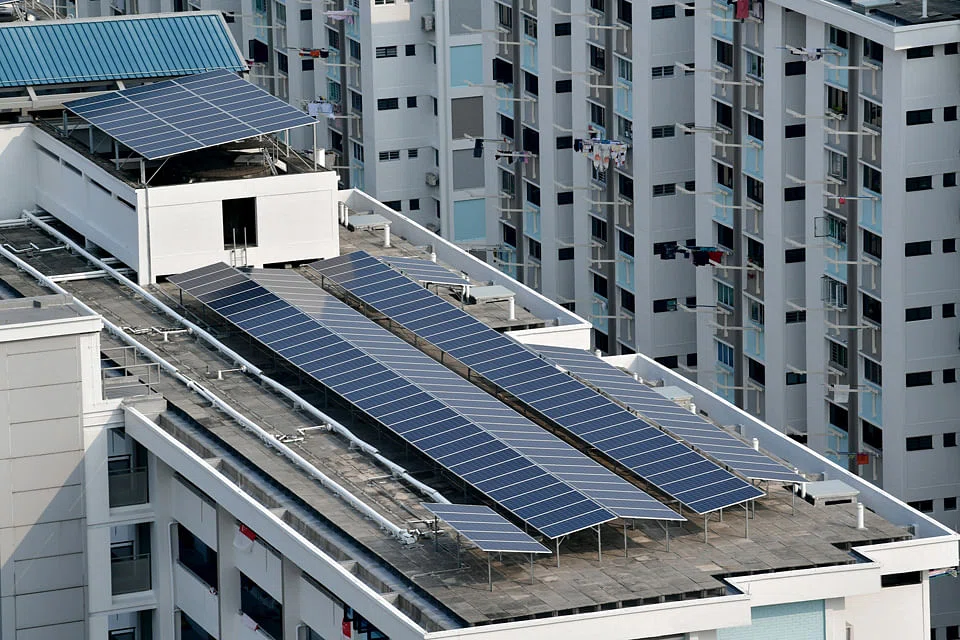
Today, 95 per cent of electricity in Singapore is generated from burning natural gas, the cleanest fossil fuel; there are plans to quadruple its solar capacity to 1.5 gigawatt-peak by 2025, and to 2 gigawatt-peak by 2030.
The outlook for the rest of Asia, however, is more uncertain, EIU said.
Asean has an aspirational target for renewables to account for 23 per cent of energy demand by 2025, but the International Renewable Energy Agency expects it to be at just 17 per cent by then.
Indonesia, Malaysia, the Philippines and Thailand have renewables targets on paper, but growth in solar and wind deployment has been slow, EIU said.
It added: "Clean energy may also be sidetracked in the short term by efforts to recover economies from the impact of Covid-19." It stressed that Asia needs to develop institutional capacity, facilitate finance, devise proper regulatory frameworks and overcome entrenched interests to realise its clean-energy potential.
Globally, clean-energy stocks have enjoyed a dizzying rally over the past few months. The growth prospects are solid, political support is common, and the theme has traction among investors.
"However, today's valuations imply too-excessive growth optimism, while the massive inflows of capital risk overwhelming the business," said Norbert Rucker, head of Economics and Next-Generation Research at Julius Baer.
The bank, which has cut its view to "neutral" and exited its positions in the theme, warned that the clean-energy business looks somewhat overwhelmed by capital inflows, in part coming from the deep pockets of big oil companies.
"This tide bears the risk of uneconomic projects, weak balance sheets, and inexperienced new entrants," Mr Rucker said.






