



Concerns swell as Thailand’s telco giants prepare for US$7.3b merger
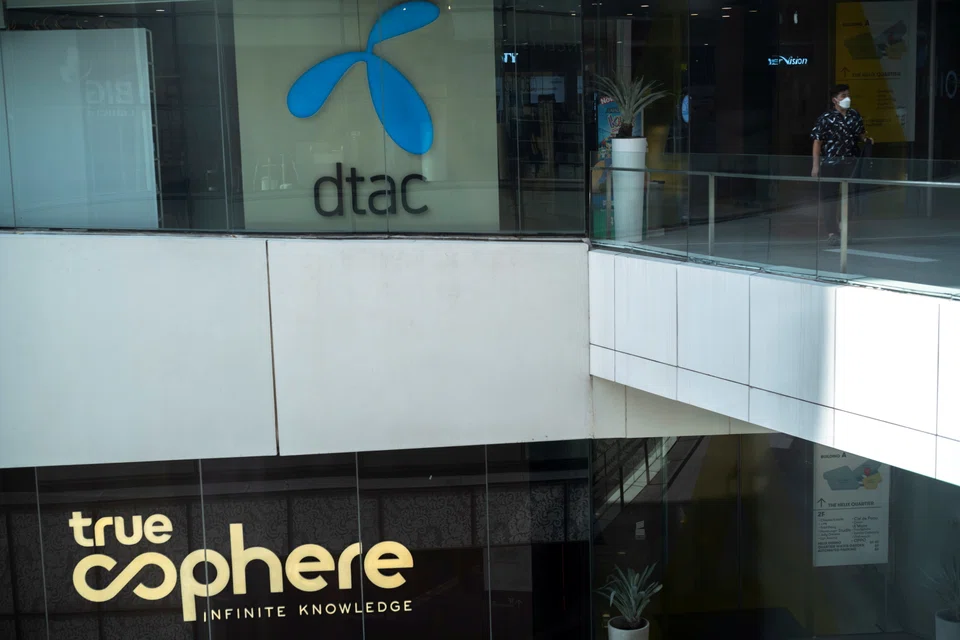
[BANGKOK] The economic impact from the recent approval of a US$7.3 billion merger between Thailand’s second- and third-largest mobile operators is not likely to be felt immediately, but it bodes poorly for the country’s overall competitive environment, analysts said.
On Oct 20, the five-member board of the National Broadcasting and Telecommunications Commission (NBTC) voted 3-2 that the regulator – in this case, NBTC itself – had no authority to decide the fate of the merger between True and DTAC, giving the controversial amalgamation a de facto go-ahead.
Since the merger was announced by Norway’s Telenor (the parent company of DTAC) and Thailand’s Charoen Pokphand Group (the parent company of True) in November 2021, it has drawn criticism from consumer protection groups, economists and opposition politicians for creating a duopoly in Thailand’s telco market, which currently includes three main players – DTAC, True and Advanced Info Service (AIS).
The NBTC now faces a possible lawsuit at the Central Administrative Court for “malfeasance”, which could lead to a temporary injunction, delaying the actual merger which is currently scheduled to take place in January 2023.
“The NBTC intended to curb its own power and failed to carry out its duties in line with the law,” said Thailand Development Research Institute president Somkiat Tangkitvanich in a Facebook post following the NBTC vote, which he labelled a “disgrace”.
TDRI, a think-tank, has warned that the DTAC-True merger could lead to higher service fees for consumers – as much as 240 per cent more – if there was any price collusion in the looming duopoly.
The merger could result in the Thai economy – the second-largest in South-east Asia – seeing a decline in GDP growth of 0.6 per cent to 1.5 per cent in five years due to lower investments, a slower rollout of 5G technology and a widening digital divide, according to findings by SCF Associates.
On the other hand, brokers have generally welcomed the decision as good news for Thailand’s three telco giants, which are all listed on the Stock Exchange of Thailand.
Thailand’s current telco scene is highly competitive with AIS claiming 46 per cent of the market (or 44.1 million subscribers), DTAC with 34 per cent (32.2 million subscribers) and True with 20 per cent (19.6 million subscribers).
After the merger, the amalgamated company, named MergeCo, will claim 54 per cent of the market against AIS’s 46 per cent, unless the subscriber mix changes significantly in the post-merger scene.
To date, Thailand’s mobile phone market, which is already pushing 5G-related services, has been characterised by steep price-competition among vendors to attract and keep subscribers, which has been good news for cost-conscious customers.
Analysts feel that this could change once a duopoly is in place, and this bodes well for the profitability of the service providers.
“I expect the overall pricing competition to be reduced in the longer term, after the three years it will take for the True-DTAC consolidation,” said Prasit Sujiravorakul, an analyst at Bualuang Securities Company. “This will benefit the two players – the new MergeCo and AIS – in terms of the gradual pricing uplift and their gradual service revenue recovery in the third year.”
The NBTC has already announced some measures on the pending duopoly such as a 12 per cent reduction in service fee ceilings, a three-year dual brand requirement on DTAC/True, and a demand that 85 per cent of the population have 5G coverage within three years. AIS already claims to be providing 5G coverage to 81 per cent of the population.
“The amalgamation will facilitate the rollout of 5G and related technology in line with Thailand’s 4.0 economic model,” said DTAC in a statement. Thailand, faced with the middle-income trap, is seeking to promote a higher-tech economy, or what the government calls the Thailand 4.0 economic model.
Much, however, will depend on the corporate behaviour of the two future telco giants in the coming years.
“Beyond the obviously enhanced market power following this horizontal ‘amalgamation’, this deal also enables the merged entity to exert market power over the supply chain of the telco industry, including media and other digital services,” said Pavida Pananong, a professor of international business at Thammasat Business School in Bangkok.
“This (merger) could send the wrong message to foreign investors or domestic newcomers that the Thai government is not too keen on creating a level playing field, as they do not seem to mind mergers that result in entities with clear market dominance,” she said.
TRENDING NOW

He built the Vingroup empire. Now South-east Asia’s richest man is handing some key roles to his sons
China’s Pinglu Canal likely to benefit Singapore, other South-east Asia ports in the long term
Suntec Reit to increase Singapore focus, sell three Australia properties

Despite the de-dollarisation debate, demand for dollar liquidity in Asia is growing

