Five things to watch at Johor elections on Mar 12
Kuala Lumpur
ON MAR 12, Johor will have its 15th state election, which is also Malaysia's third state election in the past 12 months.
The country's political scene has undergone varying degrees of turmoil since the shock defeat of the Barisan Nasional (BN) coalition at the 2018 general election, a historic vote that brought the first change of government since independence in 1957.
Since then, Malaysia has seen the collapse of 2 coalition governments, as well as the resignation of 2 prime ministers - Mahathir Mohamad in 2020 and Muhyiddin Yassin last year.
Several new political parties have also emerged, including Mahathir's Parti Pejuang Tanah Air (Pejuang) and Syed Saddiq Syed Abdul Rahman's Malaysia United Democratic Alliance (Muda).
Syed Saddiq served as the Youth and Sports Minister in the Mahathir-led Cabinet.
The Johor polls are seen as a warm-up for these parties to gauge the effectiveness of their strategies before the next general election, which analysts have speculated could take place in the second half of 2022.
The Johor poll is also special as it is the first state election where citizens as young as 18 can cast their ballot or even run as a candidate.
With so much at stake and campaigning in full swing, here are 5 key things to look out for as the countdown to Mar 12 begins:
Record numbers
The escalating political uncertainties and competition of power have fuelled up the contest in state elections where a record 239 candidates from 10 political parties, as well as independents, are competing for 56 seats in the state legislative assembly.
This is an increase of 51 per cent from 158 candidates in the 2018 general election.
New and young voters
Johor recorded a voter turnout of 1.33 million, or 74.5 per cent, in 2018. However, political observers anticipate that the turnout rate this time will be lower, partly due to the Covid-19 pandemic and travel restrictions.
With the gazette of the Undi18 Bill, all citizens who have reached the age of 18 and above as of Dec 31, 2021, will automatically be included in the electoral roll.
Based on statistics by the Election Commission, there are 2.59 million registered voters who are eligible to vote in the state election, up from 1.8 million during the 2018 election.
According to Umno secretary-general Ahmad Maslan, the implementation of Undi18 will see an increase of 30 per cent, or close to 750,000 new voters, in the upcoming Johor state election.
Although it's uncertain whether all the eligible new voters will turn up, political analysts say this young voter group may lean towards the opposition parties as the majority tend to have an anti-establishment sentiment, while some of them will vote based on the advice of their parents.
New parties, same faces
With 10 parties tossing their hats into the ring, the Johor polls will, unsurprisingly, not have a single straight fight.
Instead, there are seven 3-cornered fights, 35 4-cornered fights, eight 5-way contests, four 6-cornered battles and two 7-cornered fights.
The Sabah-based Parti Warisan Sabah, led by former Sabah chief minister Shafie Apdal, is joining the state election for the first time.
The 64-year-old, coming off a defeat in the Sabah state election in 2020, is looking to expand the party's presence in Peninsula Malaysia.
Parti Sosialis Malaysia - chaired by Johor-born Michael Jeyakumar Devaraj, who was MP for Sungai Siput in Perak for 10 years until 2018 - will also be taking part in a Johor state election for the first time.
The party has sent 46-year-old filmmaker Arangkannal Rajoo to contest for just one seat - the Kota Iskandar state seat.
Other newcomers include Syed Saddiq's Muda and Mahathir's Pejuang.
These parties will compete with the BN coalition; the Perikatan Nasional (PN) coalition, comprising Parti Pribumi Bersatu Malaysia (Bersatu), Parti Islam Se-Malaysia (PAS) and Parti Gerakan Rakyat Malaysia; and the Pakatan Harapan (PH) coalition, comprising the Democratic Action Party (DAP), Parti Keadilan Rakyat (PKR) and Parti Amanah Negara (Amanah).
Hot seats
- Larkin: This state constituency will see a 6-cornered battle between Pejuang, Muda, BN, Anwar Ibrahim's PKR, Muhyiddin's PN coalition, and an independent candidate.
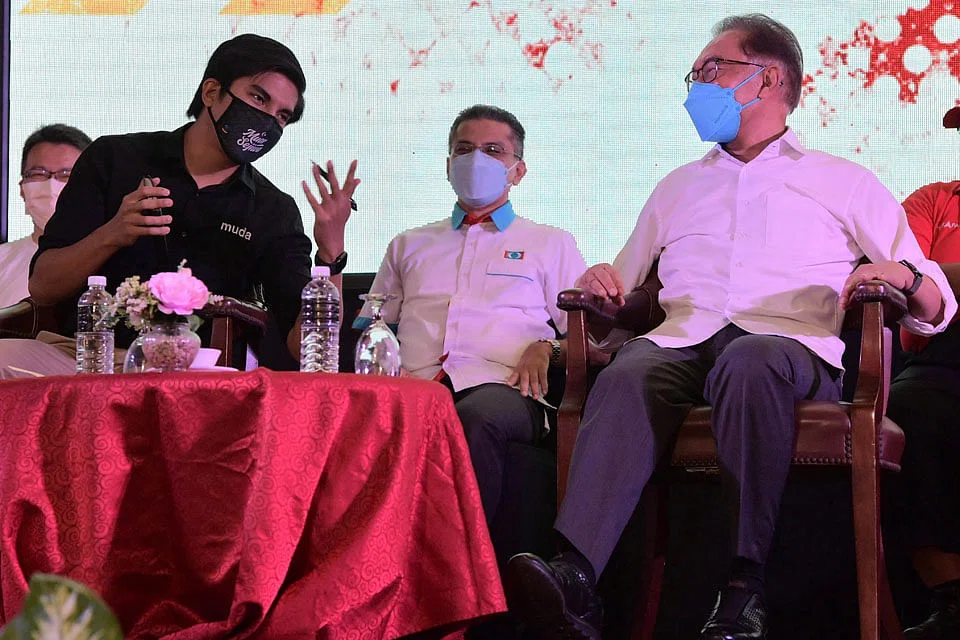
The outcome may change the relationship between Muda and PKR, as Anwar recently expressed his disappointment over Muda's participation in Larkin.
Although Muda is not officially part of the PH coalition, it was reported that the party has partnered with PH's coalition parties Amanah and DAP.
- Perling: This constituency, where the majority of voters are Chinese, has been a stronghold for the DAP.
Johor DAP chief Liew Chin Tong, a former deputy minister at the Ministry of Defence and a former MP for Kluang, will compete against BN's Nicole Tan and PN's Koo Shiaw Lee. The result of this battle could give party leaders an indication of how the Chinese support would be like at the next general election.
- Kempas and Tiram: These are the only 2 constituencies featuring a 7-cornered fight.
In Kempas, it will be a battle between BN, PKR, Pejuang, PN, and 3 independent candidates. In Tiram, it's a 7-way contest involving BN, PN, Pejuang, PKR, PBM, and 2 independent candidates.
- Puteri Wangsa: The constituency will see a 6-cornered fight. Like the Larkin seat, this battle will also put Muda and PKR's future relationship to test.
Initially, the PH coalition agreed to let Amanah compete for the Puteri Wangsa seat. However, Amanah later offered the seat to Muda.
This has led to Napsiah Khamis Maharan, the chief of the women's wing of PKR, voicing her disgruntlement over Amanah's decision in offering the seemingly "easier to win" Puteri Wangsa seat to Muda.
She said that PKR has been working hard on the ground to gain the local's support.
Meanwhile, the Malaysia Chinese Association, part of the BN coalition, will also be contesting in Puteri Wangsa for the first time.
Potential candidates for Johor chief minister
- Hasni Mohammad
He served as Johor Chief Minister from February 2020 until the Johor State Assembly was dissolved on Jan 22. He is also the chairman of Johor BN.
If he and the BN coalition win the state election, there is a high chance that Hasni will be reappointed as the state's Chief Minister for the second time.
Hasni, the most senior BN leader in Johor, was also an exco member in the state legislative assembly before becoming a Chief Minister.
- Solihan Badri and Sahruddin Jamal
Solihan, who is the information chief at Johor Bersatu, and Sahruddin, who was Johor Chief Minister between April 2019 and February 2020, are tipped to be PN's top choices to be Chief Minister.
Solihan will be competing in a 4-cornered fight for the Gambir constituency, while Sahruddin will contest the Bukit Kepong seat in a battle with Ismail Mohamed from BN, Taib Suhut from Pejuang and Nur Afiqah Zulkifli from Muda.
- Maszlee Malik
Although PH's Anwar remains tight-lipped on the potential chief minister candidate, speculation is rife that Maszlee, who was education minister in Mahathir's Cabinet and also a MP for Simpang Renggam in Johor, is likely to be named as a candidate - should PH emerge as winners in the state election.
But first, Mazlee, the only MP from PKR to compete for a Johor state seat, will need to win a 4-cornered fight in the Layang-Layang constituency.