Malaysia’s budget should stand if government re-elected: caretaker finance minister
Anita Gabriel
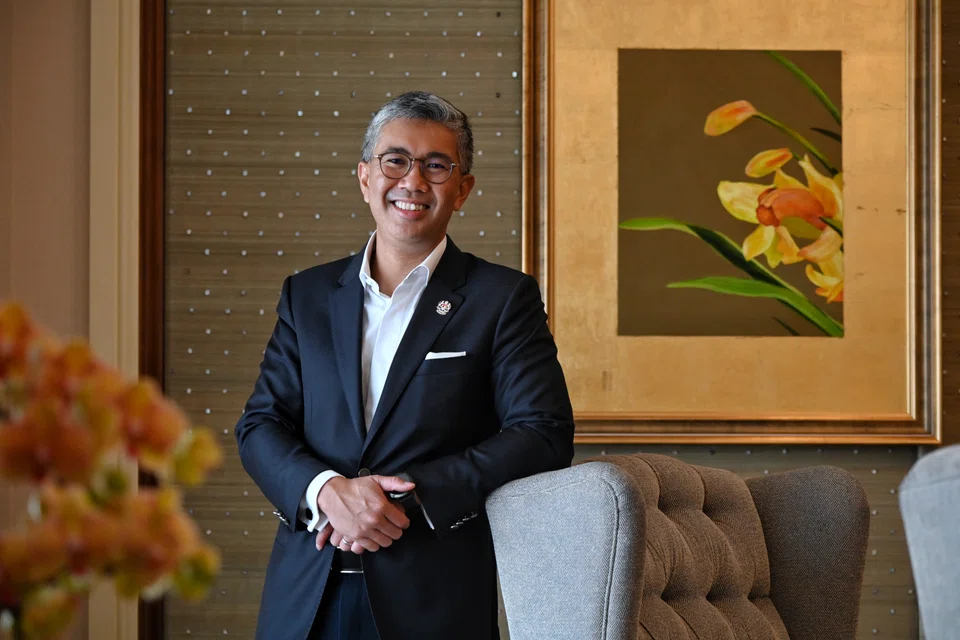
MALAYSIA’s national budget for 2023 lapsed just days after it was tabled, as parliament was dissolved to make way for the 15th general election (GE15). But caretaker Finance Minister Zafrul Aziz expects the budget would be “roughly the same” if the incumbent government, which includes the Barisan Nasional (BN) coalition, wins at the ballot box on Nov 19.
“The budget as a whole will have to be more or less the same budget. Why? Because we will carry out what we have promised. We are not in the habit of breaking promises,” Zafrul, a banker-turned-politician, told The Business Times in an interview.
“This budget was developed with input from the ground. It is a good representation of what is truly needed across the various sectors. So, if that is the desired outcome, I don’t believe there should be much deviation,” said Zafrul, who marks his political debut in this year’s national polls as the BN candidate for Kuala Selangor.
The 49-year-old, who has worked at Malaysia’s two largest banks, Maybank and CIMB Group, is deemed the “poster boy” for Umno – the Malay-dominant party in BN. Having been marred by the 1Malaysia Development Berhad saga, a corruption scandal that landed former prime minister and BN leader Najib Razak in jail, BN now hopes to regain the trust of residents in Selangor, the country’s richest state.
The government made “conservative projections” in putting together the national budget, and so should not require major revisions in the event the budget is re-tabled. “Nonetheless, if a major external shock occurs and the government is required to respond in order to mitigate the impact on our people, we still have fiscal room to manoeuvre,” he added.
“Of course, the budget can be tweaked where there may be groups that require more allocation at the time, or the global economic landscape changes drastically, or a different minister of finance may have some new ideas.”
Malaysia’s caretaker Prime Minister Ismail Sabri Yaakob, who is also Umno vice-president, has said he is committed to implement all the initiatives in the 2023 budget, which included “several goodies”.
Malaysia’s commodity-driven economy is being buffeted by geopolitical conflicts, surging inflation and tightening monetary policy. The silver lining is high oil prices, boosted by robust demand and the Russia-Ukraine war. Brent, the global benchmark, has spent a considerable time of the year above US$100 a barrel. Although the average price has fallen below the triple-digit mark since September, on recession woes, it is still more than 30 per cent higher than last year’s average price.
Elevated crude prices have plumped up the public coffers, as Malaysia is a net oil exporter. State-owned oil company Petronas upsized its dividend payout to RM50 billion (S$14.9 billion) – double that of the earlier estimated dividend – giving the government more money for subsidies.
The domestic fuel subsidy totalled around RM37 billion, Zafrul said, while the overall subsidy bill is nearly RM80 billion.
Budget 2023, tabled by Zafrul on Oct 7, involved a government spending plan of RM372.3 billion and was considered by observers to be an election budget.
It would have been “political suicide” for the sitting government to introduce new taxes or hike tax rates, said Pankaj Kumar, former chief investment officer of an insurance firm and business columnist. Instead, the government focused on improving tax collection efficiency.
Yet, at the current tax-to-GDP ratio of 11 per cent, Malaysia has one of the lowest tax revenues among its South-east Asian peers. And lower tax revenues would pose a problem for the country’s fiscal position.
Zafrul said the tax-to-GDP ratio has averaged as high as 15 per cent, but believes the “time is not right to impose new taxes”.
“We cannot stifle the recovery momentum that has resulted from three consecutive quarters of economic growth and the better-than-expected 2022 growth, which is our major reopening year,” he said.
Indeed, soaring living and food costs are major concerns among Malaysian voters. Meanwhile, an unstable political environment has resulted in a disenchanted citizenry. In 2018, the long-ruling BN was overthrown by the opposition. But this was followed shortly after by the collapse of two governing coalitions, and the appointment of three different prime ministers over a span of four years.
Responding to this, Zafrul said: “According to my own findings from surveys and engagements, one of the most pressing concern of Malaysians is the direction of the economy. The people want a return to stability and a government that is responsive to their needs, especially given the challenging global economic outlook for 2023.”
Whether the outcome of GE15 will return the long-elusive equilibrium to Malaysia’s fluid politics remains to be seen. On his part, Zafrul has successfully navigated the country’s volatile climate. He was hired for the country’s top finance job by then prime minister Muhyiddin Yassin in 2020, just as the pandemic was stinging businesses and consumers. Following a quick change of regime a year later, this time under Ismail Sabri, Zafrul managed to keep his cabinet portfolio – a much-vaunted and one of the most powerful positions in the country.
The lure of political office must have been hard to resist for the former banker, who is married to the great-granddaughter of the fifth Sultan of Selangor and has often remarked in the past that he is “not a politician”.
Zafrul’s uncle is politician Raja Nong Chik Zainal Abidin, the country’s former federal territories minister and a current Umno member. He also had tight rapport with late Umno politician and diplomat Jamaluddin Jarjis, who died in a helicopter crash several years ago.
In August this year, Zafrul was appointed BN’s Selangor treasurer. It came to light recently that he has been a “long-time” Umno party member. “Since 1997,” said Zafrul when asked.
His entry into the country’s political arena, it is hoped, will bring fresh energy to a landscape of old faces, some of them scandal-hit. His strong presence across social media platforms could be a plus: He has a following of nearly 550,000 on Facebook and over 300,000 each on Instagram and TikTok.
“I come from a long line of public servants, and I want to carry on the tradition for as long as possible, which is why I decided to enter politics,” he said. “I want to contribute and give back to the country in the best way I know how, and so far, politics has proven to be the most effective way to effect meaningful change in the lives of others.”